
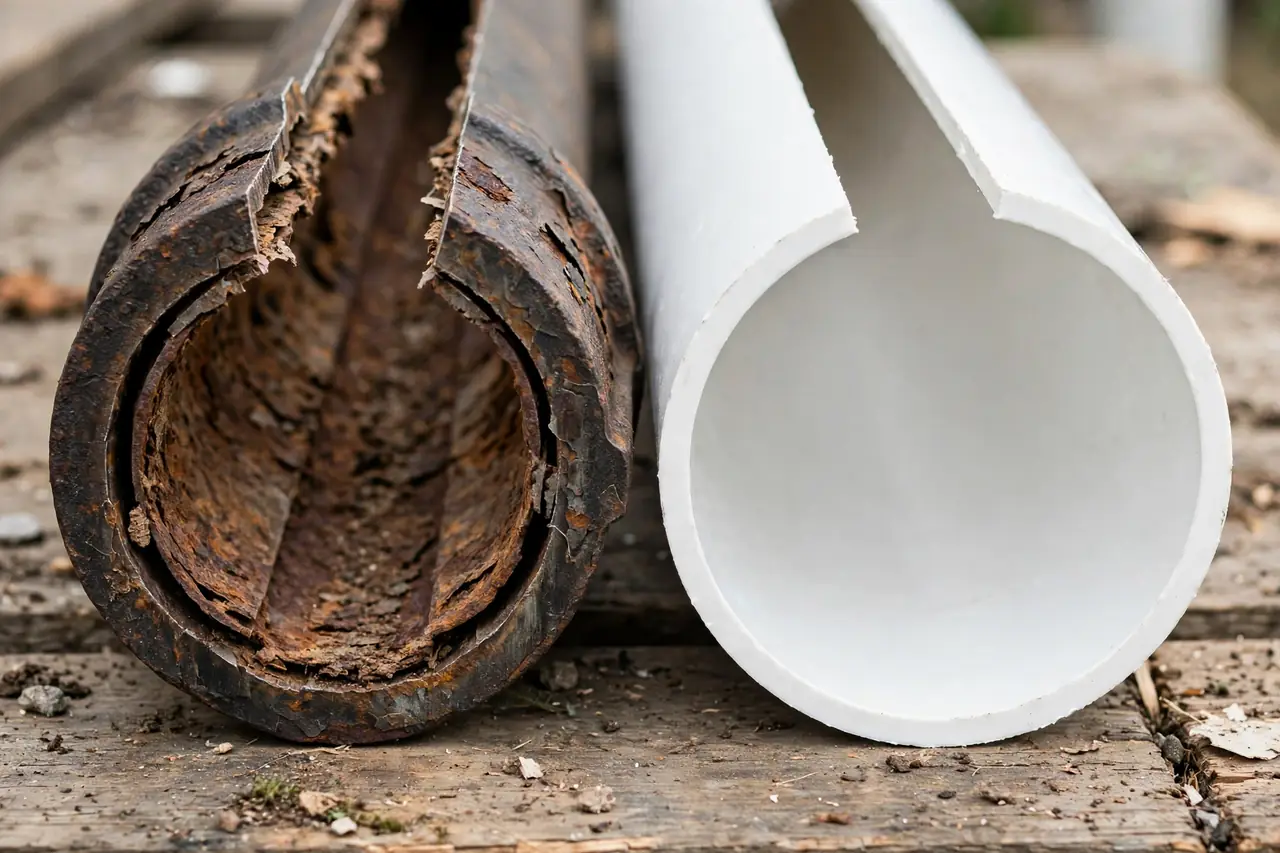
Walk through Peabody's older neighborhoods — the streets near downtown, the post-war capes and colonials — and much of what you cannot see is cast iron. Homes built from the early 1900s through the 1960s typically left the builder with cast iron soil pipe inside and a cast iron or clay lateral running out to the street. That pipe has now spent half a century or more in New England ground, and it shows.
PVC entered the picture in the 1970s and 80s and is the material used for new sewer work today. It does not rust, it goes together in long runs with few joints, and it flexes a little when frost moves the ground instead of cracking. But plenty of Peabody laterals are still cast iron — or a patchwork where sections were replaced with PVC over the years — so most homeowners eventually face the same question: repair what you have, or replace, and with what?
The answer depends on the condition of your specific line, your soil, your trees, and how the home is used. This guide compares the two materials honestly — where cast iron still earns its keep, where PVC wins clearly, and how to decide for your property.
How Cast Iron Ages in Massachusetts Soil
Cast iron fails slowly, then all at once. Inside the pipe, wastewater and the gases it carries corrode the metal from the interior outward, building up rough scale that narrows the bore and snags everything passing through. Outside, New England's wet, mineral-heavy soils work on the pipe wall, and decades of freeze-thaw cycles heave and settle the ground around it. Cast iron is strong but brittle — it does not bend with that movement, so it cracks.
The classic Peabody cast iron failure starts as a belly or offset at a joint, or a lengthwise crack along the bottom of the pipe where corrosion is worst. Roots find those openings fast — the mature maples and oaks lining older streets send feeder roots toward the moisture and nutrients leaking from every defect. Once roots are inside, they widen the damage with each growing season. A sewer camera inspection shows this aging directly: the footage reveals scale, cracks, and root masses in a way no guesswork can match.
What PVC Changes About the Equation
PVC's advantage starts with chemistry: it does not corrode. No rust, no scale buildup from the pipe material itself, and a smooth interior wall that stays smooth. That matters in a sewer lateral because every rough spot is a place for grease, paper, and roots to catch. A properly installed PVC lateral keeps its full bore for its entire service life, which is one reason installers stopped putting cast iron underground decades ago.
The joints matter as much as the material. Cast iron laterals were assembled in short sections — every joint a potential entry point for roots and a place for ground movement to create an offset. PVC comes in long lengths with gasketed bell joints, so a typical residential lateral has a fraction of the joints. Fewer joints mean fewer root invitations and fewer places for frost heave to do damage, and PVC has enough flex to tolerate the seasonal ground movement that cracks rigid pipe.
PVC is not invincible. It needs proper bedding — sharp rocks or poor compaction under the pipe create pressure points — and correct slope, because a PVC line installed flat or bellied will still collect solids. In rocky New England soil, installation quality decides everything. But installed right, PVC asks for almost nothing over its life: no corrosion, no scaling, no joint packing to rot out.
Figuring Out Which Pipe Is Under Your Yard
Home age is the first clue. If your Peabody home was built before roughly 1970 and the lateral has never been replaced, there is a strong chance you are looking at cast iron, clay tile, or a combination. Homes from the 70s onward are more likely PVC, and many older homes have hybrid lines — cast iron under the foundation transitioning to PVC in the yard where a section failed years ago.
You can sometimes see the material at the basement cleanout or where the line exits the foundation: cast iron is dark, heavy, and often rust-streaked at the hubs, while PVC is white or light gray plastic. But the only way to know the full picture — material, condition, and where transitions happen — is a camera run from the house to the street. The footage maps your lateral's materials and defects in one pass, and it is the basis for every sound repair-or-replace decision.
When Repair Still Makes Sense — and When Replacement Wins
A cast iron line with isolated damage — one cracked section, one bad joint, roots at a single entry point — is often a repair candidate. Trenchless methods can rehabilitate the line without a full dig: cured-in-place pipe lining builds a smooth new pipe inside the old one, sealing cracks and joints along the whole run, and it works inside cast iron as long as the host pipe still holds its basic shape.
Replacement makes sense when the cast iron is failing systemically: heavy scale along the full run, multiple breaks, collapsed sections, or a line so deformed that lining cannot follow it. At that point the choice becomes open-cut PVC versus trenchless replacement — pipe bursting fractures the old pipe outward and pulls a new line through the same path, which is attractive when the lateral runs under a driveway, patio, or mature landscaping worth keeping.
PVC lines fail differently and less often — usually at a single bad joint, a crushed section from surface load, or a belly from poor bedding. Those are typically spot repairs rather than full replacements, which is part of PVC's long-term value: when something does go wrong, the fix is usually small.
Deciding for Your Peabody Property
Start with the camera, not with a material preference. The footage tells you whether you are nursing a line with years left or managing one that is done. Factor in your trees — a lateral running through established root zones will keep fighting roots regardless of material, though PVC's gasketed joints give it the edge — and your soil, because Peabody's mix of clay pockets and rocky fill shifts with the seasons.
Also weigh disruption and access. A lateral under a new driveway or a finished yard pushes toward trenchless methods; an open run of lawn with easy machine access makes open-cut PVC straightforward. Either way, get the diagnosis in writing with the video, understand what happens if you do nothing for a year, and choose the fix that matches the pipe's actual condition — not its age alone. If you are weighing options, call (833) 713-2101 to talk through what the camera found and which repair path fits.