
Signs Your Sewer Line Needs Cleaning
Most sewer lines do not clog overnight. Buildup accumulates a little at a time until the pipe can no longer carry a normal flow, and that is when symptoms start showing up inside the house. The most common early warning is several drains slowing down at once: the tub drains sluggishly, the toilet flushes weakly, and the kitchen sink gurgles. When more than one fixture is affected, the restriction is usually in the main lateral rather than in a single branch line.
Other signs point just as clearly to a dirty line. Gurgling sounds from toilets or drains mean air is trapped by a partial blockage. Sewer odors drifting up from floor drains or basement fixtures suggest waste is sitting in the pipe instead of flowing away. In more advanced cases, running the washing machine causes water to back up into a shower or tub, or flushing one toilet makes another gurgle. Outside, an unusually lush or soggy patch of lawn above the sewer route can indicate a line that is struggling to carry its load.
What Causes Sewer Lines to Clog
Kitchen grease is one of the biggest contributors. Fats, oils, and grease go down the drain as liquids and harden inside the cooler underground pipe, where they trap food particles and grow into a thick, stubborn lining. Soap scum, hair, and bathroom debris add to the restriction, while so-called flushable wipes, paper towels, and feminine products do not break down the way toilet paper does and snag on any rough spot in the pipe.
Inside the pipe itself, mineral scale from hard water narrows the opening year after year, especially in cast-iron lines where corrosion adds a rough surface for deposits to grip. Tree roots are the other major cause: fine root hairs enter through tiny gaps at pipe joints seeking moisture, then expand into dense mats that catch everything passing by. Finally, low spots or bellies in the line let solids settle out of the flow and accumulate until the pipe is effectively dammed.
Our Step-by-Step Sewer Line Cleaning Process
Every cleaning visit from Sewer Line Repair Works follows the same disciplined sequence, because a proper diagnosis before the jetter ever starts is what separates a lasting result from a temporary one. If you are seeing the warning signs described above, call (833) 713-2101 and we will walk through your symptoms before we schedule the visit.
1. Symptom review and access check. We start by asking which fixtures are affected and when the problem began, then locate your cleanout or another workable access point so the equipment can reach the line without disturbing your home. 2. Camera inspection. A waterproof inspection camera is pushed through the line to identify exactly what is blocking it, where the blockage sits, and what condition the pipe is in. This step determines the right nozzle, pressure, and technique. 3. Access setup. We work through an existing cleanout whenever possible; if none exists, we may temporarily pull a toilet to gain entry, with drop cloths and shoe covers protecting your floors. 4. Hydro jetting. High-pressure water is sent through the line with a nozzle chosen for the blockage type, working methodically from the downstream end back toward the house so debris is driven out to the municipal main. 5. Debris flushing and flow testing. Once the restriction is broken up, the line is flushed thoroughly and fixtures are run to confirm water moves freely. 6. Post-cleaning camera verification. The camera goes back in to confirm the pipe walls are clean, the full diameter is restored, and no structural damage is hiding behind the buildup. 7. Findings and recommendations. You get a plain-language summary of what was found, what was removed, and whether any follow-up such as tree root removal or a regular maintenance plan makes sense for your line.
Hydro Jetting Equipment and Materials We Use
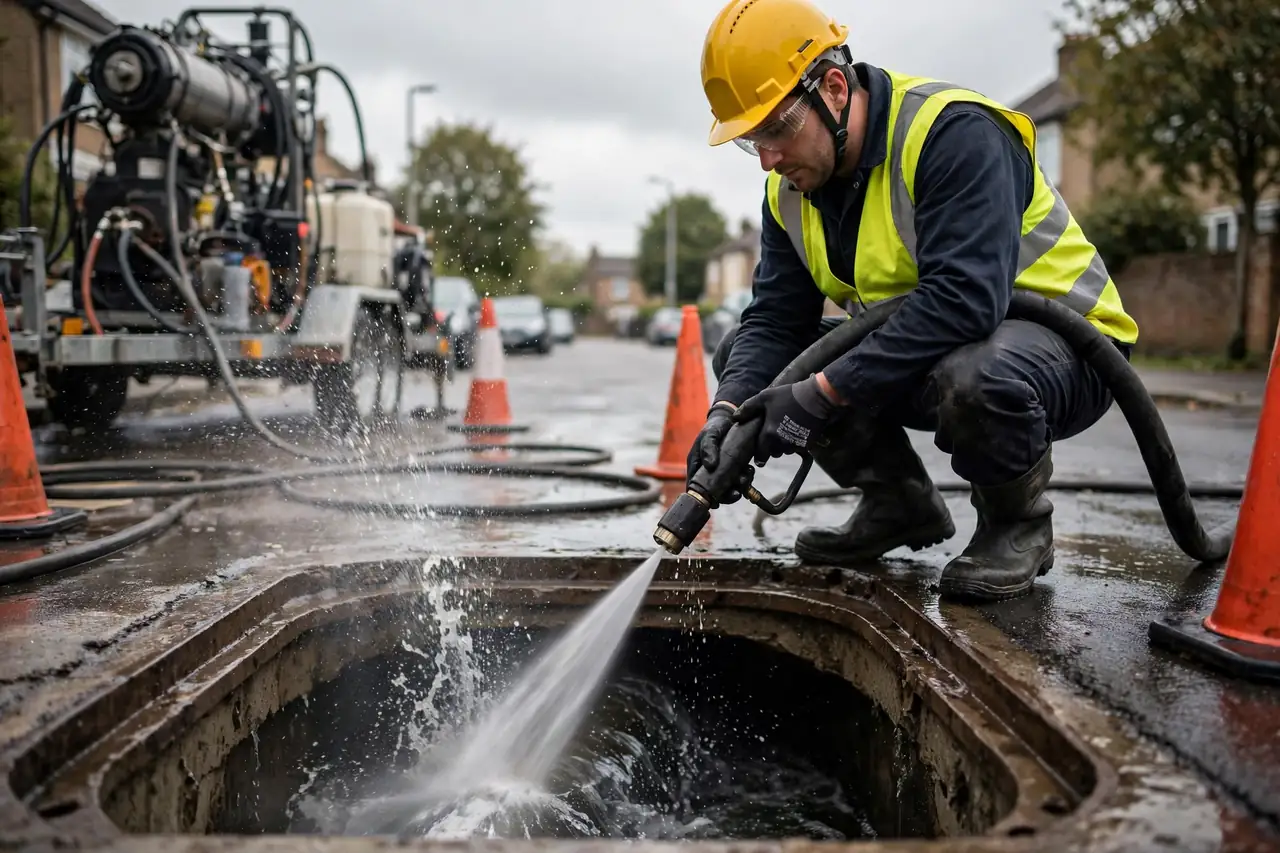
Our primary cleaning tool is a professional hydro jetting unit that delivers a focused stream of water at pressures adjustable from gentle rinsing levels up to roughly 4,000 PSI. Pressure is matched to the pipe: sturdy modern pipe can take an aggressive scouring pass, while older clay or corroded cast iron gets a lower, safer setting. Interchangeable nozzles do the specialized work: penetrating nozzles punch through dense blockages, rotating nozzles scrub the full inner circumference of the pipe, and chain-flail or root-cutting heads chew through root masses that water alone cannot move. Hoses and nozzles are sized for typical residential and light commercial lines, so the cleaning reaches the entire diameter rather than just poking a hole through the clog.
Support equipment matters just as much. Waterproof inspection cameras with built-in locators let us see the blockage and mark its exact position from above ground. Wet vacuums and containment handle any water at the access point so your basement or yard stays clean. Because hydro jetting uses only water, there are no harsh chemical drain cleaners involved, no fumes, and no corrosive residue left in your pipes or the municipal system. Debris flushed from the line goes to the city sewer as it normally would, and any material pulled back at the access point is bagged and disposed of properly.
Safety Precautions During Sewer Cleaning
High-pressure water is an effective cleaning tool precisely because it is powerful, so it is handled with strict operating discipline. Only trained technicians operate the jetter, the nozzle is never directed at people or pets, and everyone stays clear of the access point while the hose is under pressure. Pressure settings are chosen based on the camera inspection: a fragile section of old pipe gets a conservative pass first, and pressure is increased only if the pipe shows it can take it. Hoses are inspected for wear before each job, and the equipment is shut down immediately if anything behaves unexpectedly.
Working with an open sewer line also means managing sewer gases and sanitation. Access points are ventilated, technicians wear gloves, eye protection, and waterproof gear, and the work area is kept clear of children and pets until the line is closed back up. Backflow preventers protect the water supply feeding the jetter, and drop cloths plus thorough cleanup keep your property as we found it. If the camera reveals a collapsed or badly broken section that jetting cannot fix, we stop and explain your options, which may include trenchless sewer repair or a conventional sewer line replacement, rather than forcing equipment through a damaged pipe.
Sewer Line Cleaning for Peabody and North Shore Homes
Peabody's housing stock shapes the cleaning work we do. Many homes in established neighborhoods were built in the mid-20th century with clay tile or cast-iron laterals, both of which develop the joint gaps and rough interiors that invite roots and scale. Mature maples, oaks, and elms line countless Peabody streets, and their root systems are persistent about finding the moisture inside a sewer joint. Add the North Shore's freeze-thaw cycles, which subtly shift pipe joints winter after winter, plus heavy fall leaf litter washing toward drains, and local lines face more stress than their age alone would suggest.
Glacial soils across the region complicate the picture in a quiet way: sandy till lets tree roots travel easily toward a leaking joint, so root intrusions here can be extensive by the time symptoms appear. Homes on tree-lined streets often benefit from cleaning on a regular cycle rather than waiting for the next backup, and restaurants and food businesses around downtown Peabody typically need scheduled grease-line jetting to stay ahead of buildup. If your drains are slowing and you live anywhere in the Peabody area, call (833) 713-2101 and we will inspect the line, clean it thoroughly, and show you exactly what came out.
Areas Served for This Service
Sewer Line Cleaning in Beverly
Beverly, MA 01915.
Learn moreSewer Line Cleaning in Burlington
Burlington, MA 01803.
Learn moreSewer Line Cleaning in Danvers
Danvers, MA 01923.
Learn moreSewer Line Cleaning in Essex
Essex, MA 01929.
Learn moreSewer Line Cleaning in Gloucester
Gloucester, MA 01930.
Learn moreSewer Line Cleaning in Lynn
Lynn, MA 01902.
Learn moreSewer Line Cleaning in Lynnfield
Lynnfield, MA 01940.
Learn moreSewer Line Cleaning in Marblehead
Marblehead, MA 01945.
Learn moreSewer Line Cleaning in Melrose
Melrose, MA 02176.
Learn moreSewer Line Cleaning in Middleton
Middleton, MA 01949.
Learn moreSewer Line Cleaning in Nahant
Nahant, MA 01908.
Learn moreSewer Line Cleaning in North Reading
North Reading, MA 01864.
Learn moreSewer Line Cleaning in Reading
Reading, MA 01867.
Learn moreSewer Line Cleaning in Revere
Revere, MA 02151.
Learn moreSewer Line Cleaning in Salem
Salem, MA 01970.
Learn moreSewer Line Cleaning in Saugus
Saugus, MA 01906.
Learn moreSewer Line Cleaning in Stoneham
Stoneham, MA 02180.
Learn moreSewer Line Cleaning in Swampscott
Swampscott, MA 01907.
Learn moreSewer Line Cleaning in Tewksbury
Tewksbury, MA 01876.
Learn moreSewer Line Cleaning in Wakefield
Wakefield, MA 01880.
Learn moreSewer Line Cleaning in Wilmington
Wilmington, MA 01887.
Learn moreSewer Line Cleaning in Woburn
Woburn, MA 01801.
Learn more