
| ZIP | 01876 — sole standard ZIP for Tewksbury, MA (Middlesex County); post office at 1751 Main St. |
|---|---|
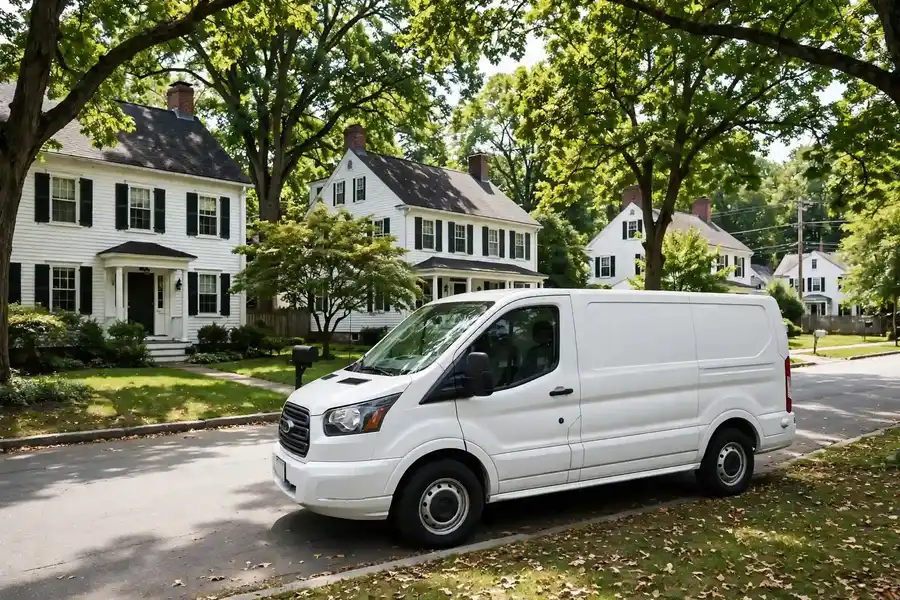
| Housing | Mix of eras. Historic core around Tewksbury Center: 19th- and early-20th-century Federal, Colonial Revival, Italianate, Queen Anne, and fieldstone/granite-foundation farmhouses (Massachusetts Historical Commission inventory forms on file — e.g., c1740 Georgian, c1817 Federal, c1875-1915 Victorians). Mid-20th-century suburban capes, ranches, and colonials; newer colonials and infill from the 1990s-2020s. ~11,800 units, ~83% owner-occupied. |
| Common pipe materials | Pre-1940 core: cast-iron interior DWV piping and vitrified-clay (VCP) or tar-and-lead-jointed clay building sewers; mid-century ranch/cape neighborhoods: cast-iron stacks with clay or early-concrete exterior laterals; 1990s+ homes: PVC/ABS. Typical for the era, never asserted for a specific home. |
| Foundations | Full basements are the norm (historic forms list stone, granite, fieldstone, and poured-concrete foundations); mid-century capes/ranches: poured-concrete full or partial basements; some ranches and condo clusters: slab or crawl space. Basement floor drains and deep building sewers below the water table are common in low-lying streets. |
| Soil & drainage | Glacial-till uplands (Paxton-type sandy loams are typical of Middlesex County uplands) with outwash sands/gravels in valley bottoms. The town's own flooding survey found the leading flood sources were backing-up road drains (40%), excess water in soil (17%), and groundwater seepage (16%) — surface-water flooding from rivers/ponds was uncommon. Flat lowlands near Silver Lake/Lubbers Brook and the Shawsheen River corridor are the most water-prone zones. |
| Key routes/landmarks | Main Street (State Route 38) is the primary commercial corridor; Andover Street (Route 133) crosses North Tewksbury toward the I-495 interchange (Exit 49); the Merrimack River forms part of the town's northern boundary and the Shawsheen River runs through the southern end; Tewksbury Public Library, 300 Chandler Street, 01876. |
Tewksbury 01876: A Historic Core and a Water-Prone Valley
Tewksbury, Massachusetts is a one-ZIP town: 01876 is the sole standard ZIP, with the post office at 1751 Main Street. But inside that single ZIP are two very different sewer towns. The historic core around Tewksbury Center holds 19th- and early-20th-century Federal, Colonial Revival, Italianate, and Queen Anne houses plus fieldstone- and granite-foundation farmhouses — the Massachusetts Historical Commission's inventory forms on file with the town document examples from a c1740 Georgian to a c1817 Federal to c1875-1915 Victorians. Around that core spread the mid-20th-century suburban capes, ranches, and colonials, with newer colonials and infill from the 1990s through the 2020s. About 11,800 housing units total, roughly 83% owner-occupied. The practical result: a lateral on one street can be 250 years newer than a lateral three streets over.
In the pre-1940 core, interior drainage is typically cast-iron DWV piping, and the building sewers are vitrified clay (VCP) or tar-and-lead-jointed clay — hand-laid lines that have been in the ground for a century or more. Mid-century ranch and cape neighborhoods typically carry cast-iron stacks with clay or early-concrete exterior laterals. Homes from the 1990s onward typically use PVC or ABS. A sewer camera inspection is the only way to know what your line actually is, because Tewksbury's era mix means the house next door is no guide to your house.
Full basements are the norm here. The historic inventory forms repeatedly list stone, granite, fieldstone, and poured-concrete foundations; mid-century capes and ranches typically sit on poured-concrete full or partial basements; some ranches and condo clusters use slab or crawl space. In the low-lying streets, basement floor drains and deep building sewers below the water table are common — a detail that matters, because a lateral that runs beneath the water table lives under constant outside pressure.
The soil splits with the town's geography. Uplands are glacial till — Paxton-type sandy loams are typical of Middlesex County uplands — with outwash sands and gravels in the valley bottoms. Tewksbury's own flooding survey is unusually honest about what the water does: the leading flood sources were backing-up road drains (40%), excess water in soil (17%), and groundwater seepage (16%), while surface-water flooding from rivers and ponds was uncommon. Translation: Tewksbury's water problem is underground, not overhead. The flat lowlands near Silver Lake and Lubbers Brook and the Shawsheen River corridor are the most water-prone zones, and that is where infiltration into aging laterals concentrates.
The climate keeps that underground pressure cycling. Tewksbury sees about 44.6 inches of annual precipitation, roughly 62 days a year with snow cover, and temperatures below 50°F for about 195 days a year. Freeze-thaw cycles, nor'easter rain-on-snow events, and spring snowmelt drive seasonal groundwater surges that stress sewer laterals — each cycle pushing water against cracked joints and shifting soil around shallow, hand-laid lines.
The town's corridors orient the work. Main Street — State Route 38 — runs through town as the primary commercial corridor, and the historic-center laterals branch off it. Andover Street (Route 133) crosses North Tewksbury toward the I-495 interchange at Exit 49. The Merrimack River forms part of the town's northern boundary while the Shawsheen River runs through the southern end, and the Tewksbury Public Library stands at 300 Chandler Street, 01876. Crews think in these corridors because they map cleanly onto the two service geographies: the old center off Main Street, and the lowlands along the Shawsheen and the Silver Lake flats.
How Sewer Services Work in Tewksbury
Tewksbury creates two distinct sewer-repair jobs in one town, and the method that fits one side can be wrong for the other. In the historic-center streets off Main Street (Route 38), crews meet century-old clay building sewers paired with stone or granite foundations and shallow, hand-laid laterals. These lines fail at their joints: root intrusion works into every opening, and frost heave separates tar-and-lead joints a fraction at a time. Here the work is diagnosis-first — a camera inspection before any quote is essential, because a shallow hand-laid lateral can sometimes be spot-repaired where a deeper line would need lining.
In the flat Shawsheen lowlands and the Silver Lake and Lubbers Brook flats, the failure mode is infiltration. High seasonal groundwater presses against aging laterals, and the town's own flood survey confirms that drain backup and groundwater seepage are the dominant water problems here. In saturated soil, open excavation is its own risk — trenches fill, walls slump, and the new pipe goes into the same wet ground that defeated the old one. That is why trenchless CIPP lining is often the more effective repair in the lowlands: pipe lining seals infiltration along the full run from the inside, creating a jointless pipe within the old one without opening the waterlogged ground.
Winter adds a third consideration across the whole town. Freeze-thaw cycles shift soils around shallow laterals — particularly the hand-laid clay runs in the historic core — misaligning joints and opening new paths for roots and groundwater. A line that camera-inspects clean in October can show joint separation by April. In Tewksbury, scheduling the inspection before quoting is not bureaucracy; it is how you avoid prescribing last season's fix for this season's pipe.
The housing mix shapes access as well. A c1740 Georgian on a fieldstone foundation may have no modern cleanout, so the crew creates an access point — routine work, but it takes planning. A 1990s colonial on a poured basement usually offers clean access and a PVC line that, if it has failed, has failed at a joint or from soil movement rather than age. Our sewer line replacement and lining crews scope each property on its own facts: foundation type, pipe material, depth, soil saturation, and what the camera actually shows.
One pattern worth naming: in the low-lying streets with basement floor drains and deep building sewers below the water table, homeowners sometimes mistake infiltration for a blockage. The drains are slow because groundwater is filling the line from the outside, not because solids are blocking it from the inside. Sewer leak detection during wet weather separates the two — and in Tewksbury's flats, few diagnostics reveal infiltration as clearly as wet-weather testing. If your street sits low near the Shawsheen or the Silver Lake flats, call (833) 713-2101 and tell us when the problem is worst; the timing tells us where to look.
Common Sewer Problems in Tewksbury 01876
Joint failure in the historic core leads the list. The pre-1940 clay building sewers off Main Street were laid with tar-and-lead or mortar joints that were never meant to last a century-plus. Roots find every opening, frost heave widens them, and eventually sections settle out of alignment. The symptom arc is classic: recurring root blockages at lengthening intervals, then a section that cleaning can no longer clear. At that point the pipe needs structure — lining or replacement — not another cleaning.
Infiltration in the lowlands is the second signature failure. Near Silver Lake, Lubbers Brook, and the Shawsheen River corridor, seasonal groundwater rises against cracked laterals and pours in through open joints. Homeowners experience it as wet-weather backups that vanish in dry spells, or as drains that run slow for weeks each spring. Because the town's flood survey shows groundwater seepage and drain backup as the dominant water problems — not river flooding — the fix has to address water entering the pipe, not water crossing the yard. A pipe lining project in Tewksbury 01876 that seals the full run is built for exactly this.
Frost-driven joint separation is the third, and it hits the shallow hand-laid laterals of the historic core hardest. Each winter's freeze-thaw cycle grips the pipe and the soil differently, working joints apart a little more. By spring, the line that drained cleanly in fall is catching paper and admitting roots. It is a slow, cumulative failure — which is why a pre-1940 lateral deserves a periodic camera look even when nothing seems wrong.
Finally, the mixed-era neighborhoods produce mixed-material surprises. A mid-century cape with a clay lateral may connect to a replaced PVC section at the property line; a 1990s colonial's PVC run may tie into an older clay main connection. Those transition points — clay to PVC, old to new — are where roots concentrate and where separations open. The camera finds them in minutes; guessing misses them for years.
First Steps When Sewer Trouble Hits in Tewksbury
If drains slow across the house, toilets gurgle, or a basement floor drain shows water, the first step is to cut water use: pause laundry, skip showers, hold the dishwasher. A lateral that is infiltrating groundwater or blocked at a separated joint only gets worse with added volume.
The next step is a camera inspection — and in Tewksbury, timing the inspection matters. If the problem is worst in wet weather or spring, say so when you call: wet-weather footage shows infiltration that dry-weather footage can miss. If the problem is constant regardless of weather, the footage will show the structural failure directly. Either way, the camera maps the line's material, depth, and path, which is what determines whether trenchless lining, spot repair, or open replacement fits.
Sewer Line Repair Works serves all of Tewksbury 01876, from the historic center off Main Street to the Shawsheen lowlands. Call (833) 713-2101 and describe what you are seeing and when it is worst. We will schedule the inspection, walk you through the footage, and recommend the repair the pipe actually needs — not the one we guessed at over the phone.
Services in This Area
Commercial Sewer Services in Tewksbury
Tewksbury, MA 01876.
Learn moreEmergency Sewer Repair in Tewksbury
Tewksbury, MA 01876.
Learn morePipe Bursting in Tewksbury
Tewksbury, MA 01876.
Learn morePipe Lining (CIPP) in Tewksbury
Tewksbury, MA 01876.
Learn moreSewer Camera Inspection in Tewksbury
Tewksbury, MA 01876.
Learn moreSewer Leak Detection in Tewksbury
Tewksbury, MA 01876.
Learn moreSewer Line Cleaning in Tewksbury
Tewksbury, MA 01876.
Learn moreSewer Line Installation in Tewksbury
Tewksbury, MA 01876.
Learn moreSewer Line Replacement in Tewksbury
Tewksbury, MA 01876.
Learn moreSewer Maintenance in Tewksbury
Tewksbury, MA 01876.
Learn moreTree Root Removal in Tewksbury
Tewksbury, MA 01876.
Learn moreTrenchless Sewer Repair in Tewksbury
Tewksbury, MA 01876.
Learn more