
| ZIP | 02176 |
|---|---|
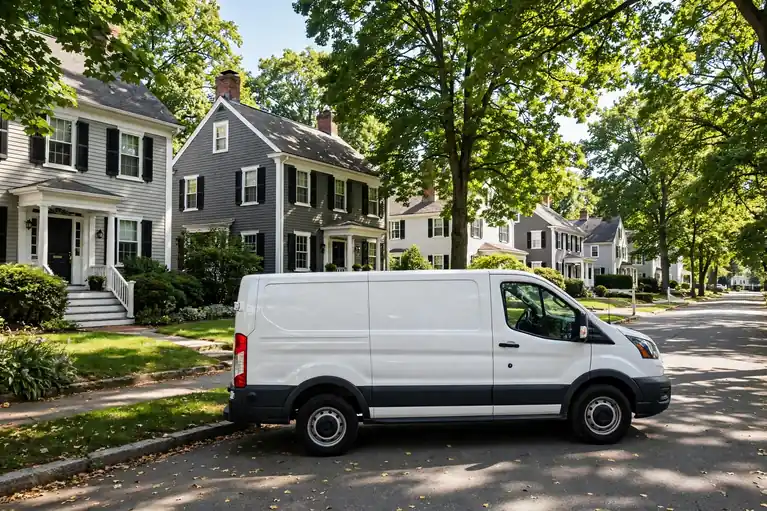
| Housing | Median year built 1926. Victorians and Colonial Revivals near downtown and the Common; 1920s–50s colonials, raised ranches, and split-levels beyond; small apartment buildings downtown (median apartment build 1965). |
| Common pipe materials | Vitrified clay tile laterals with cast-iron house stacks in the dominant pre-1940 stock; cast iron in post-war ranches and splits, transitioning to ABS/PVC in the 1970s–80s — typical for the era. |
| Foundations | Full basements — stone/rubble in 19th-century homes, block or poured concrete in 1920s+ builds; raised ranches and splits commonly have basements under part of the footprint. |
| Soil & drainage | Glacial-till uplands on the edge of the Middlesex Fells; valley-fill and swamp deposits around Ell Pond and low spots. Pond-side streets have seasonally high water tables and historic wetland margins. |
| Key routes/landmarks | Middlesex Fells Reservation (south/west border); Ell Pond downtown; Mt. Hood Golf Course; Main Street commercial spine with the MBTA commuter rail. |
Melrose, MA 02176: Housing, Pipes, and Soil Facts
Melrose is a city about seven miles north of Boston, settled in 1629, incorporated as a town in 1850, and a city since 1900. It sits at the triangle of I-93, I-95, and US Route 1, and the entire city is served by a single ZIP code: 02176, in Middlesex County. Housing here is old by national standards — the median year built is 1926, with city-data placing the median house at 1938. Victorians and Colonial Revivals cluster near downtown and the Common, ringed by 1920s–50s colonials, with raised ranches and split-levels filling in the mid-century growth areas. Small apartment buildings downtown date to a median build year of 1965. Stone foundations show up on 1880s Victorians, such as the Washington Street example documented in local listings — a reminder of just how long some of these below-grade systems have been in the ground.
For sewer purposes, what matters most is what is buried: across the dominant pre-1940 stock, vitrified clay-tile laterals with cast-iron house stacks are typical for the era. Post-war ranches and split-levels typically carry cast iron transitioning to ABS or PVC in the 1970s and 80s. Long runs of 1880–1930 clay tile pass under century-old street trees in the Victorian and Colonial neighborhoods, and those long clay runs are the classic root-intrusion candidate — every joint is a potential entry point once tree roots find the moisture. Foundations are full basements in the typical home: stone or rubble masonry in the 19th-century stock, block or poured concrete from the 1920s onward, with raised ranches and splits commonly having basement space under part of the footprint. That means most Melrose laterals exit the foundation wall below grade and run the full yard to the street main, giving roots, joints, and groundwater a long path to work on.
Soil and drainage complete the picture. Melrose sits on glacial-till uplands at the edge of the Middlesex Fells Reservation, which borders the city to the south and west, with valley-fill and swamp deposits around Ell Pond and other low spots. Ell Pond sits right downtown, and the pond-side streets carry seasonally high water tables with historic wetland margins — spring melt and heavy rain push groundwater up into exactly the zone where old clay laterals lie. Weather adds its own stress: freeze–thaw cycles drive frost heave that shifts rigid clay joints year after year, nor'easters deliver heavy rain on saturated ground, and the hillier streets around the Mt. Hood area shed runoff downhill toward low foundations and older combined-drainage connections. Other landmarks technicians use for orientation include Mt. Hood Golf Course and the Main Street commercial spine with its MBTA commuter rail station.
How Sewer Line Services Work in Melrose, MA 02176
Every sewer job in Melrose starts the same way: with a camera. A technician runs a high-definition sewer camera inspection through the lateral from an accessible cleanout — or by temporarily pulling a toilet when no cleanout exists — and you watch the footage together. A built-in sonde in the camera head lets the technician locate the exact spot above ground, marking the depth and distance of every defect: root masses, offset joints, cracks, bellies, and collapsed sections. On century-old clay-tile systems, that map is the difference between a targeted fix and an expensive guessing game, because the failure is almost never where the backup surfaces.
Melrose's defining failure mode is root intrusion at offset clay joints in its dense Victorian and Colonial neighborhoods. A century of freeze–thaw movement has worked rigid hub-and-spigot joints apart just enough for hair-thin roots to enter; once inside, roots expand into dense mats that snag solids and turn a partial restriction into a full blockage. Narrow lots and tight side yards make open-trench replacement disruptive here — tearing up a whole side yard, a shared driveway, or mature landscaping to expose a 60-foot run rarely makes sense when trenchless sewer repair can renew the same line through small access pits. Cured-in-place lining creates a seamless new pipe inside the old one, and pipe bursting pulls a new line through the old pipe's path; both eliminate every root-entry joint in a single pass. Where roots are the only problem and the pipe is otherwise sound, mechanical tree root removal followed by a camera re-check can buy time — but on 100-year-old clay, lining or bursting is usually the honest long-term answer.
Downtown Melrose adds a load problem on top of the age problem. Two-family homes and converted apartment buildings — the downtown stock dates to a median build year of 1965 — push far more fixture volume through a single aging lateral than the single-family line was originally sized for. Technicians expect undersized or grease-compromised lines in these buildings and plan for capacity checks alongside the repair: a line that backs up every holiday dinner is telling you about diameter and slope, not just debris. In these cases the repair conversation covers not only the defect but whether the lateral's capacity matches the building's actual use, and the fix may mean a larger replacement section rather than a like-for-like patch.
The third Melrose variable is water from below. Near Ell Pond and on other low-lying streets, the seasonally high water table means infiltration and inflow pour into cracked clay lines every spring, overwhelming the lateral and sometimes the municipal connection beyond it. Here the repair has to be watertight, not just unblocked: pipe-bursting replacement with sealed, gasketed joints eliminates the infiltration paths entirely, and homeowners in these pockets should have a backwater-valve conversation — a valve that prevents a surcharged main from pushing sewage back into the basement during the worst spring weeks. Winter adds its own damage as frost heave ratchets old joints open, and Mt. Hood hillside runoff loads downhill laterals with extra water every melt. A sewer line replacement or pipe bursting project in Melrose is therefore scoped against age, roots, loads, and water table together — never just the one symptom that brought the camera out.
Warning Signs Your Melrose 02176 Lateral Is Failing
Inside the house, the pattern matters more than any single symptom. One slow bathroom sink is a branch problem; slow drains across multiple fixtures, a toilet that gurgles when the washing machine discharges, or backups that always appear at the lowest drain in the house point to the main lateral. In Melrose's Victorian and Colonial neighborhoods, the classic early warning is a recurring backup every 12 to 18 months — the rhythm of root regrowth after a clearing — that eventually shortens to months as the root mass thickens. Sewage odors from floor drains or the basement, especially after heavy rain, are another lateral-level signal rather than a venting quirk.
Outside, walk the likely path of your lateral — usually a straight run from the front of the house to the street main. Unusually lush or fast-growing patches of lawn, persistently soggy ground in dry weather, or soil that has settled into a shallow trench line can all mark a leaking clay lateral feeding the soil. Around Ell Pond and the pond-side streets, foundation seepage after storms deserves a sewer look too: Melrose's older combined-drainage connections can route stormwater toward the same aging clay, and a cracked lateral becomes an entry point in both directions — sewage out, groundwater in.
Timing gives the third clue. Spring-melt backups that cluster near Ell Pond and low-lying streets are infiltration-driven: the water table rises, pours into cracked joints, and the lateral surcharges. Post-nor'easter backups on saturated ground follow the same logic. Winter slowdowns that ease in summer often trace to frost heave shifting already-offset clay joints and to root masses that keep growing while the ground is still. The cheapest response to any of these patterns is always the same — a camera inspection before the line fails completely, because a planned lining job costs a fraction of an emergency excavation, and a collapsed line removes trenchless options entirely.
From First Call to Finished Line in 02176
The first step is a phone call: reach Sewer Line Repair Works at (833) 713-2101 and describe what you are seeing — where it backs up, how often, and whether rain makes it worse. Those details tell the dispatcher what equipment to bring and whether your situation qualifies for emergency sewer repair dispatch. On site, the technician runs the camera inspection first and shows you the footage in real time, then locates and marks each defect's position and depth above ground. You see exactly what the technician sees: no diagnosis from a drain snake's guesswork, no pressure to approve work you cannot verify.
Next comes the options conversation, and in Melrose it is genuinely a conversation, because the same symptoms can point to several fixes. An isolated offset joint on an otherwise sound line may suit a spot repair. A long clay run riddled with root entries is a candidate for pipe lining or pipe bursting — both trenchless, both eliminating every joint in one pass. A collapsed section, a severe belly, or a line running in the Ell Pond high-water-table zone may call for open replacement with watertight gasketed pipe. The recommendation accounts for your pipe's material and age, the soil and water table at your address, your lot's access constraints, and the building's fixture load — not just the footage on the screen.
On work day, the crew marks utilities, sets small access pits or works from existing cleanouts, and keeps the excavation footprint as tight as the method allows — a practical necessity on Melrose's narrow lots. The job closes with a final camera pass so you can verify the finished line on video, and the site is restored as found: trenchless jobs typically leave the lawn, driveway, and landscaping you started with. Before the crew leaves, the technician walks you through what was found, what was fixed, and what maintenance — periodic cleaning, root management near those century-old street trees — keeps the new line performing for decades.
Services in This Area
Commercial Sewer Services in Melrose
Melrose, MA 02176.
Learn moreEmergency Sewer Repair in Melrose
Melrose, MA 02176.
Learn morePipe Bursting in Melrose
Melrose, MA 02176.
Learn morePipe Lining (CIPP) in Melrose
Melrose, MA 02176.
Learn moreSewer Camera Inspection in Melrose
Melrose, MA 02176.
Learn moreSewer Leak Detection in Melrose
Melrose, MA 02176.
Learn moreSewer Line Cleaning in Melrose
Melrose, MA 02176.
Learn moreSewer Line Installation in Melrose
Melrose, MA 02176.
Learn moreSewer Line Replacement in Melrose
Melrose, MA 02176.
Learn moreSewer Maintenance in Melrose
Melrose, MA 02176.
Learn moreTree Root Removal in Melrose
Melrose, MA 02176.
Learn moreTrenchless Sewer Repair in Melrose
Melrose, MA 02176.
Learn more