
Why Sewer Lines Need Ongoing Maintenance
A sewer lateral is the hardest-working pipe in your home and the least inspected, which is an unfortunate combination. It carries everything your household drains away, it sits in shifting soil under tree roots, and most homeowners only learn its condition when it fails. Maintenance flips that script: instead of reacting to backups, you stay ahead of them with periodic inspection and cleaning that keeps the line at full capacity year after year.
The problems maintenance prevents are the expensive and disruptive ones. A slow accumulation of grease and scale eventually becomes a complete blockage on the worst possible day. Fine root hairs ignored for a few seasons become a root mat that requires aggressive removal or even pipe repair. A small offset joint left unwatched becomes a separated joint collecting solids until sewage backs into the basement. Each of these failures starts as a minor, inexpensive condition that a maintenance visit would have caught. For Peabody homes with aging clay or cast-iron laterals, which make up a large share of the local housing stock, that early detection is the difference between a routine service call and a major project.
What Our Sewer Maintenance Service Includes
Our maintenance program is built around a simple cycle: inspect, clean, treat, and document. It begins with a baseline camera inspection that maps your entire lateral, noting pipe material, joint condition, root activity, and any developing trouble spots, so every future visit is measured against a known starting point. From there we establish a service interval matched to your line: lines under mature trees or with older pipe typically see us annually, while newer lines in root-free ground may go two or three years between visits.
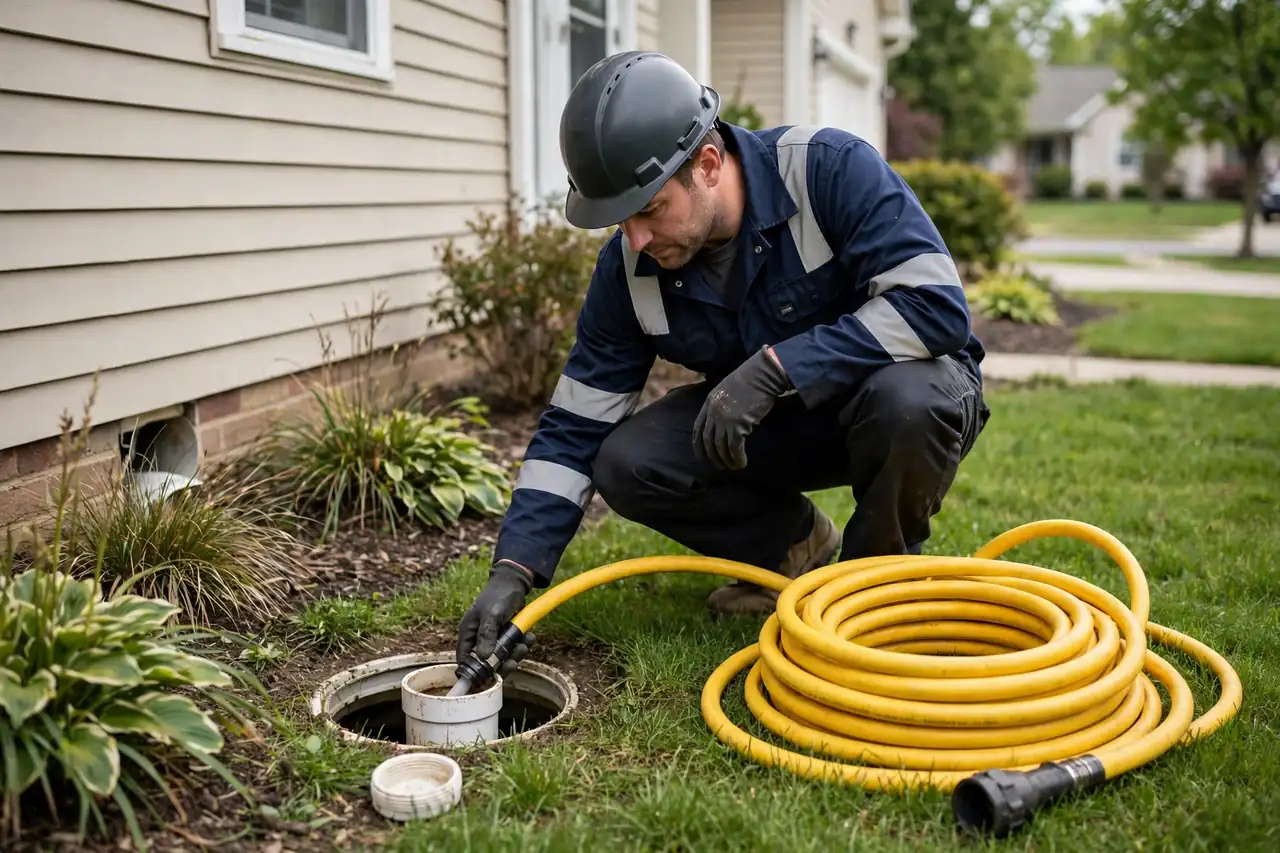
Each maintenance visit follows a consistent routine. First, a camera pass checks for changes since the last inspection: new root growth, developing scale, shifting joints, or debris accumulation. Second, the line is cleaned with hydro jetting scaled to what the camera shows, from a light scouring pass to a thorough root-cutting cleaning. Third, where roots are the recurring issue, we apply a root-inhibiting foam treatment that discourages regrowth at the joints without harming the tree itself (for heavier intrusions, see our tree root removal service). Fourth, we run flow tests on your fixtures to confirm everything drains as it should. Finally, you receive an updated condition report with the latest camera findings, so you always know exactly where your line stands. Scheduling is straightforward: call (833) 713-2101 and we will set your first visit and recommended interval.
Equipment and Materials Used in Maintenance
Maintenance uses the same professional-grade tools as our repair work, applied on a preventive schedule. Waterproof push cameras with recording capability document the line's condition visit after visit, and built-in sonde locators let us mark the exact surface position of anything that needs watching. The hydro jetter is the workhorse of each visit, with nozzle selection matched to the findings: rotating nozzles for general scouring, penetrating nozzles for developing blockages, and root-cutting heads where root hairs are reappearing at joints.
For root control between mechanical cleanings, we use foaming root-inhibiting treatments designed for sewer lines. These products coat the interior of the pipe and the root masses at joints, discouraging regrowth for an extended period, and they are applied strictly according to label directions with consideration for the surrounding landscaping. We deliberately avoid harsh chemical drain cleaners in maintenance work: they can damage older pipes, create hazardous conditions for anyone who later works on the line, and rarely solve the underlying problem. Water, mechanical cutting, and targeted root treatment keep the line clear without those downsides. Customers who want to understand the deeper cleaning side of the program can read about our sewer line cleaning service for detail on the hydro jetting process.
Safety and Precautions in Routine Maintenance
Because maintenance visits happen regularly, often while families go about their day, our safety routine is designed to be unobtrusive but thorough. Access points are opened with ventilation in mind, since even a well-functioning sewer line releases gases when opened, and technicians wear gloves, eye protection, and waterproof gear for every entry. The hydro jetter is operated at pressures matched to your pipe's known condition from prior inspections, which is one of the quiet advantages of a maintenance history: we never have to guess what your pipe can handle.
Chemical safety gets special attention in a maintenance context. Foaming root treatments are measured and applied exactly per label, kept away from storm drains and water features, and scheduled so the product has proper dwell time in the line. We also use each visit as a safety check on the system itself: verifying that cleanout caps seal properly, that no sewage odors indicate a dry trap or venting issue inside the home, and that surface grading still directs water away from the sewer route. If a maintenance inspection ever reveals damage beyond what cleaning can address, such as a newly collapsed section, we explain the finding and discuss options like trenchless sewer repair before it becomes an emergency.
Sewer Maintenance for Peabody and North Shore Properties
Peabody is a town where sewer maintenance pays for itself many times over, because the local risk factors stack up. Mature tree canopy covers much of the city, and species like maple, oak, and elm are relentless about sending feeder roots toward the moisture in sewer joints, especially in the sandy glacial soils that let roots travel far. A large share of homes still run on original clay tile or cast-iron laterals whose joints and interiors grow more vulnerable every year. Fall brings heavy leaf litter that washes into drains and catch basins, and winter's freeze-thaw cycle shifts pipe bedding just enough each year to gradually open joints that roots then exploit.
A maintenance rhythm tuned to this environment looks like annual or biennial service for homes on tree-lined streets, with a camera check each fall before the ground freezes and roots do their quiet winter growing. Commercial properties, particularly food service businesses around Peabody's commercial corridors, need more frequent grease-line attention on a quarterly or semiannual cycle. Rental property owners across the North Shore use scheduled maintenance to avoid the midnight backup call from tenants, since a documented service history also shows the line was properly cared for. Whatever your property type, a planned program beats emergency response every time: call (833) 713-2101 and we will design a maintenance interval around your line, your trees, and your soil. Learn more about everything we do on the Sewer Line Repair Works homepage.
Areas Served for This Service
Sewer Maintenance in Beverly
Beverly, MA 01915.
Learn moreSewer Maintenance in Burlington
Burlington, MA 01803.
Learn moreSewer Maintenance in Danvers
Danvers, MA 01923.
Learn moreSewer Maintenance in Essex
Essex, MA 01929.
Learn moreSewer Maintenance in Gloucester
Gloucester, MA 01930.
Learn moreSewer Maintenance in Lynn
Lynn, MA 01902.
Learn moreSewer Maintenance in Lynnfield
Lynnfield, MA 01940.
Learn moreSewer Maintenance in Marblehead
Marblehead, MA 01945.
Learn moreSewer Maintenance in Melrose
Melrose, MA 02176.
Learn moreSewer Maintenance in Middleton
Middleton, MA 01949.
Learn moreSewer Maintenance in Nahant
Nahant, MA 01908.
Learn moreSewer Maintenance in North Reading
North Reading, MA 01864.
Learn moreSewer Maintenance in Reading
Reading, MA 01867.
Learn moreSewer Maintenance in Revere
Revere, MA 02151.
Learn moreSewer Maintenance in Salem
Salem, MA 01970.
Learn moreSewer Maintenance in Saugus
Saugus, MA 01906.
Learn moreSewer Maintenance in Stoneham
Stoneham, MA 02180.
Learn moreSewer Maintenance in Swampscott
Swampscott, MA 01907.
Learn moreSewer Maintenance in Tewksbury
Tewksbury, MA 01876.
Learn moreSewer Maintenance in Wakefield
Wakefield, MA 01880.
Learn moreSewer Maintenance in Wilmington
Wilmington, MA 01887.
Learn moreSewer Maintenance in Woburn
Woburn, MA 01801.
Learn more