
Warning Signs and Common Causes
Commercial sewer trouble rarely announces itself politely. The first signals are usually operational: several fixtures draining slowly at once, a floor drain that gurgles when the dishwashers run, or a sour odor drifting out of a mop sink on a busy Friday. In restaurants the pattern often traces back to the kitchen line, where grease, food solids, and starch coat the pipe wall until the opening narrows. In offices and retail, the culprits are more mundane — paper towels and wipes flushed in restrooms, or a mop bucket emptied where it should not be. When backups start recurring at the same cleanout, or they arrive during peak hours rather than randomly, the blockage is usually in the main lateral, not a single fixture.
Underground, the causes look different. Peabody's older commercial blocks still carry cast iron and vitrified clay pipe from decades past, and clay joints are open invitations to tree roots. A hairline root intrusion becomes a woven mat over a few seasons, catching everything that passes. Cast iron scales from the inside, and in low spots the pipe can develop a belly that holds wastewater and solids. Outside the building, shallow lines under parking lots take a beating from delivery-truck loading and from freeze-thaw cycles that shift the soil around them. Construction or paving work nearby can also drop sediment or debris into an open lateral. A sewer camera inspection is the only reliable way to tell which of these is at work, because two buildings with identical symptoms often need completely different fixes.
Our Step-by-Step Process
Step 1 — Walkthrough and history. Every commercial job starts with a conversation, not a wrench. We ask how the building is used, what the tenant mix looks like, when the trouble shows up, and whether there is a grease interceptor or maintenance log we should see. Restaurants with a neglected grease trap fail differently than offices with a single aging restroom core, and the fix has to match the building. Step 2 — Camera inspection and locating. We run a camera through the line from an accessible cleanout, tracing the pipe path above ground and recording what the lens finds — roots, grease, scale, offsets, breaks — with distance marks so each defect can be found again without guesswork.
Step 3 — Written plan with options. The footage becomes a plain-language plan. Where trenchless sewer repair fits, we propose it; where a line is collapsed or back-pitched, we say so directly and lay out the open-trench alternative. Step 4 — Cleaning and preparation. Before any repair, the line gets cleaned, usually with a hydro-jetter, because liners and bursting heads both need a clear, round bore to work with. Cleaning also confirms the diagnosis: if the camera showed a belly and the jetter proves water still ponds after cleaning, the pipe geometry itself is the problem.
Step 5 — Scheduled execution. Repair work is fitted around your operation. Kitchens get early-morning windows before prep starts, offices get evenings or weekends, and retail gets overnight shifts when the floor must stay open. We keep at least one restroom bank working wherever the plumbing layout allows, and we coordinate with your staff so deliveries and customers never meet our equipment. If anything urgent surfaces mid-project, call (833) 713-2101 and the crew lead adjusts the plan on the spot. Step 6 — Verification and documentation. When the work is done, the camera goes back through the line to verify the full run, and you receive the before-and-after footage plus a written summary for your maintenance files — documentation that matters for property managers, franchise operators, and anyone answering to a corporate facilities office.
Equipment and Materials
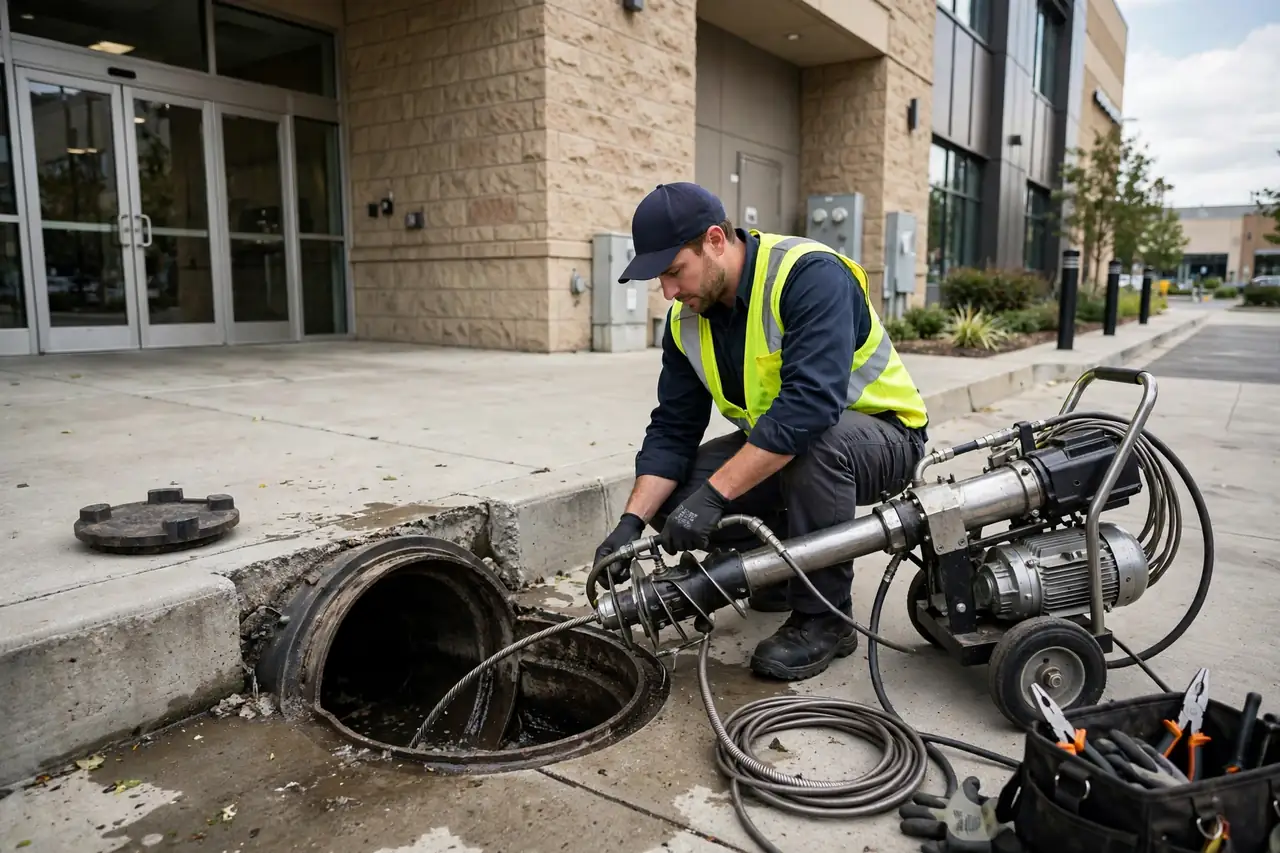
Commercial laterals are larger and longer than residential runs, so the equipment scales up. We use mainline camera crawlers and push cameras with self-leveling heads for lines from small restroom branches up to the building's main, paired with above-ground locators that trace the pipe's path and depth. Hydro-jetters with rotating nozzles scour grease and scale off the pipe wall, and root-cutting heads clear intrusions before a repair. For trenchless work we bring pipe-bursting rigs that pull a new pipe through the old one's path, and inversion or pull-in lining equipment for cured-in-place pipe. Replacement pipe is typically HDPE or SDR-35 PVC with gasketed or fused joints, selected for the soil and loading conditions at your site.
The smaller pieces matter just as much. No-hub couplings join new pipe to existing cast iron without creating a lip that catches solids. Cleanout risers get brought to grade and capped so the next service call starts in minutes instead of with a shovel. Where a building sits low relative to the street main, we install backwater valves that let wastewater out but block a surcharged municipal main from pushing sewage back in — sensible protection during the cloudburst storms that hit the North Shore every summer. For deeper work we carry confined-space entry gear, gas monitors, and ventilation blowers, because a commercial manhole or deep cleanout is treated as a permit space, not a hole in the ground.
Safety and Precautions
Safety on a commercial site is about your people as much as ours. Work areas get barricaded and signed, and we stage equipment where it will not block fire lanes, accessible entrances, or delivery routes. Any opening deeper than a few feet gets shored or sloped to the soil conditions — Essex County glacial till can stand for a while and then let go without warning, so we never gamble on trench walls. Confined-space entries follow a written procedure: atmospheric testing before anyone goes in, a blower running the whole time, and an attendant topside whose only job is watching the entrant.
Inside the building, the precautions are operational. Tenants and staff get advance notice of water shutoffs, with the window kept as short as the work allows. We never leave an open line unsecured — caps go on the moment a section is opened, and open excavations get plated or fenced at the end of every shift. Grease and sewage-contaminated soil leave the site in sealed containers, never in your dumpster. If your business handles food, we schedule the work so no open plumbing coincides with food prep, and we disinfect every surface we touch in a kitchen or restroom before we leave. One precaution worth naming directly: if you smell strong sewer gas, ventilate the space and call (833) 713-2101 instead of sending a maintenance worker into a basement or pit to investigate.
Peabody and North Shore Local Factors
Peabody's commercial stock tells the story of a former mill and tannery city. The blocks around Peabody Square and the older industrial pockets still hold buildings whose waste lines went in when cast iron and clay tile were the standard materials, and many of those lines have outlived the businesses they were built for. Newer commercial development concentrates along Route 1 and around the Northshore Mall corridor, where restaurants generate the heaviest grease loads in the city and where long parking-lot laterals run shallow under asphalt that heaves every winter. Centennial Park's industrial tenants add a different profile — process water, floor drains, and long runs to the municipal main.
The ground itself shapes the work. Much of Peabody sits on Essex County glacial till — sandy loam over a dense hardpan a couple of feet down — which drains well on the ridges but perches water in the low spots near Proctor Brook, Goldthwaite Brook, and the North River lowlands. Winter freeze-thaw shifts shallow laterals and opens clay joints; spring melt and nor'easter rains can surcharge low-lying lines from the street side. Mature oaks and maples line the older streets and many commercial lots, and their roots find every clay joint within reach. Because downtown streets are narrow and parking is tight, trenchless methods are often the practical answer — a pipe bursting project in nearby Salem can renew a failed lateral under a parking lot without closing the lot, and the same logic applies across our Peabody-area service areas. Learn more about who we are on our home page.
Areas Served for This Service
Commercial Sewer Services in Beverly
Beverly, MA 01915.
Learn moreCommercial Sewer Services in Burlington
Burlington, MA 01803.
Learn moreCommercial Sewer Services in Danvers
Danvers, MA 01923.
Learn moreCommercial Sewer Services in Essex
Essex, MA 01929.
Learn moreCommercial Sewer Services in Gloucester
Gloucester, MA 01930.
Learn moreCommercial Sewer Services in Lynn
Lynn, MA 01902.
Learn moreCommercial Sewer Services in Lynnfield
Lynnfield, MA 01940.
Learn moreCommercial Sewer Services in Marblehead
Marblehead, MA 01945.
Learn moreCommercial Sewer Services in Melrose
Melrose, MA 02176.
Learn moreCommercial Sewer Services in Middleton
Middleton, MA 01949.
Learn moreCommercial Sewer Services in Nahant
Nahant, MA 01908.
Learn moreCommercial Sewer Services in North Reading
North Reading, MA 01864.
Learn moreCommercial Sewer Services in Reading
Reading, MA 01867.
Learn moreCommercial Sewer Services in Revere
Revere, MA 02151.
Learn moreCommercial Sewer Services in Salem
Salem, MA 01970.
Learn moreCommercial Sewer Services in Saugus
Saugus, MA 01906.
Learn moreCommercial Sewer Services in Stoneham
Stoneham, MA 02180.
Learn moreCommercial Sewer Services in Swampscott
Swampscott, MA 01907.
Learn moreCommercial Sewer Services in Tewksbury
Tewksbury, MA 01876.
Learn moreCommercial Sewer Services in Wakefield
Wakefield, MA 01880.
Learn moreCommercial Sewer Services in Wilmington
Wilmington, MA 01887.
Learn moreCommercial Sewer Services in Woburn
Woburn, MA 01801.
Learn more