
Warning Signs and Common Causes
Lining is the right fix when the pipe is damaged but not destroyed. The signs that point toward it: a camera inspection showing cracks along the pipe wall, root intrusion at the joints, groundwater seeping in through separations, or interior corrosion and scale that cleaning keeps removing but that keeps coming back. Homeowners usually arrive here after a cycle of recurring service calls — the line gets jetted, works for a season, then slows again. The pipe still holds its round shape and its grade, but every joint is a weak point and every crack is a doorway for roots and soil.
The causes are the standard North Shore failure set. Vitrified clay develops hairline cracks from freeze-thaw movement and soil settlement; each crack admits a root hair, and the root wedges the crack wider season after season. Joints separate as the ground shifts, letting groundwater infiltrate — you may notice the sump pump running more, or hear water in a line that should be dry between uses. Cast iron corrodes from the inside, pitting and scaling until the wall is thin and rough. What disqualifies a line for lining is structural collapse: a pipe that has caved in, lost its shape, or developed a severe belly cannot host a liner, because the liner follows the host pipe's geometry. That is why the camera survey comes first — lining a collapsed pipe wastes everyone's time, and an honest sewer camera inspection tells you which side of that line your pipe falls on.
There is also a strong practical reason many Peabody homeowners choose lining: what sits above the pipe. Finished basements with the sewer line running beneath the slab, additions built over the lateral's path, mature trees planted directly over the line, and narrow side yards with no equipment access all make excavation punishing. Lining renews the pipe from the inside, through existing cleanouts, and none of that surface gets touched.
Our Step-by-Step Process
Step 1 — Camera survey and measurement. We inspect the line end to end, confirming it holds its shape and grade, and we measure exact lengths and diameters plus the location of every branch connection. Lining is a custom fit: the liner is cut and prepared for your pipe's specific dimensions. Step 2 — Cleaning and preparation. The line is descaled and cleared — root intrusions cut, scale removed with chain flails or high-pressure jetting — until the interior is clean enough for the resin to bond. This step is not optional; a liner installed over debris inherits every bump underneath it.
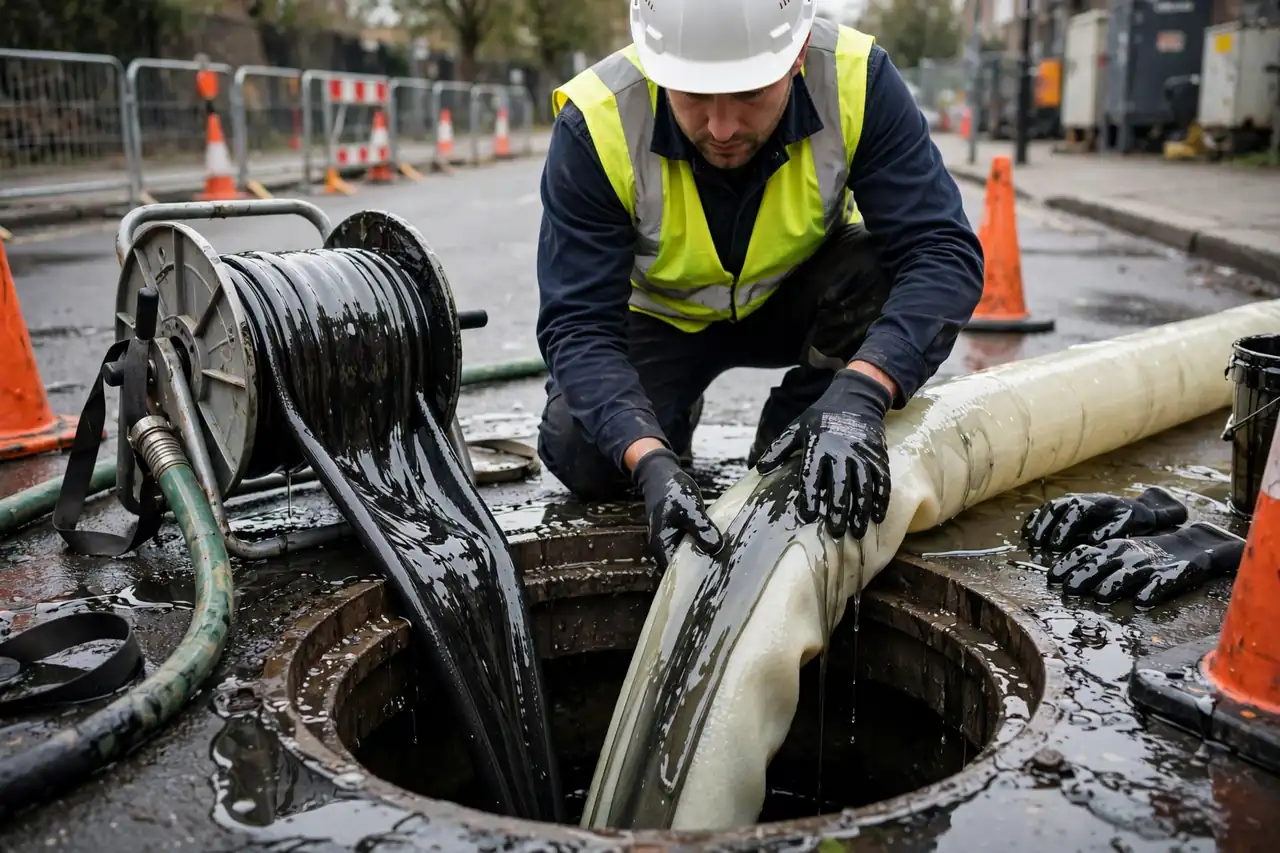
Step 3 — Liner preparation and insertion. The felt or fiberglass liner is saturated with resin, then inserted into the old pipe — either inverted with water or air pressure, which turns it inside-out as it travels, or pulled into place with a winch, depending on the run. Step 4 — Curing. Once positioned, the liner is cured hard: hot water, steam, or ambient cure depending on the resin system and the job conditions. During curing the liner presses outward against the host pipe, forming a tight, jointless new pipe inside the old one. Step 5 — Branch reinstatement and final inspection. Where branch lines join the main, a robotic cutter reopens each connection from inside the new liner with precision. A final camera run verifies the full installation — liner integrity, open branches, correct flow — before the system goes back into service. Most residential linings are completed in a day, and you can use your plumbing again once the cure is verified.
Homeowners sometimes ask how lining compares with pipe bursting. The short version: lining preserves the existing pipe as a host and suits lines whose shape is still intact; bursting replaces the pipe entirely and is the choice when the host is too far gone. The camera survey makes the call.
Equipment and Materials
The liner itself is the heart of the system: a flexible tube of felt or fiberglass, manufactured for the diameter of your pipe and saturated on site with a two-part resin — typically epoxy for its strength and chemical resistance. Inversion drums or winches place the liner; curing units circulate hot water or steam at controlled temperatures, with sensors monitoring the cure so the resin hardens fully and evenly. Robotic cutting heads, guided by a second camera, reinstate branch connections from inside the finished liner without damaging it.
Preparation equipment matters as much as the liner. Chain-flail descalers and high-pressure jetters strip scale, roots, and tuberculation from cast iron and clay so the resin bonds to a clean surface. Pre- and post-installation cameras — the same push cameras with distance counters used in our inspections — document the before and after. Calibration tubes hold the liner's diameter during curing, and end seals terminate the liner cleanly at the house connection and the municipal tap. Every material we install is selected for wastewater service and for the soil chemistry it will face; in coastal North Shore areas with brackish groundwater influence, resin and pipe selections account for that exposure.
Safety and Precautions
Cured-in-place work involves chemistry, heat, and pressure, and the safety plan covers all three. Resins are handled with chemical-resistant gloves, eye protection, and ventilation — the crew mixes and saturates liners with the work area ventilated, and occupants are told in advance what to expect. Some resin systems release a noticeable odor during curing; it dissipates, but we ask that you keep the work area ventilated and let us know if anyone in the household is chemically sensitive so we can plan accordingly. Curing temperatures are monitored continuously — an under-cured liner is a failed liner, and the sensors confirm the full cure before the system returns to service.
During installation the lined section is offline, so we schedule the work in a window that fits your household: plan for several hours without drain use on the affected line, and we will tell you exactly when the system is back in service. Pressure equipment — inversion drums and steam units — is operated at rated pressures with relief safeguards, and the work zone stays clear of anyone not on the crew. One more precaution from experience: do not run water into the line during the cure, even a little, and keep children and pets away from the equipment staging area. If you have questions during the process, call (833) 713-2101 and the crew lead will walk you through what is happening.
Peabody and North Shore Local Factors
Lining fits Peabody's housing patterns remarkably well. West Peabody's mid-century ranches and split-levels commonly have finished basements — family rooms, offices, and laundries sitting directly over or beside the sewer lateral. Excavating through a finished basement floor to reach a clay lateral is the kind of project that doubles in cost once restoration is counted; lining avoids it entirely by working through existing cleanouts. In the older neighborhoods, stone and fieldstone foundations make excavation near the foundation wall risky — hand-dug or not, disturbing the soil against a two-century-old rubble wall is something to avoid when a trenchless option exists.
Groundwater is the other local factor. Low-lying areas near Proctor Brook, Goldthwaite Brook, and the North River lowlands carry a high seasonal water table, and infiltration through separated clay joints is one of the most common camera findings in those zones. A cured-in-place liner seals every joint and crack in the lined section, cutting off that infiltration at the source — which your sump pump will notice. Winter scheduling deserves a note too: liners cure on their own chemistry, so cold weather does not stop the work, though we adjust cure times and protect the staging area from freezing. The same approach serves the surrounding towns — a pipe lining project in Lynn 01902 handled an identical finished-basement situation. Browse every community we cover on our areas page.
Areas Served for This Service
Pipe Lining (CIPP) in Beverly
Beverly, MA 01915.
Learn morePipe Lining (CIPP) in Burlington
Burlington, MA 01803.
Learn morePipe Lining (CIPP) in Danvers
Danvers, MA 01923.
Learn morePipe Lining (CIPP) in Essex
Essex, MA 01929.
Learn morePipe Lining (CIPP) in Gloucester
Gloucester, MA 01930.
Learn morePipe Lining (CIPP) in Lynn
Lynn, MA 01902.
Learn morePipe Lining (CIPP) in Lynnfield
Lynnfield, MA 01940.
Learn morePipe Lining (CIPP) in Marblehead
Marblehead, MA 01945.
Learn morePipe Lining (CIPP) in Melrose
Melrose, MA 02176.
Learn morePipe Lining (CIPP) in Middleton
Middleton, MA 01949.
Learn morePipe Lining (CIPP) in Nahant
Nahant, MA 01908.
Learn morePipe Lining (CIPP) in North Reading
North Reading, MA 01864.
Learn morePipe Lining (CIPP) in Reading
Reading, MA 01867.
Learn morePipe Lining (CIPP) in Revere
Revere, MA 02151.
Learn morePipe Lining (CIPP) in Salem
Salem, MA 01970.
Learn morePipe Lining (CIPP) in Saugus
Saugus, MA 01906.
Learn morePipe Lining (CIPP) in Stoneham
Stoneham, MA 02180.
Learn morePipe Lining (CIPP) in Swampscott
Swampscott, MA 01907.
Learn morePipe Lining (CIPP) in Tewksbury
Tewksbury, MA 01876.
Learn morePipe Lining (CIPP) in Wakefield
Wakefield, MA 01880.
Learn morePipe Lining (CIPP) in Wilmington
Wilmington, MA 01887.
Learn morePipe Lining (CIPP) in Woburn
Woburn, MA 01801.
Learn more