
| ZIP | 01907 — sole standard ZIP for Swampscott, MA (Essex County; Standard street-delivery type); population about 15,208. |
|---|---|
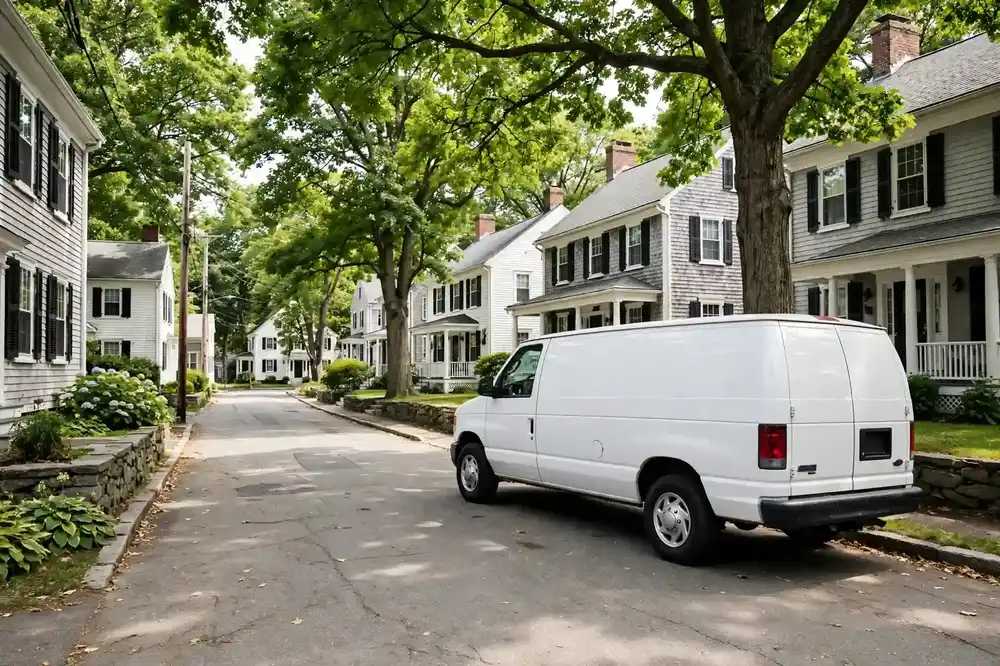
| Housing | 40.9% of units built 1939 or earlier (the largest single era); 54.5% single-family detached, 14.5% large apartment buildings; 72.7% owner-occupied; median home value 645,700. The Olmsted Historic District holds well-preserved Victorian and Colonial-style homes; the town is a former summer resort turned affluent residential community, with the Beach Bluff village and part of Clifton. |
| Common pipe materials | Pre-1939 Victorians/Colonials: clay tile or cast iron; mid-century builds: clay tile or Orangeburg; waterfront and post-1980 construction: PVC. Typical for the era, never asserted for a specific home. |
| Foundations | Pre-1939 homes: poured-concrete, block, or fieldstone/rubble with full basements; many older coastal homes sit low to grade with basements exposed to high water tables; newer construction: slab or structured foundations. |
| Soil & drainage | Coastal town on Massachusetts Bay — bedrock at or near the surface along the rocky shoreline; glacial till inland. Drainage is the town's critical issue: sea-level rise (9 inches since 1900, projected 2-4 ft more by 2070). The state's MVP program funds work at Cassidy Beach Park and Phillips Beach access ways because they 'serve as flood pathways into inland floodplains during coastal flooding events,' threatening wastewater and other infrastructure. FEMA flood maps drive the town's resiliency planning. |
| Key routes/landmarks | Phillips Beach (residents' favorite beach); Eisman's Beach (seawall repair project, southwestern exposure with Boston views); Fisherman's Beach and the historic 1890s Fish House (National Register-listed, active lobstermen) on Humphrey Street; King's Beach (partly in Lynn); Humphrey Street, Atlantic Avenue, Puritan Road, Essex Street, and Salem Street corridors; Swampscott High School, 200 Essex St; Olmsted Historic District. |
Swampscott 01907: Homes, Pipes & a Coastline That Keeps Rising
Swampscott, Massachusetts carries a single standard ZIP code: 01907. This Essex County town of about 15,208 people sits directly on Massachusetts Bay, and its sewer story starts with that fact. The housing stock is old and valuable: 40.9% of units were built in 1939 or earlier — the largest single era — while 54.5% are single-family detached and 14.5% sit in large apartment buildings. Owner-occupancy runs 72.7%, and the median home value is 645,700. The Olmsted Historic District preserves well-kept Victorian and Colonial-style homes, and the town as a whole is a former summer resort turned affluent residential community, including the Beach Bluff village and part of Clifton. Beautiful streets — and, underneath them, some of the oldest working laterals on the North Shore.
Pre-1939 Victorians and Colonials typically carry clay tile or cast-iron building sewers, materials that have been in the ground for 85-plus years. Mid-century builds commonly used clay tile or Orangeburg pipe, while waterfront and post-1980 construction typically uses PVC. A sewer camera inspection is the only way to confirm the material under any specific house, because era is a guide rather than a certainty — and in a town where homes have been renovated across generations, plenty of lines have been partially or fully replaced while their neighbors' originals remain.
Foundations in the pre-1939 stock are typically poured concrete, block, or fieldstone and rubble with full basements. Many older coastal homes sit low to grade, with basements directly exposed to high water tables — a detail that shapes both the failure pattern and the repair. Newer construction uses slab or structured foundations. Where a basement floor sits near or below the seasonal water table, the lateral leaving that basement is under hydraulic pressure from the outside, not just flow pressure from the inside.
Swampscott's ground is defined by the ocean. Bedrock sits at or near the surface along the rocky shoreline, with glacial till inland — but drainage, not rock, is the town's critical issue. Sea level has risen 9 inches since 1900 and is projected to rise another 2 to 4 feet by 2070. The state's MVP program specifically funds work at Cassidy Beach Park and the Phillips Beach access ways because they 'serve as flood pathways into inland floodplains during coastal flooding events' — pathways that threaten wastewater and other infrastructure. FEMA flood maps drive the town's resiliency planning, and any sewer contractor working Swampscott plans around them.
The weather is exposed coastal New England. Fall nor'easters drive storm surge over seawalls and into low streets — statewide flood watches were issued during the September 2026 nor'easter — while winter freeze-thaw cycles stress laterals and heavy-rain events combine with high tides to overwhelm drainage. Sea-level rise is turning what used to be 'normal' high tides into flood events. For sewer lines, that means the failure calendar follows the storm calendar: surge-driven backup clusters in the fall, frost-driven joint failures in winter, infiltration peaks with spring rains.
The town's corridors and landmarks mark the neighborhoods where these forces concentrate. Phillips Beach is the residents' favorite beach; Eisman's Beach — the subject of a seawall repair project — faces southwest with Boston views; Fisherman's Beach and the historic 1890s Fish House (National Register-listed, still home to working lobstermen) sit on Humphrey Street; King's Beach straddles the Lynn line. Humphrey Street, Atlantic Avenue, Puritan Road, Essex Street, and Salem Street carry the town's traffic; Swampscott High School stands at 200 Essex Street; and the Olmsted Historic District anchors the town's Victorian streetscapes. Homes nearest the water — around Fisherman's Beach, Eisman's Beach, and Phillips Beach — sit lowest and face the most water pressure on their laterals.
How Sewer Services Work in Swampscott
Swampscott is the most flood-driven sewer market in our area, and service here is organized around water before anything else. The town's own resiliency documents identify beach access ways — Cassidy, Phillips Beach — as flood pathways carrying coastal water into inland floodplains and threatening wastewater assets. Lateral lines in the low-lying neighborhoods face recurring saltwater intrusion, infiltration, and surge-induced backups during nor'easters. That makes the camera inspection do a specific job in Swampscott that it does not do inland: checking for infiltration and tidal influence, not just roots and cracks. Our camera crews here routinely document water entering through joints — footage that decides whether the fix is structural, hydraulic, or both.
For homes near Fisherman's Beach, Eisman's Beach, and Phillips Beach — where houses sit low with basements in high water tables — backwater protection is part of the conversation. A backwater valve stops municipal surge from reversing into the home's lowest fixtures, and it is a natural complement to a lined lateral: the liner seals the pipe against infiltration, and the valve guards against the surge events that lining alone cannot stop. We discuss both whenever the camera shows a lateral sitting below flood level.
The age of the stock adds the second layer. Pre-1939 clay and cast-iron laterals run under the Olmsted Historic District's Victorian streetscapes and the Beach Bluff and Clifton neighborhoods, bringing age-related collapse and root-intrusion risk to streets where open excavation would tear up some of the most carefully kept properties in town. Swampscott is affluent — median home value 645,700, median income 116,161 — and preservation-minded, which makes pipe lining that renews a lateral without disturbing landscaped coastal lots especially attractive. Trenchless is not just the less disruptive option here; on a historic streetscape, it is often the only option the homeowner will consider.
Storm response follows the nor'easter calendar. When surge overtops seawalls and floods low streets, the calls come from the same neighborhoods every time — and the pattern is recognizable: backups that arrive with the storm, not with daily use. Our emergency sewer repair work in Swampscott prioritizes stopping the immediate backup, then scheduling the camera work that finds the cracked joints the surge exploited. Fixing the backup without fixing the joints is how the same house calls twice in one season.
Saltwater deserves a special mention. Where seawater reaches laterals — through infiltration at high tide or surge events — it accelerates corrosion of cast iron and carries sand and sediment into the line. A sewer maintenance rhythm that includes periodic camera checks catches this early, before a corroded section collapses under a driveway or a landscaped front yard. If your home sits within a few blocks of the water anywhere in 01907, call (833) 713-2101 and ask what a maintenance inspection would look for on your street.
Common Sewer Problems in Swampscott 01907
Surge-induced backups are the signature Swampscott failure. When nor'easter surge or a high tide combined with heavy rain raises water levels faster than drainage can clear them, flow reverses into the lowest fixtures of homes whose laterals sit below flood level. The backup arrives with the weather, clears when the water recedes, and returns with the next storm — a pattern that points to hydraulic pressure, not a simple clog. An emergency sewer repair in Swampscott 01907 starts by restoring flow, then traces the route the water took so the next storm does not repeat it.
Saltwater intrusion and infiltration form the second category. Groundwater — sometimes brackish — seeps into cracked clay and corroded cast-iron joints, adding volume the lateral was never sized to carry and accelerating the corrosion that opened the joints in the first place. Homeowners notice wet-weather backups, gurgling at high tide, or a persistent dampness near the foundation exit. Because the water enters through the same openings roots use, a jointless liner addresses infiltration, root intrusion, and corrosion progression in one repair.
Age-related collapse is the third. Pre-1939 clay tile laterals under the Olmsted Historic District and the older coastal streets have simply reached the end of their structural life: joints separate, sections settle, and cast-iron runs corrode through. The symptom progression is familiar — slow drains, then recurring root blockages, then a section that no longer responds to cleaning. By the time cleaning stops working, the pipe is telling you it needs structure, not maintenance.
Frost heave plays a quieter role. Winter freeze-thaw cycles shift soil around shallow laterals, and where bedrock near the shoreline keeps pipes close to the surface, that movement works joints loose a little more each year. Combined with the salt air's effect on exposed cast iron at foundation exits, winter is when Swampscott's oldest lines take their annual beating — which is why a camera check in the off-season often finds the crack that the next nor'easter would have exploited.
First Steps When Sewer Trouble Hits in Swampscott
If a storm is passing and a floor drain or low fixture starts backing up, the first step is to stop adding water to the system — no laundry, no showers, no dishwasher. During surge events, the municipal side is already overloaded; every gallon you add is a gallon fighting for space in a line that is under pressure from both ends.
The next step, once the immediate event passes, is a camera inspection with infiltration in mind. Tell the crew when the backup happened — during the storm, at high tide, or during dry weather — because the timing tells us whether you are dealing with surge pressure, a high water table, or a structural failure that the storm merely exposed. In Swampscott, 'when' is diagnostic information, not small talk.
Sewer Line Repair Works serves every neighborhood in Swampscott 01907, from the Olmsted Historic District to the streets behind Phillips Beach. Call (833) 713-2101 and describe what you saw and when you saw it. We will schedule a camera inspection, show you the footage, and lay out the fix the line actually needs — lining, backwater protection, replacement, or a combination — before the next nor'easter tests it.
Services in This Area
Commercial Sewer Services in Swampscott
Swampscott, MA 01907.
Learn moreEmergency Sewer Repair in Swampscott
Swampscott, MA 01907.
Learn morePipe Bursting in Swampscott
Swampscott, MA 01907.
Learn morePipe Lining (CIPP) in Swampscott
Swampscott, MA 01907.
Learn moreSewer Camera Inspection in Swampscott
Swampscott, MA 01907.
Learn moreSewer Leak Detection in Swampscott
Swampscott, MA 01907.
Learn moreSewer Line Cleaning in Swampscott
Swampscott, MA 01907.
Learn moreSewer Line Installation in Swampscott
Swampscott, MA 01907.
Learn moreSewer Line Replacement in Swampscott
Swampscott, MA 01907.
Learn moreSewer Maintenance in Swampscott
Swampscott, MA 01907.
Learn moreTree Root Removal in Swampscott
Swampscott, MA 01907.
Learn moreTrenchless Sewer Repair in Swampscott
Swampscott, MA 01907.
Learn more