
Signs Your Sewer Line Needs Replacement
There is a point where cleaning a sewer line stops being maintenance and starts being life support, and recognizing that point saves money and frustration. The clearest signal is a pattern: backups or slow drains that return weeks or months after a thorough sewer line cleaning, especially when the camera shows the same root masses or debris dams reforming in the same spots. A line that cannot stay clear between cleanings is telling you the pipe itself is the problem, not what is inside it.
A camera inspection makes the verdict concrete. Collapsed or crushed sections, long bellies where the pipe has settled and holds standing water, separated or offset joints, and heavy root intrusion at nearly every joint all point toward replacement rather than another repair. So does pipe material at the end of its life: clay tile with missing sections and corroded cast iron with scale-choked interiors will keep failing no matter how carefully they are cleaned. If sewage is surfacing in the yard or the basement is taking on water through floor drains, the situation has moved past maintenance and into replacement territory.
Our Step-by-Step Sewer Line Replacement Process
Replacing a sewer line is a significant project, so our process is designed to remove guesswork: diagnose precisely, choose the method that fits your pipe and property, and execute it cleanly. It starts with a conversation, call (833) 713-2101 and we will review your line's history and symptoms before we ever put a camera in the ground.
1. Camera diagnosis and measurement. We inspect the full length of the lateral, recording the location, depth, and nature of every defect so the replacement plan is based on evidence, not assumptions. 2. Method selection. Depending on the pipe's condition, depth, and what sits above it, we recommend the least disruptive workable method: trenchless pipe bursting, cured-in-place pipe lining, or conventional open-trench replacement, and we explain the trade-offs of each in plain terms. 3. Permits and utility marking. Municipal permits are secured and underground utilities are marked through Dig Safe before any work begins. 4. Installation. With pipe bursting, a bursting head pulls new HDPE pipe through the old line, fracturing it outward; with lining, an epoxy-saturated liner is inverted into the cleaned pipe and cured in place; with open trench, the old pipe is excavated and new pipe is laid on compacted bedding at verified slope. 5. Connections and testing. The building drain and the municipal tap are connected, and the new line is camera-inspected and flow-tested. 6. Restoration. Trenches are backfilled in compacted lifts, access pits are closed, and surfaces are restored. A final walkthrough goes over the camera footage of your new line with you.
Replacement Methods, Pipe Materials, and Equipment
Trenchless methods have changed what replacement means for homeowners. Pipe bursting replaces the old line with new high-density polyethylene (HDPE) pipe pulled through the existing path, which requires only small entry and exit pits instead of a full trench, making it ideal when driveways, patios, or mature landscaping sit above the line. Cured-in-place pipe (CIPP) lining creates a new structural pipe inside the old one: a resin-saturated felt or fiberglass liner is inverted into the cleaned pipe and hardened with hot water, steam, or UV light, sealing cracks, joints, and root entry points without excavation. Both methods leave you with a jointless, root-resistant, corrosion-proof pipe.
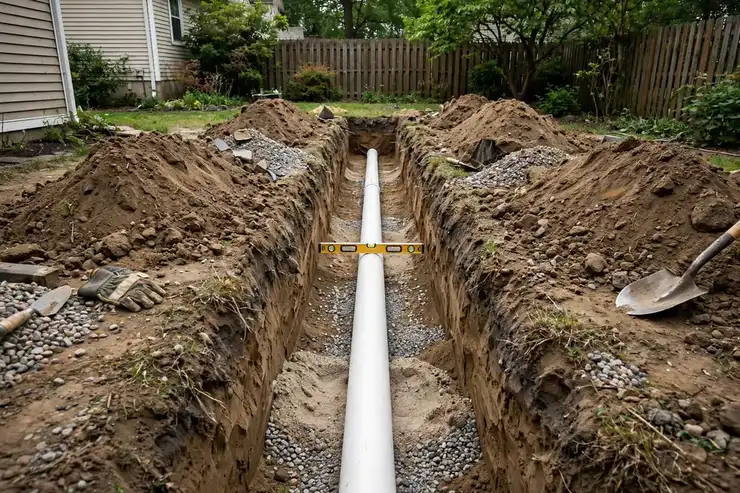
Conventional open-trench replacement still has its place: collapsed lines that have lost their shape, severely offset joints, or pipes too deteriorated to guide trenchless equipment are most reliably handled by excavating and laying new PVC or SDR-35 pipe on engineered bedding at laser-verified slope. The equipment roster spans both worlds: bursting rigs and liner inversion drums, curing units, robotic cutters for reopening branch connections after lining, compact excavators, shoring systems, and inspection cameras that verify every foot of the finished installation. Material and method are matched to your pipe's condition and your property, and if you are weighing options you can also read about trenchless sewer repair to understand where lining and bursting are most appropriate.
Safety Precautions During Sewer Line Replacement
Replacement work combines the hazards of excavation with specialized trenchless equipment, so the safety plan covers both. Utility location comes first on every job: gas, electric, water, and communications lines are marked and hand-exposed near the work zone before machines dig. Open excavations get shoring, shielding, or proper sloping based on depth and soil conditions, spoil is kept back from trench edges, and no one enters an unprotected trench. For pipe bursting, the pulling equipment is anchored and operated with clear communication between the entry and exit pits, and exclusion zones keep everyone clear of tensioned cables and hydraulic equipment.
Cured-in-place lining brings its own precautions: resins are handled according to manufacturer safety data, the work area is ventilated during inversion and curing, and curing temperatures are monitored so the liner hardens correctly without overheating. Throughout the project the site is barricaded, trenches and pits are covered or guarded when the crew leaves for the day, and your property is kept orderly with daily cleanup. We would rather spend an extra hour on protection than explain an accident, and that discipline runs through every replacement we perform.
Sewer Line Replacement in Peabody and the North Shore
Peabody's older neighborhoods are prime candidates for replacement work, and the reasons are written into the local ground. Miles of clay tile laterals installed from the postwar decades onward are now at an age where joints separate, sections crack under soil movement, and roots exploit every opening. Cast-iron lines of similar vintage corrode from the inside until scale and tuberculation choke the diameter. The North Shore freeze-thaw cycle accelerates the damage: each winter's frost heave nudges joints and bedding a fraction of an inch, and over decades those fractions add up to offsets and bellies that trap solids and breed blockages.
The local soil adds a practical wrinkle. Glacial till with cobbles and occasional ledge makes open trenching slower and less predictable, which is one reason trenchless methods are popular here: bursting or lining a line under a Peabody driveway avoids both the excavation battle and the surface destruction. Municipal tap rules and inspection requirements govern how the new line meets the city main, and we coordinate those approvals as part of the job. If your line has moved from needing occasional sewer maintenance to needing constant rescue, call (833) 713-2101 for a camera diagnosis and a straight answer about whether replacement is the right call.
Areas Served for This Service
Sewer Line Replacement in Beverly
Beverly, MA 01915.
Learn moreSewer Line Replacement in Burlington
Burlington, MA 01803.
Learn moreSewer Line Replacement in Danvers
Danvers, MA 01923.
Learn moreSewer Line Replacement in Essex
Essex, MA 01929.
Learn moreSewer Line Replacement in Gloucester
Gloucester, MA 01930.
Learn moreSewer Line Replacement in Lynn
Lynn, MA 01902.
Learn moreSewer Line Replacement in Lynnfield
Lynnfield, MA 01940.
Learn moreSewer Line Replacement in Marblehead
Marblehead, MA 01945.
Learn moreSewer Line Replacement in Melrose
Melrose, MA 02176.
Learn moreSewer Line Replacement in Middleton
Middleton, MA 01949.
Learn moreSewer Line Replacement in Nahant
Nahant, MA 01908.
Learn moreSewer Line Replacement in North Reading
North Reading, MA 01864.
Learn moreSewer Line Replacement in Reading
Reading, MA 01867.
Learn moreSewer Line Replacement in Revere
Revere, MA 02151.
Learn moreSewer Line Replacement in Salem
Salem, MA 01970.
Learn moreSewer Line Replacement in Saugus
Saugus, MA 01906.
Learn moreSewer Line Replacement in Stoneham
Stoneham, MA 02180.
Learn moreSewer Line Replacement in Swampscott
Swampscott, MA 01907.
Learn moreSewer Line Replacement in Tewksbury
Tewksbury, MA 01876.
Learn moreSewer Line Replacement in Wakefield
Wakefield, MA 01880.
Learn moreSewer Line Replacement in Wilmington
Wilmington, MA 01887.
Learn moreSewer Line Replacement in Woburn
Woburn, MA 01801.
Learn more