
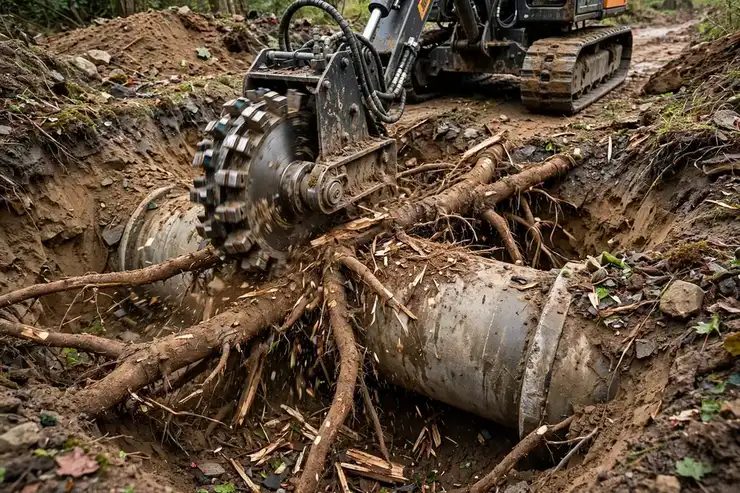
How Tree Roots Invade Sewer Lines
Tree roots do not break into healthy, watertight pipes; they exploit weaknesses that already exist. It starts with moisture: a sewer lateral carries a constant supply of water and nutrients, and the tiny vapor escaping through a hairline crack or a slightly gapped joint signals nearby roots that a resource is close. Fine feeder roots, thinner than a thread, grow toward that signal and slip through openings a fraction of an inch wide. Once inside, they find an ideal environment, constant moisture, warmth, and nutrients, and they grow with remarkable speed.
That is when the real damage begins. The fine roots thicken into a dense, tangled mat that acts like a net across the pipe, catching toilet paper, grease, and solids until flow is choked off. As the mat grows, hydraulic pressure from the expanding root mass wedges joints further apart and widens cracks, turning a small entry point into a large one. In clay tile lines, roots can dislodge entire sections; in cast iron, they enter through corroded joints and accelerate the deterioration. By the time a homeowner notices slow drains or backups, the intrusion is usually far more extensive than the symptoms suggest, which is why a camera inspection is the essential first step.
Signs of Root Intrusion in Your Sewer Line
Root problems announce themselves in patterns that repeat. The classic signature is a drain blockage that keeps coming back: you clear it, flow returns to normal, and weeks or months later the same fixtures slow down again. That cycle happens because cutting or clearing the visible mass leaves the root ends alive inside the pipe, and they regrow. Gurgling toilets and drains, especially after heavy rain when soil moisture surges and roots grow aggressively, are another telltale sign. Multiple fixtures affected at once point to the main lateral rather than a branch.
Outside the house, the clues are subtler but just as meaningful. A section of lawn above the sewer route that stays greener and lusher than the surrounding grass is often drinking from a leaking joint. Sinkholes or depressions forming along the pipe path suggest soil is washing into the pipe through root-opened gaps. And if your property has large trees, particularly maples, oaks, elms, or willows, within twenty or thirty feet of the sewer route, roots should be the prime suspect for any recurring drainage trouble. When these signs appear, call (833) 713-2101 for a camera inspection that shows exactly where the roots are and how extensive the intrusion is.
Our Step-by-Step Tree Root Removal Process
Removing roots from a sewer line is a two-part job: get the roots out, then keep them out. Our process addresses both, because cutting roots without a follow-up plan just schedules the next blockage. Every root removal starts with seeing the problem clearly.
1. Camera inspection and mapping. We run a camera through the full lateral to locate each intrusion, assess how the roots entered, and check the pipe's structural condition around every entry point. The footage is recorded and the intrusion locations are marked from the surface. 2. Mechanical root cutting. A root-cutting head, either a spinning chain flail or a mechanical auger cutter, is worked through the intrusions to shred the root masses and cut them back to the pipe wall. This is done carefully, with the camera guiding the work, so the cutting removes roots without gouging the pipe. 3. Hydro jetting flush. High-pressure water with a root-cutting nozzle scours the pipe walls, flushes the shredded root material out to the municipal main, and restores the full interior diameter. 4. Post-removal camera verification. The camera goes back in to confirm the pipe is clear, to document the condition of the joints and cracks the roots used, and to measure how much structural damage the intrusion caused. 5. Root-inhibiting treatment. A foaming treatment is applied to discourage regrowth at the entry points, buying significant time before roots return. 6. Long-term recommendation. Based on the damage the roots caused, we lay out your options honestly: a sewer maintenance schedule to manage regrowth, or a structural fix such as trenchless sewer repair that seals the entry points permanently.
Root Removal Equipment and Materials
The cutting itself is done with purpose-built equipment, not improvised tools. Mechanical root cutters use spinning heads fitted with chains or blades that shred root masses on contact, and they come in sizes matched to residential laterals so the head cleans the full diameter without binding. For the finishing pass, hydro jetting units fitted with root-cutting nozzles use focused high-pressure streams, sometimes with forward and rear jets, to slice remaining root fibers and blast the debris downstream. Both tools are guided by live camera footage so the operator can see exactly what the cutter is doing inside the pipe. For background on the jetting side of the process, see our sewer line cleaning page.
Inspection cameras with locators are the other half of the equipment story: they find the intrusions, measure their extent, and mark their surface positions, which matters if any excavation or spot repair is ever needed. For the regrowth-control step we use foaming root-inhibiting treatments formulated for sewer lines, applied per label directions so the foam fills the pipe, contacts the root ends at the joints, and discourages regrowth without harming the tree above. After the work, any root material pulled back at the access point is removed and disposed of, and the site is left clean.
Safety Precautions During Tree Root Removal
Root cutting equipment is powerful rotating machinery operating inside a confined pipe, and it demands the same respect as any industrial cutter. Only trained technicians operate the cutting heads, the equipment is inspected before each use, and the cutter is never run blind: camera guidance keeps the head on the roots and off the pipe wall, which protects both the operator and your pipe. Hydro jetting pressures are set based on the pipe's condition as seen on camera, because a root-damaged joint is exactly the wrong place for excessive pressure, and everyone stays clear of the access point while hoses are under pressure.
Chemical safety applies to the root-inhibiting treatment step. Products are mixed and applied strictly according to their labels, with protective gloves and eye protection, and kept away from storm drains, wells, and ornamental water features. The treatment targets roots inside the pipe, not the tree itself, and correct dosing matters: enough to discourage regrowth, applied where it belongs. Work areas are barricaded, open access points are never left unattended, and we confirm before leaving that every cleanout cap is sealed and the line is flowing. If the camera shows the roots have structurally destroyed sections of pipe, we stop and discuss structural options rather than cutting roots out of a pipe that cannot be saved.
Tree Root Problems in Peabody and the North Shore
If there is a town built for root intrusion, Peabody is a strong candidate. The city's mature tree canopy is one of its defining features: maples, oaks, and elms line residential streets, fill backyards, and shade entire neighborhoods, and their root systems are extensive, aggressive seekers of moisture. Much of the housing stock still runs on original clay tile laterals whose bell-and-spigot joints were never watertight by modern standards; each joint is a potential doorway. The region's sandy glacial soils make the situation worse by letting roots travel long distances with little resistance, so a tree thirty feet from the sewer route can still reach it.
Seasonality matters here too. Roots grow most aggressively in late spring and after heavy rains, which is when we see the surge in root-related backup calls across the North Shore. Winter does not kill the problem; roots continue slow growth in the relatively warm soil around a sewer line even when the ground surface freezes. For homes on Peabody's tree-lined streets, root management is not a one-time fix but an ongoing relationship with the landscape: regular inspection, cutting on a sensible cycle, and, when the pipe's joints are too far gone, sealing the entries permanently with lining. To find out where your line stands in that cycle, call (833) 713-2101 and we will put a camera in the line and show you the roots for yourself. You can also compare trenchless sewer repair in nearby Lynn to see how no-dig methods work across the North Shore.
Areas Served for This Service
Tree Root Removal in Beverly
Beverly, MA 01915.
Learn moreTree Root Removal in Burlington
Burlington, MA 01803.
Learn moreTree Root Removal in Danvers
Danvers, MA 01923.
Learn moreTree Root Removal in Essex
Essex, MA 01929.
Learn moreTree Root Removal in Gloucester
Gloucester, MA 01930.
Learn moreTree Root Removal in Lynn
Lynn, MA 01902.
Learn moreTree Root Removal in Lynnfield
Lynnfield, MA 01940.
Learn moreTree Root Removal in Marblehead
Marblehead, MA 01945.
Learn moreTree Root Removal in Melrose
Melrose, MA 02176.
Learn moreTree Root Removal in Middleton
Middleton, MA 01949.
Learn moreTree Root Removal in Nahant
Nahant, MA 01908.
Learn moreTree Root Removal in North Reading
North Reading, MA 01864.
Learn moreTree Root Removal in Reading
Reading, MA 01867.
Learn moreTree Root Removal in Revere
Revere, MA 02151.
Learn moreTree Root Removal in Salem
Salem, MA 01970.
Learn moreTree Root Removal in Saugus
Saugus, MA 01906.
Learn moreTree Root Removal in Stoneham
Stoneham, MA 02180.
Learn moreTree Root Removal in Swampscott
Swampscott, MA 01907.
Learn moreTree Root Removal in Tewksbury
Tewksbury, MA 01876.
Learn moreTree Root Removal in Wakefield
Wakefield, MA 01880.
Learn moreTree Root Removal in Wilmington
Wilmington, MA 01887.
Learn moreTree Root Removal in Woburn
Woburn, MA 01801.
Learn more