
| ZIP | 01923 |
|---|---|
| Housing | Median year built 1964 — old by national standards. Split personality: First Period 17th-century farmhouses (Rebecca Nurse Homestead c. 1700, Prince Osborne House 1690–1720 era, Judge Samuel Holten House c. 1670) and 19th-century colonials (e.g. an 1885 colonial on Maple St) in the older south; 1950s–70s suburban tract housing in the north/northwest, which holds the newest homes. |
| Common pipe materials | 17th–19th-century homes: whatever was installed at modernization (often mid-20th-century cast iron or clay, replaced in phases) — camera first, since 'typical for the era' does not apply cleanly. 1950s–70s tract homes: cast iron interiors with clay tile or ABS/PVC laterals, typical for the era. Newer north-end builds: PVC. |
| Foundations | Oldest farmhouses sit on fieldstone/rubble foundations with shallow stone cellars — laterals can exit at unusual angles and depths. Mid-century tract homes have full poured basements; some split-levels and slabs in the 60s–70s stock. |
| Soil & drainage | Essex County glacial till — Essex-series sandy loam, well drained on uplands with dense-till hardpan 20–30 inches down; hydric muck and poorly drained soils in low-lying wetland pockets (documented in the adjacent Bradley Palmer/Topsfield area). Seasonal high water table in low terrain near river/wetland corridors is the working assumption. |
| Key routes/landmarks | Rebecca Nurse Homestead, 149 Pine St; Endicott Park, 57 Forest St; Glen Magna Farms; Route 114 (runs through town, junction with Route 128/I-95). Danvers Post Office at 17 Conant St serves 01923. |
Danvers, MA 01923: Housing, Pipes, and Soil Facts
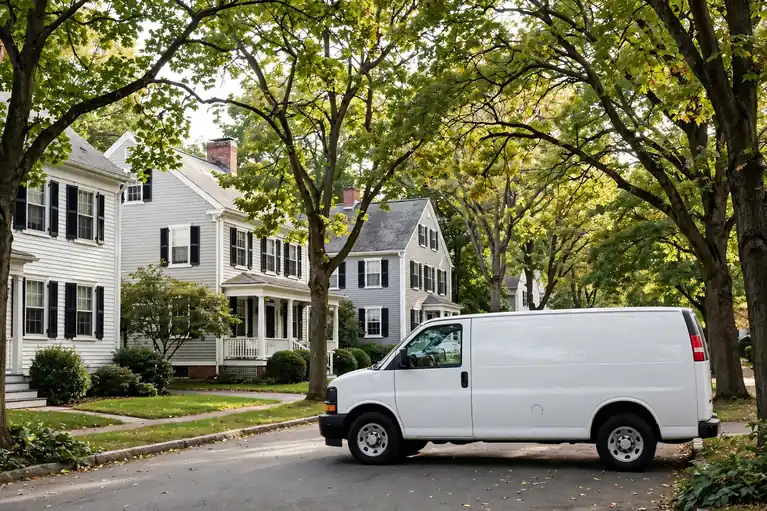
Danvers, MA 01923 is a two-era town, and sewer work here has to be quoted differently by neighborhood. The median year built is 1964 — old by national standards — but that single number hides a genuine split personality. The older south holds First Period 17th-century farmhouses like the Rebecca Nurse Homestead (c. 1700) at 149 Pine St, the Prince Osborne House (1690–1720 era), and the Judge Samuel Holten House (c. 1670), alongside 19th-century colonials such as the 1885 colonial on Maple St. The north and northwest are 1950s–70s suburban tract housing, which holds the newest homes in the 01923 ZIP.
That split runs straight underground. In the south-end historic properties, the pipe history is retrofit, not original — whatever was installed at modernization, often mid-20th-century cast iron or clay replaced in phases, exiting through fieldstone and rubble foundations at unusual angles and depths. In the northern tract neighborhoods, the stock is predictable: cast-iron interiors with clay tile or ABS/PVC laterals, typical for the era, under full poured basements. Newer north-end builds run PVC.
Orientation landmarks for the 01923 ZIP include Endicott Park at 57 Forest St, Glen Magna Farms, and Route 114 running through town to its junction with Route 128/I-95. The Danvers Post Office at 17 Conant St serves the whole ZIP. Knowing which side of that two-era divide your home sits on is the single most useful thing you can tell us when you call — it changes what we expect before the camera confirms it.
How Sewer Services Work in Danvers
For the south-end historic properties, sewer service in Danvers is a careful business. Stone and rubble foundations in the oldest farmhouses are fragile — a careless excavation can disturb walls that have stood for three centuries — and laterals can exit at unusual angles and depths that no standard estimate captures. Camera inspection is mandatory here since the pipe history is retrofit rather than original; we map the exact geometry before recommending anything. Where excavation is needed near fieldstone walls, we favor hand-careful work or trenchless-first approaches that never put a bucket near the foundation. If your Danvers home dates to the 17th or 18th century, tell us when you call (833) 713-2101 so the crew arrives with the right plan.
The 1950s–70s northern tract stock is the sweet spot for trenchless relining of clay-tile laterals with root intrusion. These homes follow the classic pattern — full poured basements, clay or early-ABS laterals, mature trees overhead — and cured-in-place lining renews the line without opening finished basements or long tract driveways. Our sewer camera inspection in Danvers 01923 is the mandatory first step in both eras of town: it is the only way to see offset joints, root masses, bellies, and infiltration before choosing a method.
The leading failure driver in Danvers is freeze-thaw. Frost heave is the dominant lateral-shifting force for clay tile joints here, and heaved joints plus offset clay tile are the most common find on camera — especially after hard winters. That is why a trenchless sewer repair in Danvers 01923 plan almost always starts with a joint-by-joint video map: the repair has to address every heaved joint, not just the one that is currently blocked.
Pipe Materials Under Danvers Homes, by Era
In the 17th-to-19th-century homes of south Danvers, there is no 'typical for the era' underground — the original homes had no modern plumbing, so everything below grade is the product of later modernization, usually mid-20th-century cast iron or clay installed or replaced in phases. This is the one stock in our service area where a material guess is genuinely unhelpful: two farmhouses of the same age can have completely different laterals depending on when each was modernized. Camera first, always, and we quote only from footage.
The 1950s–70s tract homes are the predictable generation: cast-iron interior stacks with clay tile or ABS/PVC laterals, typical for the era. Clay joints in this stock show the standard freeze-thaw offset and root-intrusion pattern; early ABS laterals generally hold up but can separate at old connections where additions tied in. Root intrusion is the headline problem across these neighborhoods — mature tract trees over 60-year-old clay joints — and our tree root removal in Danvers 01923 work pairs cutting with camera verification and joint sealing so the intrusion does not return through the same openings.
Newer north-end builds run PVC, which resists root entry and joint shifting far better than the older materials. Even so, the foundation-wall penetration and the connection at the street main deserve a look on any north-end home showing symptoms — a misaligned tap or a broken transition fitting fails regardless of what the middle of the run is made of.
Soil, Water Table, and Drainage in Danvers
Danvers sits on Essex County glacial till: Essex-series sandy loam that drains well on uplands, with a dense-till hardpan 20 to 30 inches down. That hardpan matters for excavation — it slows digging and favors trenchless methods — and it also creates a perched drainage layer that keeps shallow soils wetter than the surface suggests. In low-lying wetland pockets, hydric muck and poorly drained soils appear (documented in the adjacent Bradley Palmer/Topsfield area), and the working assumption for low terrain near river and wetland corridors is a seasonal high water table.
That water table is the quiet risk factor in Danvers sewer work. Infiltration through cracked clay joints below a high water table brings fine soil into the line with it, and over time those soil losses become voids around the pipe — the precursor to sinkholes and collapsed sections. On low-lying streets we test for infiltration before quoting lining, because a liner over actively infiltrating joints needs sealing first.
The Ipswich River basin adds a Danvers-specific cycle worth naming: documented summer low-flow and drought stress, followed by sudden storms. Drought-shrunk soils followed by a deluge move old pipes and open joints — and post-drought storm seasons produce a genuine spike in joint-separation callouts. If your drains start acting up after the first big storm following a dry summer, that drought-then-deluge mechanism is a likely culprit, and a camera check will show whether a joint opened.
Common Sewer Line Problems We See in Danvers
Heaved joints and offset clay tile lead the list. Freeze-thaw is the dominant lateral-shifting force in Danvers, and after decades of frost cycles the hub joints of clay laterals — in both the tract neighborhoods and the retrofitted historic homes — sit offset enough to catch paper, admit roots, and restrict flow. The symptom progression is familiar: occasional slow drains, then gurgling, then clogs that return faster each time they are cleared. Camera footage with joint-by-joint documentation tells us whether spot repairs, lining, or full replacement fits the pattern.
Root intrusion follows immediately behind. Mature trees over 1950s–70s tract lots and around historic farmsteads send roots into every compromised joint, and the intrusion compounds the offset problem — roots wedge joints further open as they grow. Where the pipe retains structural integrity, we cut roots on camera and seal the entry points; where roots have destroyed the joint, sewer line replacement in Danvers 01923 with a root-resistant joint system is the lasting fix.
In the oldest homes, odd lateral geometry creates its own problems. Laterals exiting fieldstone foundations at unusual angles and depths can include sharp bends and shallow transitions that modern installations would never use — snag points and freeze-vulnerable spots. These lines reward the camera-first approach most of all: you cannot plan a repair on geometry you have not seen.
Trenchless vs. Traditional Sewer Repair in Danvers
In the northern tract neighborhoods, trenchless methods are usually the right answer. Cured-in-place lining renews a clay lateral from small access pits — no trench through the tract driveway, no excavation under the finished basement — and pipe bursting replaces the line entirely along its existing path where the clay has lost structural integrity. Both methods sidestep the dense-till hardpan that makes open digging slow 20 to 30 inches down, and both keep the job compatible with the mature landscaping these 60-year-old lots have grown.
In the south-end historic district, the calculus is about preservation as much as pipe. Trenchless-first approaches avoid disturbing fragile fieldstone and rubble foundations and keep surface restoration — old walkways, stone walls, mature plantings — to a minimum. Where excavation cannot be avoided near a historic foundation, hand-careful work around the wall is non-negotiable, and we plan it that way from the estimate.
Open-cut replacement remains the right call for collapsed sections, severe bellies needing regrade, and lines whose geometry no trenchless method can track. Whatever the method, the sequence never changes in Danvers: camera first, infiltration check on low-lying streets, then the repair that fits the footage. Call (833) 713-2101 and we will start with the inspection that makes the choice clear.
Services in This Area
Commercial Sewer Services in Danvers
Danvers, MA 01923.
Learn moreEmergency Sewer Repair in Danvers
Danvers, MA 01923.
Learn morePipe Bursting in Danvers
Danvers, MA 01923.
Learn morePipe Lining (CIPP) in Danvers
Danvers, MA 01923.
Learn moreSewer Camera Inspection in Danvers
Danvers, MA 01923.
Learn moreSewer Leak Detection in Danvers
Danvers, MA 01923.
Learn moreSewer Line Cleaning in Danvers
Danvers, MA 01923.
Learn moreSewer Line Installation in Danvers
Danvers, MA 01923.
Learn moreSewer Line Replacement in Danvers
Danvers, MA 01923.
Learn moreSewer Maintenance in Danvers
Danvers, MA 01923.
Learn moreTree Root Removal in Danvers
Danvers, MA 01923.
Learn moreTrenchless Sewer Repair in Danvers
Danvers, MA 01923.
Learn more