
Warning Signs and Common Causes
Pipe bursting is the answer to a specific kind of failure: a sewer line that is structurally finished but still traceable. The signs that point here usually arrive after years of recurring trouble. Your line has been jetted or root-cut more than once and the roots keep coming back through the same clay joints. The camera shows cracked, offset, or partially collapsed sections — damage too extensive for a liner to bridge, but with enough of the old pipe's path intact to guide a bursting head. Cast iron laterals that have scaled down to a fraction of their original opening, or clay tile with joints so displaced that cleaning only buys months, are classic bursting candidates.
The underlying causes are the familiar North Shore lineup. Vitrified clay joints admit roots, and each growth cycle widens the joint a little more until sections shift out of alignment. Cast iron corrodes from the inside out, developing scale, tuberculation, and eventually holes. Freeze-thaw cycles heave shallow runs and snap brittle clay. Soil settlement under driveways and additions stresses the pipe until it bellies or cracks. What these failures share is a host pipe that can no longer be trusted but still marks a clear path underground — and that is exactly the condition pipe bursting was designed for. A sewer camera inspection first confirms the line qualifies, because bursting needs a followable path; a line that has vanished into a void or been crushed flat needs a different approach.
There is also the surface side of the decision. Many Peabody properties have something worth protecting above the pipe: a paved driveway, a mature tree the homeowner refuses to lose, a new patio, or a finished walkway. When the surface restoration would cost nearly as much as the pipe work, bursting earns its keep — the new line goes in while the surface stays put.
Our Step-by-Step Process
Step 1 — Camera inspection and mapping. We inspect the full lateral, record every defect with its distance from the cleanout, and trace the pipe's path and depth above ground with a locator. This survey decides whether bursting is viable and exactly where the entry and exit pits will go. Step 2 — Utility mark-out and pit excavation. Before any digging, underground utilities are marked through the state's Dig Safe notification system, and we pothole by hand near any crossing lines. Then we excavate two pits: a launch pit at one end of the run and a receiving pit at the other, each only as large as the equipment requires and shored to the soil conditions.
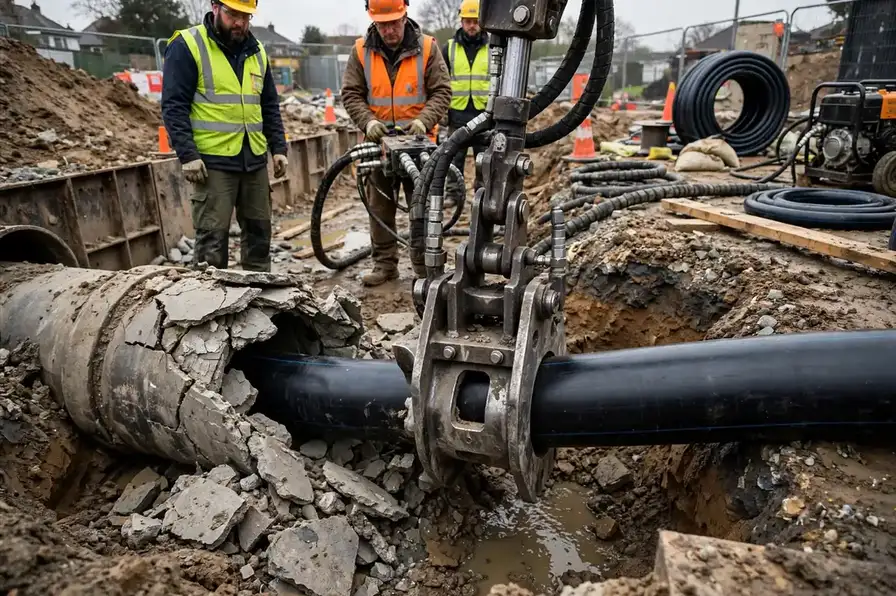
Step 3 — Cable and bursting head. A steel cable or rod string is threaded through the old pipe from the receiving pit to the launch pit and attached to the bursting head, with the new HDPE pipe fused into one continuous length behind it. Step 4 — The pull. The bursting rig draws the head steadily through the old line. The head fractures the existing pipe outward into the surrounding soil while the new pipe slides into the space it creates — old pipe out, new pipe in, in a single pass. Step 5 — Connections and verification. The new pipe is connected to the house system and the municipal main with proper fittings and couplings, the pits are backfilled in compacted lifts, and a camera runs the full length of the new line to verify grade, joints, and flow. Step 6 — Surface restoration. Pits are restored to match their surroundings — soil, seed, or patch paving — so the only evidence of the project is a sewer line that works. Homeowners comparing methods often ask about trenchless sewer repair generally; bursting is the trenchless option you choose when the old pipe is too far gone to line but the ground above must stay undisturbed.
Equipment and Materials
The bursting rig is the centerpiece — a hydraulic pulling unit sized to the pipe diameter and soil conditions, capable of drawing the bursting head and new pipe through runs of a hundred feet or more. Bursting heads come in styles matched to the host pipe: heads that split brittle clay and concrete, and heads that cut and expand through cast iron. Ahead of the head, a cable or rod string is winched through the old line; behind it, the replacement pipe follows. That replacement is high-density polyethylene (HDPE), fused into a single jointless length before the pull — no bell joints for roots to find, and a smooth interior that resists scale and grease adhesion.
Support equipment does the rest. Excavators open the launch and receiving pits; trench boxes or shoring protect the crew in deeper pits. Locators and sondes track the head's position and depth during the pull, confirming the new pipe follows the intended grade. Fusion equipment joins HDPE sections into one continuous pipe with joints as strong as the pipe wall itself. At the connections we use shielded couplings to join the new HDPE to the existing house plumbing and the city tap without creating a lip that catches debris. When bursting is not the right fit — a fully collapsed line with no path, or a run that needs regrading — we say so and propose sewer line replacement by open trench instead.
Safety and Precautions
Trenchless does not mean risk-free, and the safety plan reflects that. Every burst starts with utility mark-outs, because pulling a bursting head through a gas line or electric conduit would be catastrophic — we verify crossings by hand-dug potholing wherever the locator shows a close approach. Launch and receiving pits are treated as excavations: shored, sloped, or benched to the soil, with spoil piles kept back from the edge and ladders in any pit deeper than four feet. The pulling operation itself is fenced off, because a cable under tens of thousands of pounds of tension is not something to stand near.
Around the property, we take precautions specific to bursting. The head displaces soil outward as it fractures the old pipe, so we check for nearby structures, shallow foundations, and parallel utility lines that could feel the ground movement — in tight downtown Peabody lots, that survey matters. Vibration is monitored near older stone or block foundations. Homeowners are asked to keep water use to a minimum during the pull window, and the crew confirms the new line is connected and flowing before anyone resumes normal use. As with every project, call (833) 713-2101 if anything looks or smells wrong during the work; the crew lead would rather check a false alarm than miss a real one.
Peabody and North Shore Local Factors
Peabody is strong bursting territory for two reasons: old pipe and surfaces worth saving. The clay tile laterals under the older neighborhoods near Peabody Square and South Peabody are exactly the host pipes bursting handles well — brittle, root-invaded, but still tracing a clear path. Meanwhile the properties above them have mature landscaping, stone walls, and paved driveways that homeowners understandably want to keep. West Peabody's mid-century ranches add another pattern: long laterals running under front lawns and driveways to reach the street main, where open-trench replacement would mean tearing up fifty or more feet of finished yard.
The ground cooperates more often than not. Essex County glacial till is dense but burstable; the old clay shatters and the till absorbs the fragments. Ledge is the exception — where granite sits shallow, the head cannot displace rock, and the camera survey will catch that before anyone commits to the method. Frost depth matters for pit work in winter, and high seasonal groundwater near the brook corridors means pits get dewatered and backfill gets compacted in lifts so the new line holds its grade. For homeowners weighing options across the area, the same trenchless logic applies in neighboring towns — see how a pipe bursting project in Danvers 01923 handled a similar clay lateral under a finished driveway. Start from our home page to explore every service we offer.
Areas Served for This Service
Pipe Bursting in Beverly
Beverly, MA 01915.
Learn morePipe Bursting in Burlington
Burlington, MA 01803.
Learn morePipe Bursting in Danvers
Danvers, MA 01923.
Learn morePipe Bursting in Essex
Essex, MA 01929.
Learn morePipe Bursting in Gloucester
Gloucester, MA 01930.
Learn morePipe Bursting in Lynn
Lynn, MA 01902.
Learn morePipe Bursting in Lynnfield
Lynnfield, MA 01940.
Learn morePipe Bursting in Marblehead
Marblehead, MA 01945.
Learn morePipe Bursting in Melrose
Melrose, MA 02176.
Learn morePipe Bursting in Middleton
Middleton, MA 01949.
Learn morePipe Bursting in Nahant
Nahant, MA 01908.
Learn morePipe Bursting in North Reading
North Reading, MA 01864.
Learn morePipe Bursting in Reading
Reading, MA 01867.
Learn morePipe Bursting in Revere
Revere, MA 02151.
Learn morePipe Bursting in Salem
Salem, MA 01970.
Learn morePipe Bursting in Saugus
Saugus, MA 01906.
Learn morePipe Bursting in Stoneham
Stoneham, MA 02180.
Learn morePipe Bursting in Swampscott
Swampscott, MA 01907.
Learn morePipe Bursting in Tewksbury
Tewksbury, MA 01876.
Learn morePipe Bursting in Wakefield
Wakefield, MA 01880.
Learn morePipe Bursting in Wilmington
Wilmington, MA 01887.
Learn morePipe Bursting in Woburn
Woburn, MA 01801.
Learn more