
Warning Signs and Common Causes
Most homeowners call for a camera inspection after a pattern, not a single event. The drain that slows every few months and then clears. The basement floor drain that gurgles when the laundry runs. A sewage odor that comes and goes with no visible source. One clogged fixture is a branch problem; recurring trouble across multiple fixtures is a main-line problem, and the camera is how you find out which it is without digging. Inspections are also the standard first step before any repair method is chosen — lining, bursting, and spot repairs all depend on knowing the pipe's material, condition, and geometry.
There are scheduled reasons to inspect too. Buying an older Peabody home is the biggest one: a pre-purchase camera inspection reveals the clay or cast iron lateral's true condition before you inherit it, and the footage gives you leverage in negotiations or at least a repair budget with eyes open. After major landscaping, driveway work, or nearby construction, an inspection confirms the line survived the heavy equipment. And if you are planning an addition or a patio over the lateral's path, knowing exactly where the pipe runs — and what shape it is in — keeps the project from building over a future failure. The causes the camera typically finds in Peabody are the local usuals: root intrusion at clay joints, offset or separated joints from freeze-thaw soil movement, bellies where the ground has settled, scale and tuberculation inside aging cast iron, and the occasional surprise — a lost cleanout buried under a walkway, or a section of pipe that was never properly connected in the first place.
One more scenario deserves mention: mysterious odors with no backup. A cracked vent or a dried trap can mimic a sewer problem, but so can a broken lateral leaking gas into the soil around the foundation. The camera distinguishes between them in under an hour, which beats weeks of guessing.
Our Step-by-Step Process
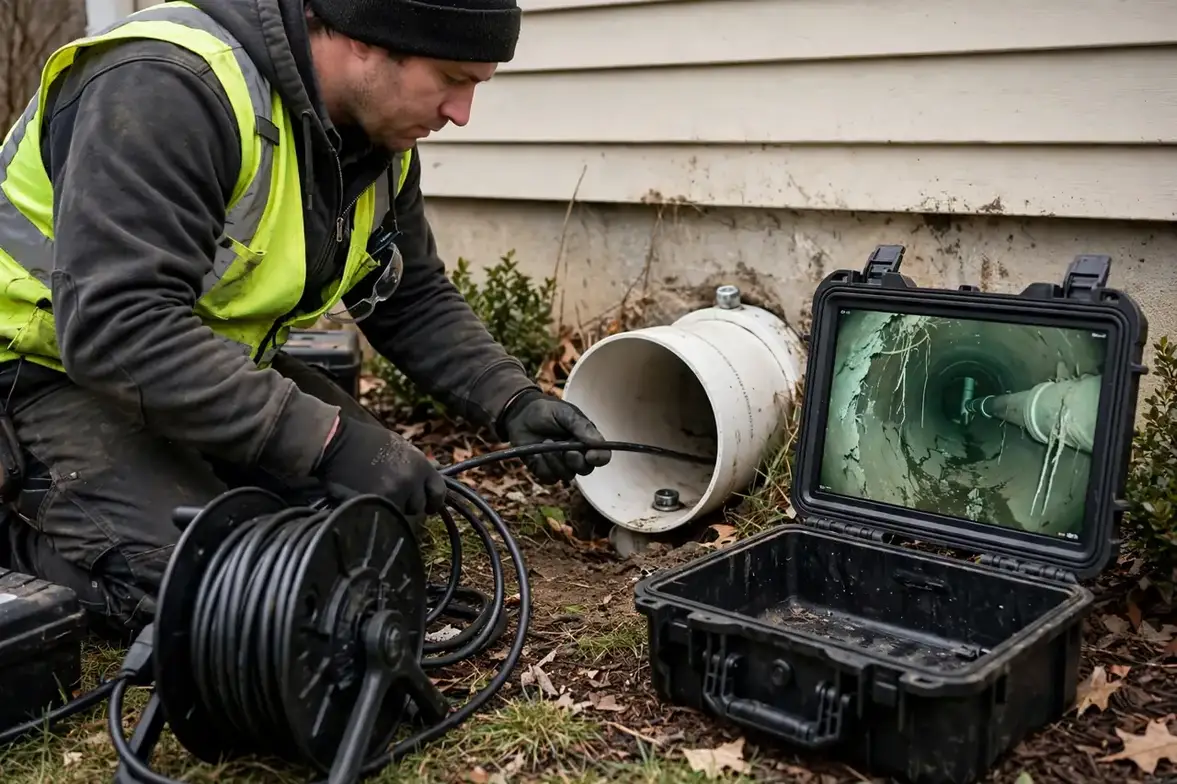
Step 1 — Access. We start at the most informative entry point, usually an exterior cleanout. If the property has no accessible cleanout, we can often run the camera through a pulled toilet or a roof vent — and we will tell you honestly when installing a proper cleanout first would give a better inspection. Step 2 — Camera run. The push camera travels the full lateral from the house to the municipal main, with a distance counter recording exactly how far down the line each observation sits. The self-leveling head keeps the picture upright so defects read correctly on screen, and we narrate what we see as we go.
Step 3 — Locate and depth. Wherever the camera finds something worth marking — a break, a root mass, a belly — we trace the camera head's sonde signal from above ground with a locator, marking the spot and reading its depth. This turns a video finding into a dig location accurate enough to excavate with confidence. Step 4 — Recording and report. The full run is recorded, and you receive the video file plus a written report: pipe material and diameter, total length, each defect with its distance mark and depth, and our plain-language recommendation. Step 5 — Next steps. The report ends with options, not a sales pitch. A line with light root intrusion gets a maintenance plan; a line with separated joints gets repair options with the trade-offs explained. If the line is healthy, we say so — an inspection that finds nothing wrong is still money well spent, because now you know.
The whole process typically takes under an hour for a residential lateral, and you are welcome to watch the monitor with the technician. Most homeowners find it genuinely interesting to see what their underground infrastructure actually looks like — and it makes the repair conversation concrete instead of abstract.
Equipment and Materials
The camera itself is a waterproof, self-leveling video head on a flexible push rod, sized for residential laterals from two inches up to the main. A built-in sonde transmits a signal the above-ground locator reads, giving us the pipe's path and depth without excavation. The distance counter on the reel ties every frame of video to a footage mark, so a crack at forty-two feet can be found again at forty-two feet. The monitor records in high definition, and the footage is saved as a digital file you keep.
For larger commercial mains we run crawler cameras — motorized units with pan-and-tilt heads that inspect lines too large or too long for a push rod. Locators handle both: tracing metallic pipe directly and tracing the sonde signal for non-metallic lines like clay, Orangeburg-style fiber, or PVC. Supporting gear includes cleanout keys and adapters for odd-sized access points, portable monitors for immediate viewing on site, and marking paint and flags to leave defect locations visible on the surface. When an inspection reveals damage needing repair, the same footage guides the fix — it is the diagnostic basis for our pipe lining and pipe bursting work, which is why we never propose trenchless repairs without it.
Safety and Precautions
Camera work is low-impact, but the precautions are real. Sealed cleanouts on a blocked line can be under pressure — the technician stands clear and opens them slowly, because a cap released under sewage pressure is a hazard. We never force a camera past a hard obstruction; pushing through a collapse or wedging the head in a root mass turns an inspection into a retrieval operation, so when the camera stops, we stop and report what the line allowed us to see. Roof vent access involves ladder work with standard fall precautions, and we will decline a vent entry that cannot be done safely.
For the homeowner, the main precaution is about expectations. A camera shows the pipe's interior condition — it does not see through the pipe wall, measure wall thickness, or detect leaks outside the pipe. If leak detection is the goal, the inspection pairs with sewer leak detection methods like smoke or dye testing. We also protect your property during the visit: drop cloths at interior access points, cleanout caps replaced and tightened, and any disturbed landscaping put back. If an inspection uncovers an active sewage leak or a collapse that threatens a backup, we tell you immediately and prioritize the follow-up — call (833) 713-2101 any time the findings cannot wait.
Peabody and North Shore Local Factors
Peabody's pipe stock makes camera inspection close to mandatory before any repair decision. The pre-war housing near Peabody Square and South Peabody carries vitrified clay laterals and cast iron of genuinely unknown condition — retrofitted, extended, and repaired piecemeal over generations. Assuming anything about those lines without looking is how repair projects go wrong. The camera routinely finds what the era predicts: root intrusion at every clay joint under the mature oaks and maples, offset joints where freeze-thaw has worked the soil, and cast iron interiors scaled nearly shut in the oldest runs.
Real-estate timing adds a local wrinkle. North Shore buyers are increasingly requesting sewer scopes as part of home inspections, and sellers who scope first control the narrative — a clean inspection report is a selling asset, and a report showing defects lets the seller address them on their own schedule instead of under closing pressure. Newer West Peabody subdivisions are less dramatic but not exempt: construction-era damage, buried cleanouts, and settlement bellies show up on camera in twenty-year-old lines too. Whatever the neighborhood, the inspection habit pays — a sewer camera inspection in Marblehead 01945 recently saved a buyer from inheriting a collapsed clay lateral, and the same one-hour visit protects Peabody buyers every week. See every town we serve on our areas page.
Areas Served for This Service
Sewer Camera Inspection in Beverly
Beverly, MA 01915.
Learn moreSewer Camera Inspection in Burlington
Burlington, MA 01803.
Learn moreSewer Camera Inspection in Danvers
Danvers, MA 01923.
Learn moreSewer Camera Inspection in Essex
Essex, MA 01929.
Learn moreSewer Camera Inspection in Gloucester
Gloucester, MA 01930.
Learn moreSewer Camera Inspection in Lynn
Lynn, MA 01902.
Learn moreSewer Camera Inspection in Lynnfield
Lynnfield, MA 01940.
Learn moreSewer Camera Inspection in Marblehead
Marblehead, MA 01945.
Learn moreSewer Camera Inspection in Melrose
Melrose, MA 02176.
Learn moreSewer Camera Inspection in Middleton
Middleton, MA 01949.
Learn moreSewer Camera Inspection in Nahant
Nahant, MA 01908.
Learn moreSewer Camera Inspection in North Reading
North Reading, MA 01864.
Learn moreSewer Camera Inspection in Reading
Reading, MA 01867.
Learn moreSewer Camera Inspection in Revere
Revere, MA 02151.
Learn moreSewer Camera Inspection in Salem
Salem, MA 01970.
Learn moreSewer Camera Inspection in Saugus
Saugus, MA 01906.
Learn moreSewer Camera Inspection in Stoneham
Stoneham, MA 02180.
Learn moreSewer Camera Inspection in Swampscott
Swampscott, MA 01907.
Learn moreSewer Camera Inspection in Tewksbury
Tewksbury, MA 01876.
Learn moreSewer Camera Inspection in Wakefield
Wakefield, MA 01880.
Learn moreSewer Camera Inspection in Wilmington
Wilmington, MA 01887.
Learn moreSewer Camera Inspection in Woburn
Woburn, MA 01801.
Learn more