
| ZIP | 01970 |
|---|---|
| Housing | 50.0% of units built 1939 or earlier; only 25.5% single-family detached. One of the greatest concentrations of pre-1900 domestic structures in the U.S. — the Samuel McIntire Historic District alone holds 407 buildings; 600+ in local historic districts, 1,000+ on the National Register. |
| Common pipe materials | Vitrified clay tile laterals typical in homes predating ~1930, with cast iron common at the building connection; PVC in post-war infill and 1980s–2000s renovations — typical for the era, never asserted per home. |
| Foundations | Pre-1900 homes in the historic districts typically sit on fieldstone/rubble-masonry or brick foundations with full basements; old masonry is porous, often with weeping-tile or footer drains tied into older combined sewers. Mid-century and newer: poured concrete or slab. |
| Soil & drainage | Glacial till and sandy glaciofluvial deposits over granite/gneiss bedrock. Low-lying coastal pockets have very poorly drained mucky soils with water tables at 0–12 inches. FEMA AE zones along the North River; VE coastal zones at Forest River, Waikiki Beach, Willows Pier, Dead Horse Beach, Collins Cove (maps revised July 2025). |
| Key routes/landmarks | Peabody Essex Museum; Salem Witch Museum; Salem Maritime National Historic Site (Custom House, Derby Wharf); Salem State University; Salem Common; Salem Willows Park. Corridors: Derby, Essex, Lafayette, Boston Streets; Washington Square. |
Salem, MA 01970: Historic Housing, Old Pipes, and Coastal Ground
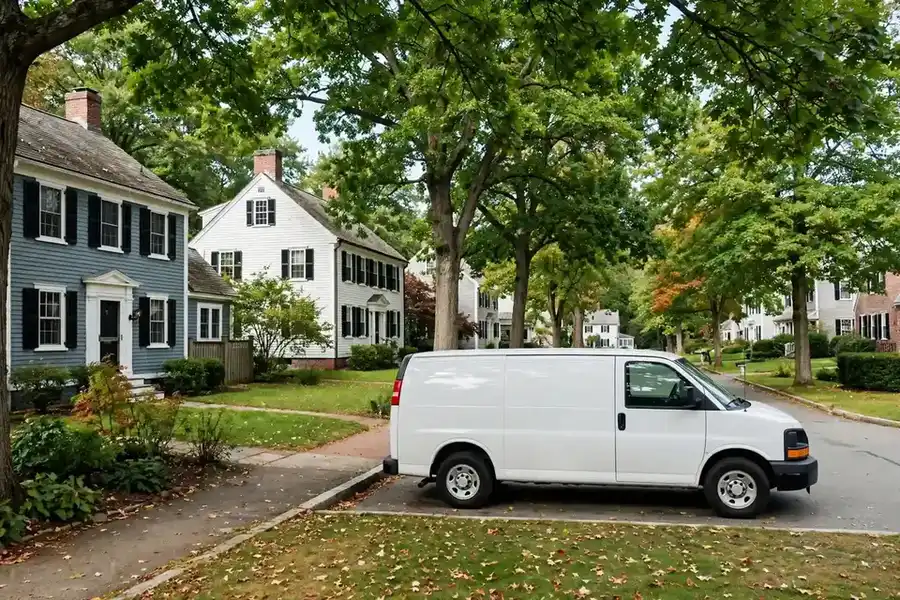
Salem is the highest-complexity market in this service area, and the numbers explain why. Half of all housing units — 50.0% — were built in 1939 or earlier, and the city's own housing profile puts 56% of units in buildings predating 1939. Only 25.5% of homes are single-family detached; 16.1% sit in large apartment buildings. Salem holds one of the greatest concentrations of pre-1900 domestic structures in the United States: the Samuel McIntire Historic District alone contains 407 buildings in Federal, Georgian, Greek-revival, and Colonial-revival styles, joined by the Chestnut Street District and the Salem Common Historic District — 600-plus buildings in local historic districts and more than 1,000 on the National Register, according to Historic Salem, Inc. The primary delivery ZIP is 01970 in Essex County (01971 is PO Box–only). Repair crews here routinely work under landmarked streetscapes where preservation matters as much as plumbing.
The pipes match the architecture's age. In homes predating about 1930, vitrified clay tile laterals are typical for the era, with cast iron common at the building connection; post-war infill and 1980s–2000s renovations typically use PVC. Foundations in the pre-1900 historic-district homes are typically fieldstone or rubble masonry, or brick, with full basements — and that old masonry is porous, often with weeping-tile or footer drains tied into older combined sewers, which means the foundation drainage and the sewer lateral have been interacting for a century. Mid-century and newer construction uses poured concrete foundations or slab-on-grade. So the dominant Salem service picture is a century-old clay lateral leaving a porous stone foundation under a landmarked street — the exact situation where trenchless or spot-repair methods are often mandatory to preserve historic sidewalks and streets.
The ground and water complete the complexity. Essex County soils are glacial till and sandy glaciofluvial deposits over granite and gneiss bedrock, but Salem's low-lying coastal pockets carry very poorly drained mucky soils with water tables at 0 to 12 inches — essentially at the surface. Flood exposure is significant and mapped: FEMA designates AE zones along the North River and VE high-risk coastal zones at Forest River, Waikiki Beach, Willows Pier, Dead Horse Beach, and Collins Cove, with revised maps effective July 2025. Two tidal rivers — the Forest River and the South River — increase inland flood risk and sea-level-rise pressure near Salem State. Weather is the New England coastal pattern: powerful fall and winter nor'easters drive coastal flooding and heavy surf, freeze–thaw cycles and ground frost shift soil and stress old laterals each winter, and spring snowmelt and rain saturate soils and raise water tables. Orientation corridors confirmed in sources include Derby Street, Essex Street, Lafayette Street, Boston Street, and Washington Square, with landmarks from the Peabody Essex Museum and Salem Witch Museum to the Salem Maritime National Historic Site's Custom House and Derby Wharf, Salem State University, Salem Common, and Salem Willows Park.
How Sewer Services Work in Salem, MA 01970
Salem jobs are planned around three constraints at once — historic fabric, old pipe, and coastal water — and the sewer camera inspection is what reconciles them. Run from a cleanout or a pulled toilet and reviewed together on video, the inspection maps every defect by depth and distance: root masses at clay joints, offset hubs, cracked sections, bellies, and collapsed runs. But in Salem the footage is read with two extra lenses. First, the preservation lens: where exactly does the lateral run under historic sidewalks, granite curbing, or landmarked streetscapes, so the repair method can avoid disturbing them? Second, the water lens: is infiltration entering through cracked joints — the dominant failure mode where porous fieldstone foundations meet high coastal water tables — and are tidal influences visible? Access itself is slower here than in the suburbs: narrow historic-district streets, condos carved from old single-family homes, and dense urban blocks (15.7% of households have no vehicle) complicate equipment staging and camera routing, so the inspection doubles as the access survey.
The method decision in Salem defaults trenchless for reasons both practical and civic. Century-old clay laterals under Federal- and Georgian-era streetscapes make open-trench replacement a preservation problem as well as a plumbing one — trenchless sewer repair renews the line through small access points, leaving historic sidewalks, curbing, and street trees intact. Cured-in-place lining creates a continuous watertight pipe-within-a-pipe that seals every root-entry joint and every infiltration crack in one pass; where the pipe has lost its shape, pipe bursting pulls a new line through the old alignment. That watertightness is doing double duty in Salem: it stops root intrusion and it stops the groundwater infiltration that plagues cracked clay near the Forest and South Rivers and the waterfront VE zones. The standard sequence on the historic stock is tree root removal to clear the line, camera re-check, then lining or bursting — clearing alone just rents the problem another year.
The foundation factor deserves its own attention because Salem's old masonry changes the diagnostic. Porous fieldstone and rubble foundations with weeping-tile or footer drains tied into older combined sewers mean basement dampness can come from the foundation drainage, the lateral, or both — and the camera inspection plus a careful site read distinguishes them. A damp basement with a sound lateral is a waterproofing conversation, not a sewer replacement; a damp basement with a cracked clay lateral taking in groundwater is a lining candidate whose watertight renewal solves both the infiltration and the dampness contribution. Technicians in the historic districts also plan for what the camera cannot see from inside the pipe: the cast-iron building connection at the foundation wall, the transition most likely to be corroded after a century of coastal exposure, gets its own assessment.
Storm response rounds out the Salem scope. Winter nor'easters and sea-level rise periodically flood low-lying basements, producing surge-related backup calls — and in the FEMA-mapped AE and VE zones, a sewer line replacement or pipe bursting scope routinely includes the backwater-valve conversation: the valve that keeps a surcharged, storm-driven system from pushing sewage back into the house. Emergency calls cluster around the same nor'easters that flood the waterfront, which is why emergency sewer repair readiness is part of the standard Salem offering. Every scope here balances the three constraints — preserve the streetscape, renew the century-old pipe, defeat the coastal water — and the camera footage is what lets all three be addressed in a single project.
Warning Signs Your Salem 01970 Lateral Is Failing
In Salem, the warning signs sort by neighborhood as much as by symptom. In the historic districts — McIntire, Chestnut Street, Salem Common — the classic signal is the recurring backup on root regrowth's 12-to-18-month rhythm through century-old clay joints, with the interval shortening as the mass thickens. Gurgling fixtures, slow drains across multiple fixtures, and sewage odors from basement floor drains point lateral-ward. But here the porous fieldstone foundation adds a confounding symptom: basement dampness that may come from the foundation drainage, the lateral, or both. Dampness that tracks storms and tides leans lateral and groundwater; dampness constant regardless of weather leans foundation drainage — and the camera inspection is what separates a waterproofing job from a sewer lining job before money is spent on the wrong one.
Near the Forest River, South River, and the waterfront VE zones — Forest River, Waikiki Beach, Willows Pier, Dead Horse Beach, Collins Cove — watch for the coastal symptom set: backups that worsen after nor'easters or during high-water periods, sewage odors intensifying after storms, and basement flooding that arrives with the weather rather than with fixture use. Those patterns describe infiltration and tidal influence entering through failed clay joints, the dominant failure mode where high coastal water tables meet century-old pipe. In the low-lying pockets with mucky soils and water tables at 0 to 12 inches, even a sound-looking line deserves suspicion: groundwater is not a seasonal visitor here, it is a permanent neighbor.
The condo factor adds a third watch list. With only a quarter of Salem homes single-family detached and many condos carved from old single-family houses, shared laterals serve multiple units through one aging clay line — and backups that strike during peak-use hours point to capacity as well as condition. For condo associations, the warning signs are collective: recurring issues across units, shared basement dampness, and cleanout locations nobody can find because they predate the conversion. A camera inspection that maps the full shared lateral — and finds its cleanouts — is the document a condo board needs before it can scope, bid, or assess any repair. And the seasonal rule: inspect in the calm season, repair before the nor'easter season, because surge-related emergencies in the flood zones are the most expensive way to discover a failed lateral.
From First Call to Finished Line in 01970
The first step is a call to Sewer Line Repair Works at (833) 713-2101. Mention your neighborhood — a McIntire-district Federal, a condo conversion downtown, a home near the Forest River or the Willows — because the historic, water-table, and access context shapes the crew's planning from the start. Describe the symptoms and their timing: recurring, storm-linked, tide-linked, or constant. For condos, note the unit count and whether issues are building-wide; shared laterals change the diagnostic. If sewage is actively backing into the building, say so; that qualifies for emergency dispatch, with crews prepared for narrow-street staging and saturated coastal ground.
On site, the technician runs the camera inspection first and reviews the footage with you, marking each defect's position and depth — including where the lateral passes under historic sidewalks or streetscapes and where infiltration is entering. The options conversation in Salem is built around the three constraints: a century-old clay run under a landmarked street is a textbook lining candidate, renewing the pipe with no disturbance to the historic fabric; a collapsed section may need pipe bursting through the existing alignment; a flood-zone lateral with chronic infiltration gets scoped for watertight renewal plus a backwater-valve recommendation. Access planning — narrow streets, limited staging, condo coordination — is part of the written scope, not an afterthought.
On work day, the crew stages compactly, works from small access points or existing cleanouts, and keeps excavation minimal — a preservation necessity in the historic districts and a practical one on Salem's dense blocks. The job closes with a final camera pass verifying the finished, watertight line on video and the site — sidewalks, curbing, landscaping — restored as found. Before leaving, the technician walks you through what was found, what was fixed, and the maintenance that fits a historic coastal line: periodic camera checks after major storm seasons, root management where lines pass under street trees, backwater-valve testing before nor'easter season, and — for the porous-foundation homes — keeping the foundation drainage and the renewed lateral understood as two separate systems. A Salem lateral carries a century of history; the repair should respect it and outlast it.
Services in This Area
Commercial Sewer Services in Salem
Salem, MA 01970.
Learn moreEmergency Sewer Repair in Salem
Salem, MA 01970.
Learn morePipe Bursting in Salem
Salem, MA 01970.
Learn morePipe Lining (CIPP) in Salem
Salem, MA 01970.
Learn moreSewer Camera Inspection in Salem
Salem, MA 01970.
Learn moreSewer Leak Detection in Salem
Salem, MA 01970.
Learn moreSewer Line Cleaning in Salem
Salem, MA 01970.
Learn moreSewer Line Installation in Salem
Salem, MA 01970.
Learn moreSewer Line Replacement in Salem
Salem, MA 01970.
Learn moreSewer Maintenance in Salem
Salem, MA 01970.
Learn moreTree Root Removal in Salem
Salem, MA 01970.
Learn moreTrenchless Sewer Repair in Salem
Salem, MA 01970.
Learn more