
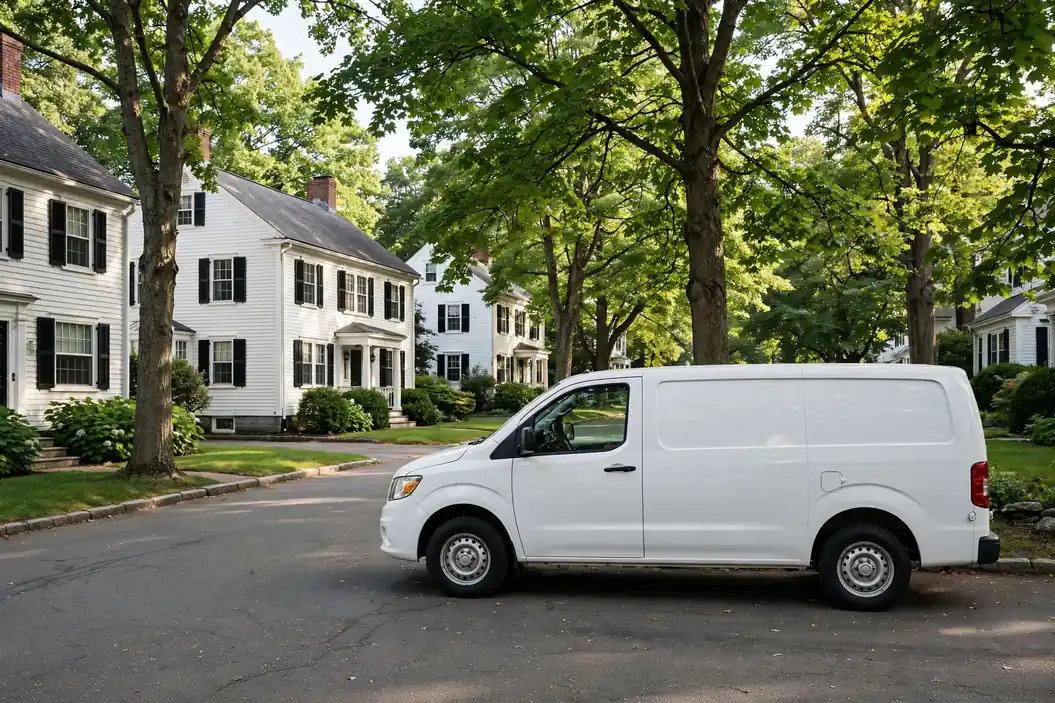
| ZIP | 01940 |
|---|---|
| Housing | Median year built 1960; median lot about 24,000 sq ft. Developed chiefly in the late 1950s–1970s as a post–Route 128 suburb — it had the highest growth rate of any Bay State community 1951–1953. Predominantly single-family Colonials, raised ranches, and split-levels on generous lots. Older pockets: South Lynnfield turn-of-the-century four-squares, Colonial Revivals, Dutch Colonials, and Tudors; scattered First Period survivors (Henfield House c.1700; Hart House c.1695). |
| Common pipe materials | Typical for the era: cast-iron main stacks with vitrified clay laterals for 1950s–60s builds; PVC/ABS becoming common from the late 1970s onward. Older South Lynnfield homes may still have original clay tile. In the handful of 17th–18th-century homes, below-grade waste piping is the product of later (typically mid-20th-century) retrofits. |
| Foundations | Typical for the era: full poured-concrete basements dominate the 1950s–70s stock; split-levels frequently combine slab sections with basement sections; older homes range from stone rubble to block. |
| Soil & drainage | Glacial-till uplands with bedrock near the surface in places, typical of the Lynnfield escarpment area. Drainage flows to tributaries of the Saugus and Ipswich River systems. Large lots and mature tree cover mean long laterals threading through root zones. |
| Key routes/landmarks | Route 128 and Route 1 — the town's defining highways (the suburb's growth 'coincided conveniently with the opening of Route 128'); MarketStreet Lynnfield, the major outdoor shopping center in the 01940 ZIP; Lynnfield High School. 'South Lynnfield' is listed as NOT ACCEPTABLE by USPS. |
Lynnfield, MA 01940: Housing, Pipes, and Soil Facts
Lynnfield, MA 01940 is the post–Route 128 suburb in its purest form: developed chiefly in the late 1950s through the 1970s, with the highest growth rate of any Bay State community from 1951 to 1953, and the town kept building for two more decades. The median year built is 1960, the median lot is about 24,000 square feet, and the stock is predominantly single-family Colonials, raised ranches, and split-levels on generous, tree-lined lots. Older pockets survive — South Lynnfield's turn-of-the-century four-squares, Colonial Revivals, Dutch Colonials, and Tudors, plus scattered First Period survivors like the Henfield House (c. 1700) and the Hart House (c. 1695).
Underground, the 01940 ZIP is defined by its 1950s–60s cohort: cast-iron main stacks with vitrified clay laterals, typical for the era, with PVC and ABS becoming common from the late 1970s onward. Older South Lynnfield homes may still carry original clay tile, and in the handful of 17th-and-18th-century homes the below-grade waste piping is the product of later — typically mid-20th-century — retrofits. Full poured-concrete basements dominate the 1950s–70s stock, with split-levels frequently combining slab sections with basement sections.
The town's defining highways are Route 128 and Route 1 — the suburb's growth, as one local account puts it, 'coincided conveniently with the opening of Route 128' — with MarketStreet Lynnfield as the major outdoor shopping center in the 01940 ZIP and Lynnfield High School anchoring the school district. One addressing note: 'South Lynnfield' is listed as NOT ACCEPTABLE by USPS, so the whole town addresses as Lynnfield, MA 01940 — a single ZIP for the entire service area.
How Sewer Services Work in Lynnfield
Lynnfield sewer work typically targets 1950s–60s cast-iron-plus-clay systems reaching end of life simultaneously — a full subdivision cohort aging out together, so cluster failures by street are common. When one Colonial's clay lateral fails on a 1962 street, its neighbors were installed the same year under the same mature trees, and they are usually not far behind. Our sewer camera inspection in Lynnfield 01940 is the first step on every job: it documents the joints, roots, and transitions on HD video so the repair plan matches the line's real condition.
The large lots change the job geometry. Laterals here are often 60 to 100+ feet from the house to the curb, frequently running under mature shade trees — and root intrusion at clay joints under driveways and lawns is the signature Lynnfield failure. That length makes video-camera inspection and trenchless lining especially valuable: open trenches would destroy expensive landscaping and long paved driveways, while pipe lining in Lynnfield 01940 renews the line from small access points and leaves the yard intact.
Basement construction shapes the interior side of the work. Basements are typically deep and finished, so failed house connections and cast-iron stack transitions under basement slabs call for interior access planning — and for pipe-bursting or epoxy lining rather than tearing up finished floors. We plan the interior access path before quoting, because a repair that requires demolishing a finished basement is a different job than one that does not.
Route 128 corridor lots add one more variable: many Lynnfield homes near the highway sit on fill or regraded ground from the suburb's rapid 1950s–70s development, and fill settles differently than native till. A lateral bedded in old fill can develop bellies where the fill compacted unevenly — another reason the camera pass measures slope, not just condition. If your home sits on a regraded lot near Route 128 or Route 1, mention it when you call; it tells us to read the slope data closely.
Pipe Materials Under Lynnfield Homes, by Era
The 1950s–60s core — most of Lynnfield — typically runs cast-iron main stacks with vitrified clay laterals. The clay joints are the known weak point: decades of freeze-thaw heave have offset them, roots from the town's mature tree cover have entered at every compromised joint, and the cast-iron stacks show the scale and tuberculation of 60-plus years. This is the cohort-aging-out-together stock, and the camera routinely finds the same pattern house after house on a street.
From the late 1970s onward, PVC and ABS become common — in the later subdivisions and in replacement work. These materials resist root entry and joint shifting far better, but the long Lynnfield runs still deserve a look where symptoms appear: a misaligned connection at the foundation wall or a poorly bedded joint under a 90-foot run fails regardless of material. Older South Lynnfield homes may still have original clay tile from the turn-of-the-century era, which at 100+ years is well past realistic service life.
In the handful of 17th-and-18th-century homes — the Henfield and Hart houses and their peers — any below-grade waste piping is the product of later retrofits, typically mid-20th-century. There is no era assumption to lean on; camera first, and the repair plan follows whatever the footage shows.
Soil, Water Table, and Drainage in Lynnfield
Lynnfield sits on glacial-till uplands with bedrock near the surface in places — typical of the Lynnfield escarpment area. That near-surface rock matters for excavation: trenching can encounter ledge unexpectedly, which is one more reason trenchless methods earn their keep here. Drainage flows to tributaries of the Saugus and Ipswich River systems, and the working assumption for low terrain near those corridors is the usual seasonal high water table.
The defining soil fact for sewer work in the 01940 ZIP, though, is not the till — it is the trees. Large lots and mature tree cover mean long laterals threading through root zones for 60 to 100+ feet, and mature street trees are a major seasonal root-growth factor. Every clay joint along that run is a potential root entry point, and the roots have had six decades to find them. This is why the Lynnfield camera inspection covers the full run to the curb, not just the first 30 feet.
Weather adds the surface-water dimension. New England freeze-thaw heave works the clay joints; nor'easters and spring melt saturate the ground; and the big flat yards that define Lynnfield lots can shed heavy storm runoff toward low basements. Where grading sends runoff toward the foundation, the basement takes water from above while the lateral struggles below — and both problems deserve attention in the same visit.
Common Sewer Line Problems We See in Lynnfield
Root intrusion along long clay runs is the Lynnfield signature. Sixty-to-100-foot laterals threading through mature root zones, with clay joints offset by decades of frost heave — the result is the classic progression of slowing drains, gurgling, and recurring clogs that snaking clears only temporarily. Our tree root removal in Lynnfield 01940 service cuts roots on camera across the full run, then seals or lines the entry joints so the next growing season does not simply repeat the cycle.
Cluster failures by street are the second pattern — really a neighborhood-level version of the first. When a subdivision cohort ages out together, we see the same clay-joint failure on house after house along a street. If a neighbor just had their lateral lined or replaced, that is actionable intelligence: your line was installed the same year under the same trees. A preventive camera check costs far less than an emergency excavation through your driveway.
Failed house connections and stack transitions under finished basements form the third pattern. Deep, finished basements mean the cast-iron-to-lateral transition and the stack base sit under finished floors — and when those transitions fail, the backup appears at the lowest fixture with finished space all around it. Interior access planning, pipe-bursting, or epoxy lining keeps the repair from becoming a basement demolition project.
Trenchless vs. Traditional Sewer Repair in Lynnfield
Trenchless methods are the natural fit for Lynnfield's lots. Cured-in-place lining renews a 60-to-100-foot lateral from small access pits — no trench through the mature landscaping, no excavation under the long paved driveway, no torn-up lawn. Pipe bursting replaces the old clay entirely along its existing path where the line has lost structural integrity. Both methods sidestep the near-surface bedrock that can surprise an open trench on the Lynnfield escarpment, and both keep the job compatible with the finished basements these homes are built around.
Open-cut replacement still earns its place for collapsed sections, severe bellies needing regrade, and lines whose condition no trenchless method can track. But on a 24,000-square-foot lot with mature trees and a 90-foot paved driveway, the collateral damage of a continuous trench — landscaping, driveway, restoration — is often the largest line item after the pipe itself. We quote that restoration honestly so the trenchless comparison is apples to apples.
Our Lynnfield estimating sequence: full-run camera to the curb, measurement of the actual lateral length, interior access planning for the basement transitions, then the method that fits all three. Call (833) 713-2101 — and if a neighbor on your street just had sewer work done, mention it; the cluster pattern means your block's history is genuinely predictive.
Services in This Area
Commercial Sewer Services in Lynnfield
Lynnfield, MA 01940.
Learn moreEmergency Sewer Repair in Lynnfield
Lynnfield, MA 01940.
Learn morePipe Bursting in Lynnfield
Lynnfield, MA 01940.
Learn morePipe Lining (CIPP) in Lynnfield
Lynnfield, MA 01940.
Learn moreSewer Camera Inspection in Lynnfield
Lynnfield, MA 01940.
Learn moreSewer Leak Detection in Lynnfield
Lynnfield, MA 01940.
Learn moreSewer Line Cleaning in Lynnfield
Lynnfield, MA 01940.
Learn moreSewer Line Installation in Lynnfield
Lynnfield, MA 01940.
Learn moreSewer Line Replacement in Lynnfield
Lynnfield, MA 01940.
Learn moreSewer Maintenance in Lynnfield
Lynnfield, MA 01940.
Learn moreTree Root Removal in Lynnfield
Lynnfield, MA 01940.
Learn moreTrenchless Sewer Repair in Lynnfield
Lynnfield, MA 01940.
Learn more