
| ZIP | 01902 |
|---|---|
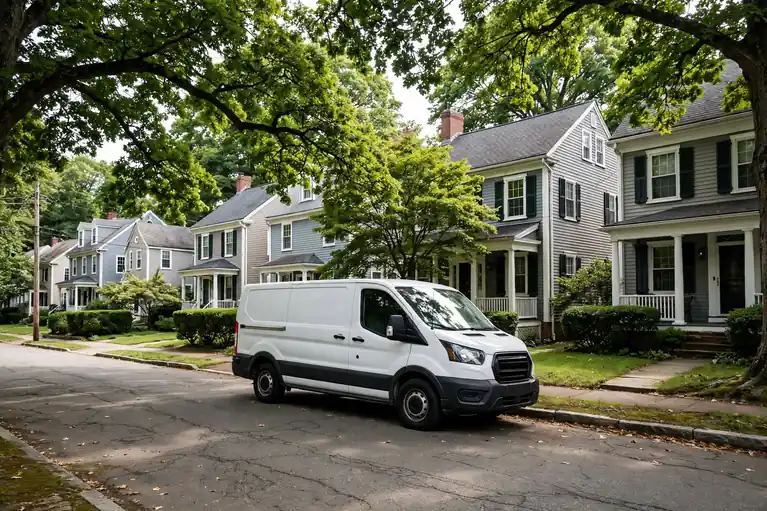
| Housing | Median year built 1925 citywide; the Lynn English neighborhood median is 1910, downtown 1924. Dense stock: two- and three-family houses, workers' cottages, and multifamily walk-ups from the 1850–1920 shoe-factory boom, plus 1889-rebuild-era large brick blocks; the Diamond District holds larger suburban-style homes along the shore; some recent townhome construction (Birch Brook area). Lynn grew as the 'shoe center of the country' with 450% population growth 1860–1910; GE later became the dominant employer. |
| Common pipe materials | Typical for the era: vitrified clay (clay tile) laterals and cast-iron interior stacks in pre-1940 homes; later 20th-century replacements commonly cast iron and early PVC/ABS. Clay-tile joints from this era are the classic failure point — they shift, crack, and admit roots. |
| Foundations | Typical for the era: full basements with stone/rubble or concrete-block walls in the oldest homes; poured-concrete basements in early–mid 20th-century builds. |
| Soil & drainage | 'Rocky coastal soils' historically difficult to farm; glacial-till uplands typical of coastal Essex County. Coastal neighborhoods (Lynn Shore Drive corridor) sit at low elevation with exposure to coastal storm surge flooding and a high seasonal water table near the harbor. |
| Key routes/landmarks | Lynn Woods Reservation, High Rock Reservation, and Lynn Shore Drive — the city's three major historic open spaces; Central Square / Market Street commercial core with the MBTA commuter rail station; Lynn English neighborhood (median build 1910). |
Lynn, MA 01902: Housing, Pipes, and Soil Facts
Lynn, MA 01902 is one of the oldest urban housing stocks on the North Shore, and its sewer lines have the mileage to prove it. The citywide median year built is 1925; in the Lynn English neighborhood the median is 1910, and downtown it is 1924. The stock is dense and working-class in origin: two- and three-family houses, workers' cottages, and multifamily walk-ups from the 1850–1920 shoe-factory boom — Lynn grew as the 'shoe center of the country' with 450% population growth between 1860 and 1910 — plus the large brick blocks of the 1889 rebuild era. The Diamond District holds larger suburban-style homes along the shore, and GE's long tenure as the dominant employer shaped whole neighborhoods of company-era housing.
Underground, the 01902 ZIP is clay-tile country. Pre-1940 homes typically carry vitrified clay laterals with cast-iron interior stacks, and the clay-tile joints from this era are the classic failure point — they shift, crack, and admit roots after a century of freeze-thaw movement. Later 20th-century replacements commonly run cast iron and early PVC or ABS. Foundations are full basements with stone, rubble, or concrete-block walls in the oldest homes, and poured concrete in early-to-mid-20th-century builds.
The city's three major historic open spaces — Lynn Woods Reservation, High Rock Reservation, and Lynn Shore Drive — frame the 01902 service area, with the Central Square/Market Street commercial core and its MBTA commuter rail station anchoring downtown. Lynn as a whole also uses 01901, 01904, and 01905, but 01902 covers the dense historic core where the oldest laterals live.
How Sewer Services Work in Lynn
In Lynn, sewer-line repair work most often means replacing or lining original clay-tile laterals under dense triple-decker and two-family lots — in neighborhoods like Lynn English and downtown, where the median build year runs 1910 to 1924 and the joints have had a century of freeze-thaw movement and root intrusion. Our sewer camera inspection in Lynn 01902 is the mandatory first step: it documents every offset joint, root mass, and cracked hub on HD video, because a line this old cannot be quoted from the surface.
Digging is tight in the 01902 ZIP, and that changes the economics. Small lots, narrow side yards, and shared driveways frequently push the math toward trenchless lining or point repair rather than full open-trench replacement — there is often simply no room to stage an excavator without tearing up a neighbor's property line. Trenchless sewer repair in Lynn 01902 renews the lateral from small access pits, which fits the triple-decker lot the way open trenching does not.
Coastal pockets near Lynn Shore Drive add a second layer: high groundwater and corrosive, salt-influenced soil conditions. Technicians here expect saturated trenches, rapid infiltration during storms, and corroded cast-iron house connections — and shallow cover over old lines near the shore makes these laterals especially vulnerable to damage from surface traffic and landscaping equipment. On shore-side streets we pair the camera pass with an infiltration check and a corrosion look at the cast-iron transitions.
Pipe Materials Under Lynn Homes, by Era
The pre-1940 bulk of Lynn — the triple-deckers, two-families, workers' cottages, and walk-ups — typically runs vitrified clay laterals with cast-iron interior stacks. The clay-tile joints are the defining vulnerability: a century of frost heave has shifted them, cracks have opened, and roots have entered at every compromised joint. Inside, the cast-iron stacks show scale, tuberculation, and roughened interiors that snag waste. This is the stock where 'camera first' is not a slogan but the only sane estimating method.
Later 20th-century replacements and repairs commonly run cast iron and early PVC or ABS — often installed piecemeal as sections of the original clay failed over the decades. Those piecemeal transitions are worth finding on camera: a clay-to-PVC or clay-to-cast-iron coupling from a 1970s spot repair is a classic separation point today. The camera pass maps every material transition so the repair plan addresses the actual weak points, not just the visibly blocked section.
Near Lynn Shore Drive and the harbor, add corrosion to the assessment. Salt-influenced soils and a high seasonal water table accelerate exterior corrosion of aging cast iron, and shallow cover leaves old lines exposed to surface damage. If your Lynn home sits on a low coastal street, mention it when you call (833) 713-2101 so we build the corrosion and infiltration checks into the inspection.
Soil, Water Table, and Drainage in Lynn
Lynn's soils are the 'rocky coastal soils' that were historically difficult to farm — glacial-till uplands typical of coastal Essex County. On the upland streets this means competent digging with the usual till challenges; the drainage story that matters for sewers, though, is the coastal one. The Lynn Shore Drive corridor and harbor neighborhoods sit at low elevation with exposure to coastal storm surge flooding and a high seasonal water table near the harbor.
That high water table is the quiet force behind Lynn's infiltration problems. Cracked clay joints below the water table admit groundwater continuously — and in the dense 01902 core, where laterals run under small lots with minimal cover, infiltration shows up fast as chronic dampness, floor-drain seepage, and backups that worsen after storms. Rapid infiltration during nor'easters can overwhelm a compromised lateral in hours, not days.
The weather pattern is classic New England: freeze-thaw cycles with frost heave shifting old clay joints, nor'easter-driven coastal flooding, and spring snowmelt raising the water table and infiltrating cracked laterals. Each cycle compounds the last — heave opens joints, meltwater enters, roots follow — which is why a Lynn lateral that 'was fine last year' can become an emergency this spring.
The 1889 rebuild era left its own underground legacy. The large brick blocks built after the fire often share party-wall foundations and closely spaced laterals, so a failing line on one side of a block can affect — and be affected by — its neighbors' lines. On these blocks we camera with an eye on the shared geometry: knowing where your lateral runs relative to the adjoining building's line prevents a repair on one property from undermining the next, and it explains why whole blocks sometimes schedule work in the same season.
Common Sewer Line Problems We See in Lynn
Century-old clay joints with root intrusion are the defining Lynn call. In Lynn English and downtown — median build 1910 to 1924 — the joints have had a hundred years of freeze-thaw movement, and mature street trees have had a hundred years to find them. The progression is familiar: slow drains across fixtures, gurgling, clogs that return faster after each clearing. Our tree root removal in Lynn 01902 service cuts roots on camera and then addresses the entry points — because cutting without sealing just schedules the next visit.
Multi-unit loading is the second Lynn pattern. Two- and three-family houses put two to three times the fixture load on laterals sized for a single family a century ago, and converted walk-ups add grease and solids loading the original clay was never designed for. Where the camera shows an intact but undersized or grease-compromised line, we plan for capacity alongside condition — an upsized replacement at the right time beats a same-diameter fix that inherits the overload.
Shore-side infiltration and corrosion complete the picture. Saturated trenches, rapid storm infiltration, corroded cast-iron house connections, and shallow-cover damage from surface traffic and landscaping equipment are the coastal-street realities. On these streets the camera pass includes an infiltration assessment and a close look at every cast-iron transition — the two failure points the upland streets do not share.
Trenchless vs. Traditional Sewer Repair in Lynn
In Lynn's dense 01902 core, trenchless methods win on access alone. Small lots, narrow side yards, and shared driveways leave no room for open-trench staging — but cured-in-place lining needs only small access pits, and pipe bursting replaces the line along its existing path without a continuous trench. For triple-decker and two-family lots where three households share one narrow parcel, trenchless is often the only method that does not require negotiating access across property lines. It also keeps the disruption compatible with tenants: no open trench through the only yard three families share.
Open-cut replacement still has its place where the camera shows collapse, severe bellies needing regrade, or a lateral so compromised that no trenchless method can track it. Near the shore, though, open trenches mean saturated digging and dewatering — and shallow cover means the excavation itself risks the remaining old pipe. We price those realities explicitly rather than discovering them mid-job.
The Lynn rule on every estimate: camera first, infiltration and corrosion checks on shore-side streets, then the method that fits the lot's real constraints. If your street is all triple-deckers with no side-yard access, say so when you call (833) 713-2101 — it tells us the trenchless plan before we arrive.
Services in This Area
Commercial Sewer Services in Lynn
Lynn, MA 01902.
Learn moreEmergency Sewer Repair in Lynn
Lynn, MA 01902.
Learn morePipe Bursting in Lynn
Lynn, MA 01902.
Learn morePipe Lining (CIPP) in Lynn
Lynn, MA 01902.
Learn moreSewer Camera Inspection in Lynn
Lynn, MA 01902.
Learn moreSewer Leak Detection in Lynn
Lynn, MA 01902.
Learn moreSewer Line Cleaning in Lynn
Lynn, MA 01902.
Learn moreSewer Line Installation in Lynn
Lynn, MA 01902.
Learn moreSewer Line Replacement in Lynn
Lynn, MA 01902.
Learn moreSewer Maintenance in Lynn
Lynn, MA 01902.
Learn moreTree Root Removal in Lynn
Lynn, MA 01902.
Learn moreTrenchless Sewer Repair in Lynn
Lynn, MA 01902.
Learn more