
Warning Signs and Common Causes
Sewer leaks are quieter than backups, which is what makes them expensive. The classic outdoor sign is a patch of yard that stays soggy long after rain, or a strip of grass that grows faster and greener than everything around it — wastewater is fertilizer, and the lawn knows it before you do. In dry spells the contrast is even sharper: one lush green band crossing an otherwise brown lawn usually traces the leaking lateral. Other signs: a persistent sewage or musty odor near the foundation, around a cleanout, or in the basement; new settlement or a soft spot over the pipe's path; an uptick in flies or rodents near one area of the yard; and dampness or staining on a basement wall that does not match any plumbing fixture above it.
Inside, the signs are subtler. Mold or mildew recurring on a basement wall despite dehumidification can trace to a leaking lateral saturating the soil against the foundation. A floor drain that smells even when traps are full, or gurgling that appears without any fixture running, can mean a cracked pipe is admitting soil and air. The causes behind these leaks are the North Shore standards: cracked vitrified clay from freeze-thaw movement, joints separated by soil settlement, root intrusions that start as hairline entries and wedge into full breaks, and cast iron corroded through at its low points. Heavy equipment — a delivery truck cutting across the lawn, or excavation for a patio — can crack a shallow line in a single afternoon. One important clarification: a sewer leak will not raise your water bill. If your water bill spikes with no visible leak, that is a supply-side problem, not a sewer problem — but if the yard is soggy and the bill is normal, the sewer lateral is the prime suspect.
Leaks also invite company. A steady trickle of wastewater into the soil draws roots toward the moisture, and the roots widen the very opening they entered through. Rodents follow the same path into the pipe and, in bad cases, into the house. Finding the leak early interrupts that cycle before a small crack becomes a collapsed section.
Our Step-by-Step Process
Step 1 — Interview and walkthrough. We start with your observations: where the soggy spot is, when the odor appears, how long it has been going on, and what sits above the suspected area. That history narrows the search enormously — a leak that appeared after driveway work points somewhere different than a leak that has worsened over five years. We walk the property noting surface evidence: lush strips, settlement, cleanout locations, and the likely path from house to street main. Step 2 — Camera inspection. The camera goes through the line and we watch for the telltale signs of leakage: cracks with visible soil intrusion, joints with gaps, root entries, standing water outside the pipe's normal flow, and sections where the lens fogs from moisture entering the line.
Step 3 — Locating and surface correlation. Each suspect defect gets traced with the sonde locator and marked on the surface, then matched against the surface evidence from the walkthrough. When a marked crack sits directly under the soggy patch, the diagnosis is solid. Step 4 — Confirmation testing. Where the camera leaves doubt — a line too damaged to traverse fully, or multiple suspect joints — we confirm with targeted tests. Smoke testing pressurizes the line with harmless theatrical-grade smoke; where smoke escapes the pipe and surfaces, there is an opening. Dye testing traces flow paths, useful when groundwater complicates the picture. Step 5 — Repair plan. With the leak pinpointed, we lay out the fix: a spot repair at the marked location, lining the affected section, or bursting the run if the damage is extensive. The plan includes the excavation footprint, if any, so you know exactly what gets disturbed — usually a single small pit, not the whole yard.
This methodical sequence is what separates detection from guessing. A sewer camera inspection alone finds most leaks; the locating and confirmation steps are what let us repair with a shovel instead of an excavator.
Equipment and Materials
Detection starts with the inspection camera — the same push cameras with self-leveling heads and distance counters used in our standard inspections — because most leaks are found visually first. The sonde transmitter in the camera head pairs with an above-ground locator to mark each defect's position and depth on the surface. For confirmation, we carry smoke testing machines that fill the line with dense, non-toxic smoke, plus blowers and caps to control the test. Tracing dye in bright, unmistakable colors maps flow paths where smoke alone is inconclusive, and moisture meters help distinguish active sewage dampness from ordinary groundwater on basement walls.
For the repair side, the marked location determines the method. Spot repair kits — repair couplings, short sections of SDR-35 or HDPE pipe, and proper bedding material — handle single defects through a targeted excavation. Sectional liners seal a run of bad joints from the inside without digging. And where the camera shows the line is failing along its whole length, the detection workup feeds directly into trenchless sewer repair options like bursting or full-length lining. Whatever the fix, the detection footage becomes part of your file — useful if the property ever sells, since documented sewer work answers buyers' questions before they are asked.
Safety and Precautions
Leak detection is gentle work, but it has its own safety notes. Smoke testing uses a non-toxic, theatrical-grade smoke — it will not harm people, pets, or plants — but it can enter buildings through dry traps or defective plumbing, which is actually one of the things the test is designed to reveal. Before a smoke test we ask you to make sure every trap has water in it (run each fixture briefly) and to tell us about any known plumbing quirks. If smoke appears inside the house during the test, ventilate and let the crew know immediately; it tells us something useful about your plumbing, and it clears quickly.
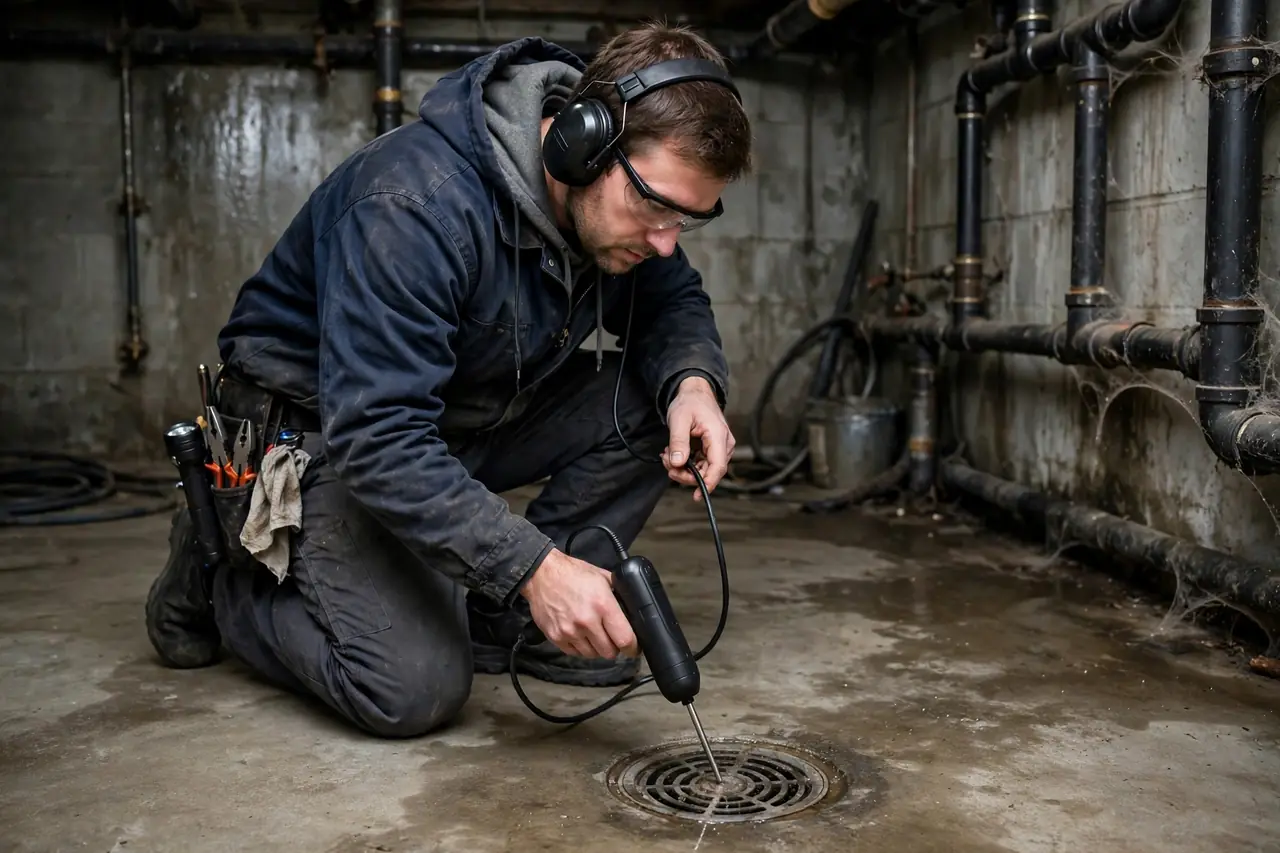
Sewage exposure precautions apply throughout. Technicians wear gloves, eye protection, and waterproof footwear around any suspected leak, and we keep children and pets away from soggy areas until the leak is characterized — standing wastewater is a biological hazard even when it looks like a puddle. Excavation for confirmation or repair follows the same rules as all our dig work: utility mark-outs first, shored or sloped pits, and no open holes left unsecured. One caution for homeowners: do not try to find the leak by digging exploratory holes yourself. Beyond the utility-strike risk, an unmarked dig can collapse the weakened soil around a leaking pipe and turn a pinpoint repair into a major one. If you suspect a leak, call (833) 713-2101 and let the locating equipment do the finding.
Peabody and North Shore Local Factors
Peabody's ground complicates leak detection in a specific way: the seasonal water table. In low-lying areas near Proctor Brook, Goldthwaite Brook, and the North River lowlands, groundwater runs high enough in spring that a soggy patch might be a high water table, a leaking lateral, or both at once. The camera-plus-locating sequence sorts that out — groundwater does not crack a pipe on video, and a cracked pipe under a dry-season soggy spot is a leak regardless of the water table. This is also why dye testing earns its keep locally: it distinguishes sewage flow paths from ambient groundwater when the spring melt muddies the picture.
The pipe stock writes the rest of the story. Vitrified clay laterals under the older neighborhoods have spent decades in freeze-thaw soil, and their joints are the modal leak point — infiltration in spring, exfiltration the rest of the year, with roots widening the openings every season. Cast iron laterals in mid-century homes corrode at their low points, where wastewater sits between uses. And Peabody's mature tree canopy means root-driven leaks cluster under the oldest streets, where the largest trees meet the oldest clay. When detection points to a full-length failure rather than a single leak, homeowners often compare the trenchless options — a sewer leak detection visit in Saugus 01906 recently traced a mystery soggy lawn to three separate clay joint failures, and lining resolved all of them without disturbing the yard. See every community we serve on our areas page.
Areas Served for This Service
Sewer Leak Detection in Beverly
Beverly, MA 01915.
Learn moreSewer Leak Detection in Burlington
Burlington, MA 01803.
Learn moreSewer Leak Detection in Danvers
Danvers, MA 01923.
Learn moreSewer Leak Detection in Essex
Essex, MA 01929.
Learn moreSewer Leak Detection in Gloucester
Gloucester, MA 01930.
Learn moreSewer Leak Detection in Lynn
Lynn, MA 01902.
Learn moreSewer Leak Detection in Lynnfield
Lynnfield, MA 01940.
Learn moreSewer Leak Detection in Marblehead
Marblehead, MA 01945.
Learn moreSewer Leak Detection in Melrose
Melrose, MA 02176.
Learn moreSewer Leak Detection in Middleton
Middleton, MA 01949.
Learn moreSewer Leak Detection in Nahant
Nahant, MA 01908.
Learn moreSewer Leak Detection in North Reading
North Reading, MA 01864.
Learn moreSewer Leak Detection in Reading
Reading, MA 01867.
Learn moreSewer Leak Detection in Revere
Revere, MA 02151.
Learn moreSewer Leak Detection in Salem
Salem, MA 01970.
Learn moreSewer Leak Detection in Saugus
Saugus, MA 01906.
Learn moreSewer Leak Detection in Stoneham
Stoneham, MA 02180.
Learn moreSewer Leak Detection in Swampscott
Swampscott, MA 01907.
Learn moreSewer Leak Detection in Tewksbury
Tewksbury, MA 01876.
Learn moreSewer Leak Detection in Wakefield
Wakefield, MA 01880.
Learn moreSewer Leak Detection in Wilmington
Wilmington, MA 01887.
Learn moreSewer Leak Detection in Woburn
Woburn, MA 01801.
Learn more