
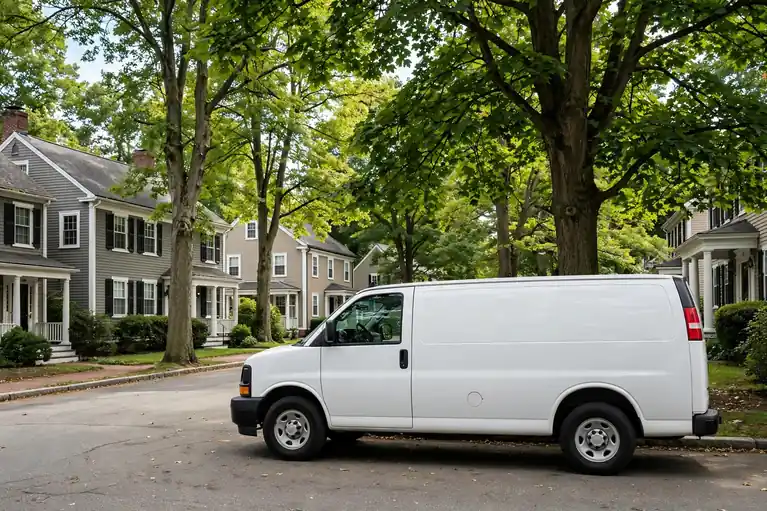
| ZIP | 01949 |
|---|---|
| Housing | Mixed old-rural and new-suburban: 14% built before 1939, 24% built in 2000 or later; ~89% owner-occupied single-family homes on large lots. Colonial survivors include the c.1753 Philip Knight House. |
| Common pipe materials | About 99% of homes are on septic, so work targets the building sewer (house-to-tank line): cast iron in older homes, PVC/SDR-35 in post-1980 builds — typical for the era. |
| Foundations | Full poured-concrete basements in post-1980 subdivisions; older farmhouses with stone rubble or block foundations. |
| Soil & drainage | Wetland-rich terrain: an extensive red maple swamp complex with peat bog and nine interconnected ponds; seasonally high water tables, poorly drained till soils, and wetland buffer constraints on excavation. |
| Key routes/landmarks | Harold Parker State Forest; Richardson's Ice Cream Farm; Flint Public Library; Howe-Manning and Fuller Meadow schools. |
Middleton, MA 01949: The Septic Town — Housing, Pipes, and Soil
Middleton is the outlier of the North Shore, and the single most important fact about sewer work here is this: about 99% of homes have septic systems rather than public sewer, according to the Middleton Health Department. That changes the entire meaning of “sewer line repair” in 01949 — it almost always means the building sewer, the line running from the house to the septic tank, plus drain work near the leach field. Municipal lateral replacement, the bread and butter of neighboring towns, barely exists here. Any contractor who quotes you a standard “municipal lateral” job in Middleton is working from the wrong playbook; the rules that govern the work are the town Board of Health's on-site-system rules, including installer permits, inspections, and pressure testing of sewer lines.
The housing stock is a split personality: 14% of units were built before 1939, but 24% were built in 2000 or later — one of the newest housing stocks in the area, against a statewide average of just 9%. About 89% of homes are owner-occupied single-family houses on large lots. The old side is a former farming community between Salem and Andover that kept its fields and open space, with Colonial survivors like the Philip Knight House built around 1753; older farmhouses carry stone-rubble or block foundations and original cast-iron building sewers from later septic retrofits. The new side is estate-style subdivisions and multifamily development such as Ferncroft, where post-1980 homes typically run PVC or SDR-35 building sewers from poured-concrete basements. In those farmhouses, the cast-iron-to-PVC transition at the foundation wall is the classic failure point — two materials, two eras, one joint.
The ground itself is the third actor. Middleton's terrain is wetland-rich: a town wetland-delineation study documents an extensive red maple swamp complex with peat bog and nine interconnected ponds at the former Middleton Golf Course site, and stormwater filings routinely map hydrologic soil groups, depth to bedrock, and depth to water table. Expect seasonally high water tables, poorly drained till soils, and real wetland-buffer constraints on any excavation — digging near a protected resource area without the right approach can stall a project fast. Low-lying lots near wetlands and meadow ponds flood seasonally, which can surcharge septic leach fields and shallow building sewers alike. Local landmarks that help technicians orient include Harold Parker State Forest, Richardson's Ice Cream Farm, and the Flint Public Library.
How Sewer Services Work in Middleton, MA 01949
Because Middleton runs on septic, the diagnostic sequence starts at the tank. A sewer camera inspection of the building sewer — the house-to-tank line — maps root entries, separations, bellies, and breaks along its full length, and the footage is reviewed together with the homeowner so the problem is visible before any work is approved. On older farmhouses, the camera also checks the cast-iron-to-PVC transition at the foundation wall, the single most failure-prone joint in town. Where the building sewer is sound, the same visit can scope the tank inlet for root intrusion and check grading and drainage around newer PVC lines in the post-2000 subdivisions — the typical trouble spots on modern systems.
The repair method follows the setting. In the post-1980 subdivisions, PVC building sewers with isolated defects are often candidates for trenchless sewer repair: lining or pipe bursting renews the line through small access points, which matters on estate-style lots where long paved driveways and finished landscaping make open trenches expensive. On the older farmhouse stock, original cast-iron building sewers with heavy scale, corrosion, or multiple breaks usually call for full sewer line replacement with modern PVC — and that replacement must satisfy Middleton Board of Health rules, including installer permits, inspections, and pressure testing of the new line. Whatever the method, the high water table shapes the job: trenches in saturated till need dewatering and shoring plans, and work near wetland buffers stays inside the existing pipe envelope — trenchless rehabilitation — wherever the pipe's condition allows, because it avoids the buffer entirely.
Middleton's seasonal rhythm drives the service calendar. Spring melt and heavy rain raise the water table across the wetland-rich terrain, and that is when shallow building sewers and leach-field-adjacent drains show their weaknesses: gurgling fixtures, slow drains, sewage odors at the tank area, and wet spots over the line's path. Low-lying lots near the swamp complexes and meadow ponds can see seasonal flooding that surcharges the whole on-site system. A spring camera inspection — when groundwater is highest and infiltration is visible — is the most informative diagnostic of the year, and it is also when sewer leak detection earns its keep, distinguishing a cracked building sewer from a saturated leach field before money is spent on the wrong fix.
Older farmhouses deserve their own paragraph because their failures are layered. A stone-rubble foundation from the 1700s or 1800s, a cast-iron building sewer from a mid-20th-century septic retrofit, and a PVC extension from a later tank replacement can all meet at one foundation wall — and the joint where eras meet is where separations, root entries, and infiltration concentrate. The repair here is part plumbing, part archaeology: expose carefully, replace the compromised transitions with properly bedded PVC, pressure-test per Board of Health requirements, and restore without disturbing more of the old foundation than necessary. In the newer subdivisions the work skews the other way — inspection, root management at tank inlets, and grading or drainage corrections around otherwise healthy PVC. Same town, two completely different service profiles, and the camera tells you which one you have before a shovel comes out.
Warning Signs Your Middleton 01949 Building Sewer Is Failing
Because the building sewer is short — house to tank, not house to street — its symptoms show up fast and close to home. The classic sequence is slow drains and gurgling across multiple fixtures at once, followed by sewage odors near the tank area or in the basement, and finally wet, sunken, or unusually lush ground along the line's path between the house and the tank. In the older farmhouses, a sudden backup after decades of trouble-free service often traces to the cast-iron-to-PVC transition at the foundation wall finally separating; in the subdivisions, recurring springtime sluggishness that clears by midsummer points to groundwater infiltration into a compromised joint rather than a blockage.
The septic context adds symptoms a municipal-sewer town never sees. If the tank itself is backing up into the house, the problem may be at the tank inlet — root intrusion at the inlet tee is a signature Middleton failure — rather than in the building sewer at all, and the camera distinguishes the two in minutes. Ponding or breakout near the leach field after rain suggests the field is saturated, which can make a healthy building sewer look guilty by association; that is why diagnosis here covers the whole on-site system, not just the pipe. And any excavation-season symptom — new wet spots, new odors — on a low-lying lot near wetlands deserves prompt attention, because saturated ground accelerates every failure mode at once.
Timing is diagnostic in Middleton. Problems that appear with spring melt and vanish by July are water-table problems until proven otherwise. Problems that appear after heavy rain on flat lots near the swamp complexes are drainage and surcharge problems. Problems that are constant regardless of weather are pipe problems — breaks, separations, bellies — and those are the ones a camera inspection finds in a single visit. Note the season when symptoms appear; it is the single most useful thing you can tell the technician on the first call.
From First Call to Finished Line in 01949
The first step is a call to Sewer Line Repair Works at (833) 713-2101. Describe what you are seeing — which fixtures are affected, whether the tank area shows symptoms, whether rain or melt makes it worse, and the age of your home. In a septic town, those details route the job correctly from the start: a building-sewer camera inspection, a tank-inlet check, or a full on-site-system diagnostic. If sewage is actively backing into the house, say so — that qualifies for emergency sewer repair dispatch, and the crew arrives prepared for septic-system realities, not municipal-lateral assumptions.
On site, the technician cameras the building sewer first and reviews the footage with you, marking defect locations and depths above ground. The options conversation in Middleton is shaped by Board of Health rules from the beginning: any replacement work needs the proper installer permits, inspections, and pressure testing, and the proposal says so plainly. For an isolated defect in a PVC line, a spot repair or trenchless lining may be the answer; for a failed cast-iron farmhouse line, full replacement with bedded PVC; for root intrusion at the tank inlet, inlet repair plus root management. Where the pipe runs near wetland buffers, trenchless methods that stay inside the existing pipe envelope are preferred — they keep the project out of buffer jurisdiction and avoid dewatering saturated trenches.
The job closes the same way everywhere: a final camera pass to verify the finished line, pressure testing where the Board of Health requires it, and the site restored. Before leaving, the technician walks you through what was found and what was fixed — and, in a septic town, what to watch: keep heavy vehicles off the line's path, manage the trees near the tank inlet, and schedule a camera check if springtime sluggishness ever returns. A building sewer is the shortest line we service and one of the most consequential, because everything in the house depends on it reaching the tank intact.
Services in This Area
Commercial Sewer Services in Middleton
Middleton, MA 01949.
Learn moreEmergency Sewer Repair in Middleton
Middleton, MA 01949.
Learn morePipe Bursting in Middleton
Middleton, MA 01949.
Learn morePipe Lining (CIPP) in Middleton
Middleton, MA 01949.
Learn moreSewer Camera Inspection in Middleton
Middleton, MA 01949.
Learn moreSewer Leak Detection in Middleton
Middleton, MA 01949.
Learn moreSewer Line Cleaning in Middleton
Middleton, MA 01949.
Learn moreSewer Line Installation in Middleton
Middleton, MA 01949.
Learn moreSewer Line Replacement in Middleton
Middleton, MA 01949.
Learn moreSewer Maintenance in Middleton
Middleton, MA 01949.
Learn moreTree Root Removal in Middleton
Middleton, MA 01949.
Learn moreTrenchless Sewer Repair in Middleton
Middleton, MA 01949.
Learn more