
Warning Signs and Common Causes
A sewer emergency looks different from an ordinary clog, and recognizing the difference saves damage. The signature pattern is wastewater appearing where it should never be: sewage backing up into a basement floor drain, a shower, or a first-floor toilet when another fixture is used. Multiple drains failing at once — the kitchen sink gurgling while the washing machine drains, or toilets bubbling when the tub empties — points to the main line, not a branch. A sudden, strong sewage odor inside the house, especially combined with slow drains, means the line is already compromised. Outside, watch for a soggy patch of yard that never dries, a new dip or sinkhole over the pipe's path, or the sound of running water under the floor when nothing is on.
The causes behind these emergencies are usually months or years in the making. Root masses are the most common: fine roots enter through a clay joint and grow into a dense plug that finally seals the pipe shut. Collapsed sections of old clay or Orangeburg-style pipe give way under soil load, sometimes after a heavy rain saturates the ground. Grease plugs harden in kitchen lines until flow stops entirely. Foreign objects — from a child's toy to construction debris — lodge at a bend or offset joint. And on the North Shore, storm surges do their part: a cloudburst or rapid snowmelt can overwhelm a low-lying lateral, pushing water back toward the house. Whatever the trigger, a main-line failure will not clear itself, and waiting turns a repair into a cleanup. If you see sewage, stop using water and call (833) 713-2101 right away.
One distinction matters before we arrive. If a single sink or toilet is clogged but everything else drains normally, that is a branch problem you may be able to wait on. If sewage is actively rising, if more than one fixture is affected, or if you hear gurgling from drains you are not using, treat it as an emergency. A quick sewer camera inspection once the immediate crisis is contained will show exactly what failed and where, so the permanent fix addresses the cause instead of just the symptom.
Our Step-by-Step Process
Step 1 — Phone triage. When you call, we ask what is happening, which fixtures are affected, whether sewage is actively backing up, and whether anyone has used chemical drain cleaners. That last question matters: chemical cleaners in a blocked main line sit against the clog, generate heat, and can injure whoever opens the line next — tell us if they were used. We then talk you through immediate steps: stop all water use, keep people and pets away from any backed-up areas, and if the basement is flooding, avoid walking through the water because of electrical hazards. Step 2 — Rapid dispatch and containment. The crew arrives with the goal of stopping the damage first. That means getting flow restored or contained — clearing the blockage enough to relieve pressure, pumping out standing sewage where needed, and isolating the failed section so the rest of the system can be used safely.
Step 3 — Camera diagnosis. Once the line is stable, we run a camera to find the actual failure: a root plug, a collapsed section, a separated joint, a belly holding solids. Emergency repairs done blind tend to fail again, so we diagnose before we commit to a fix. Step 4 — Immediate relief, then permanent repair. Wherever possible we separate the two. Relief might mean cutting roots or jetting a grease plug so your household or business can function tonight; the permanent repair — pipe bursting, lining, or a spot replacement — follows once the full picture is clear and, for larger work, once proper access is arranged in daylight.
Step 5 — Verification and prevention plan. After the repair, the camera goes through the line again to confirm the full run is clear and the fix is sound. Then we walk you through what failed and why, and what would keep it from happening again — a maintenance cleaning schedule for a root-prone line, a backwater valve for a house that sits low, or a full lateral replacement where the pipe is simply at the end of its life. You leave the emergency with a working system and a plan, not just a cleared drain.
Equipment and Materials
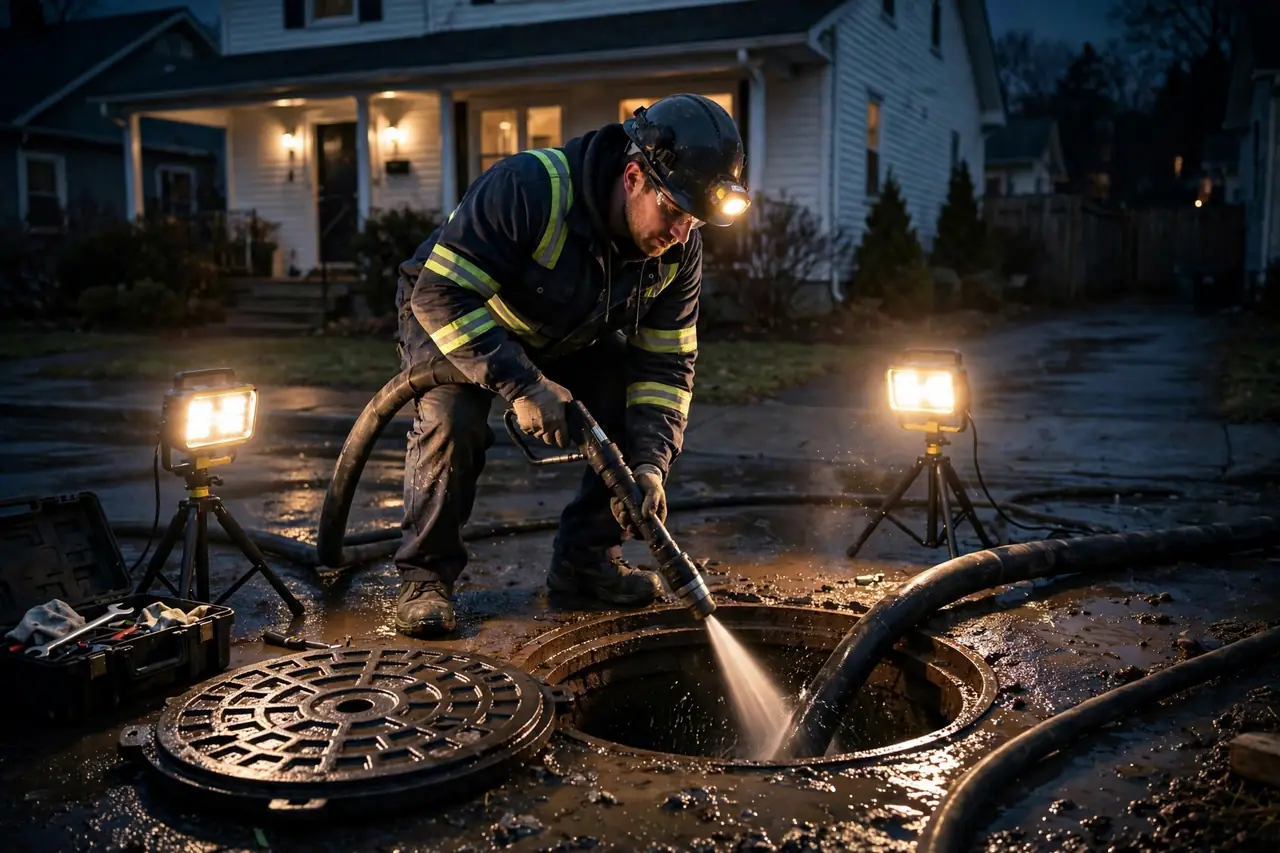
Emergency trucks carry the tools to handle whatever the camera finds. High-capacity hydro-jetters clear grease, sludge, and soft blockages fast; sectional root-cutting machines chew through root masses that a jetter alone cannot move. Push cameras and locators diagnose the failure and mark its exact position and depth above ground. For lines that need more than clearing, the truck stocks repair couplings, sectional liners for spot repairs, and the fittings to make a sound temporary or permanent connection the same visit. Portable pumps move standing water out of basements and pits so the crew can work, and extraction equipment removes sewage-contaminated water for proper disposal.
When the emergency calls for replacement rather than clearing, we bring the method that fits the site. Pipe-bursting rigs pull new HDPE through the failed line's path with minimal digging — the right answer when a yard, driveway, or parking area cannot be torn up. Cured-in-place lining equipment renews cracked but stable pipe from the inside. For collapsed sections that neither method can follow, excavation equipment opens a targeted pit at the marked defect instead of trenching the whole run. Disinfectants and antimicrobial cleaners go down on every surface that contacted sewage before we leave, because an emergency repair is not finished until the space is safe to re-enter.
Safety and Precautions
Sewage is a biological hazard, and emergency conditions make it more dangerous, not less. Keep everyone — children and pets especially — away from backed-up areas and standing wastewater. Do not wade through a flooded basement to rescue belongings; beyond the contamination, flooded basements hide electrical hazards from submerged outlets, appliances, and panels. If water is near electrical equipment, stay out and tell the dispatcher when you call. Ventilate the affected space if you can do so safely, but do not run the furnace or central air in a way that spreads contaminated air through the house.
There are two mistakes we see repeatedly. The first is pouring chemical drain cleaner into a main-line backup. In a fully blocked line the chemical sits in one place, heats up, and can crack porcelain, damage pipes, and cause chemical burns to whoever opens the line afterward. The second is renting a drain snake and forcing it into an unknown blockage — a cable punched through a collapsed clay pipe or driven into a root mass can wedge permanently or break the pipe further. Our crews work in full protective gear with eye and respiratory protection, test the atmosphere before entering any pit or confined space, and never leave an open excavation unsecured. If sewage is rising and you are unsure what to do, the safest move is simple: stop using water, keep clear, and call (833) 713-2101.
Peabody and North Shore Local Factors
Peabody's emergencies follow the North Shore calendar. Spring is the busiest season: snowmelt saturates the glacial till, the ground shifts, and clay joints that survived winter open a little wider — right as tree roots wake up and push into them. Summer cloudbursts are the second peak; a fast, heavy storm can surcharge low-lying laterals near Proctor Brook, Goldthwaite Brook, and the North River lowlands, pushing water backward toward houses that sit below street grade. Winter brings its own failures when frost heave shifts shallow lines and opens separations that spent the fall as slow drains. Knowing this rhythm matters because the same symptom in April and in August can have different causes.
The housing stock shapes what fails. Older neighborhoods near Peabody Square and South Peabody carry vitrified clay laterals and cast iron that have been in the ground for generations — prime candidates for root intrusion and collapse. West Peabody's mid-century ranches and split-levels often have longer, deeper runs to the street, which means a blockage can back up a finished basement before anyone notices a slow drain upstairs. Mature oaks and maples are everywhere in the older sections, and their roots do not respect property lines. When an emergency strikes anywhere from downtown to the Lynnfield line, our crews know these patterns — and if you are just over the line in Beverly, our emergency sewer repair team covers 01915 with the same rapid response. See all the communities we serve on our areas page.
Areas Served for This Service
Emergency Sewer Repair in Beverly
Beverly, MA 01915.
Learn moreEmergency Sewer Repair in Burlington
Burlington, MA 01803.
Learn moreEmergency Sewer Repair in Danvers
Danvers, MA 01923.
Learn moreEmergency Sewer Repair in Essex
Essex, MA 01929.
Learn moreEmergency Sewer Repair in Gloucester
Gloucester, MA 01930.
Learn moreEmergency Sewer Repair in Lynn
Lynn, MA 01902.
Learn moreEmergency Sewer Repair in Lynnfield
Lynnfield, MA 01940.
Learn moreEmergency Sewer Repair in Marblehead
Marblehead, MA 01945.
Learn moreEmergency Sewer Repair in Melrose
Melrose, MA 02176.
Learn moreEmergency Sewer Repair in Middleton
Middleton, MA 01949.
Learn moreEmergency Sewer Repair in Nahant
Nahant, MA 01908.
Learn moreEmergency Sewer Repair in North Reading
North Reading, MA 01864.
Learn moreEmergency Sewer Repair in Reading
Reading, MA 01867.
Learn moreEmergency Sewer Repair in Revere
Revere, MA 02151.
Learn moreEmergency Sewer Repair in Salem
Salem, MA 01970.
Learn moreEmergency Sewer Repair in Saugus
Saugus, MA 01906.
Learn moreEmergency Sewer Repair in Stoneham
Stoneham, MA 02180.
Learn moreEmergency Sewer Repair in Swampscott
Swampscott, MA 01907.
Learn moreEmergency Sewer Repair in Tewksbury
Tewksbury, MA 01876.
Learn moreEmergency Sewer Repair in Wakefield
Wakefield, MA 01880.
Learn moreEmergency Sewer Repair in Wilmington
Wilmington, MA 01887.
Learn moreEmergency Sewer Repair in Woburn
Woburn, MA 01801.
Learn more