
When a New Sewer Line Installation Is Needed
Most homeowners never think about their sewer line until something goes wrong, but there are situations where installing a brand-new line is the right move from the start. New construction is the most obvious: every new home or commercial building needs a lateral connecting it to the municipal sewer main, sized and sloped correctly from day one. Home additions that add bathrooms, or accessory dwelling units, can also require a new or upsized lateral when the existing line cannot handle the additional flow.
Another common trigger is a failed line that has reached the end of its useful life. When a camera inspection shows a clay or cast-iron lateral riddled with breaks, severe root intrusion at every joint, or long settled sections, patching one spot after another becomes a losing strategy, and a full sewer line replacement or new installation is the practical answer. Properties converting from septic to city sewer likewise need a completely new connection trenched from the building to the street. In each case, starting fresh with modern materials and proper engineering eliminates the inherited problems of the old pipe.
Our Step-by-Step Sewer Line Installation Process
Installing a sewer line is underground construction, and the quality of the finished work is decided long before the first shovelful of dirt moves. Our process is built around planning, precise grading, and inspection at every stage, so the line you get drains correctly for decades. To start the conversation about your project, call (833) 713-2101.
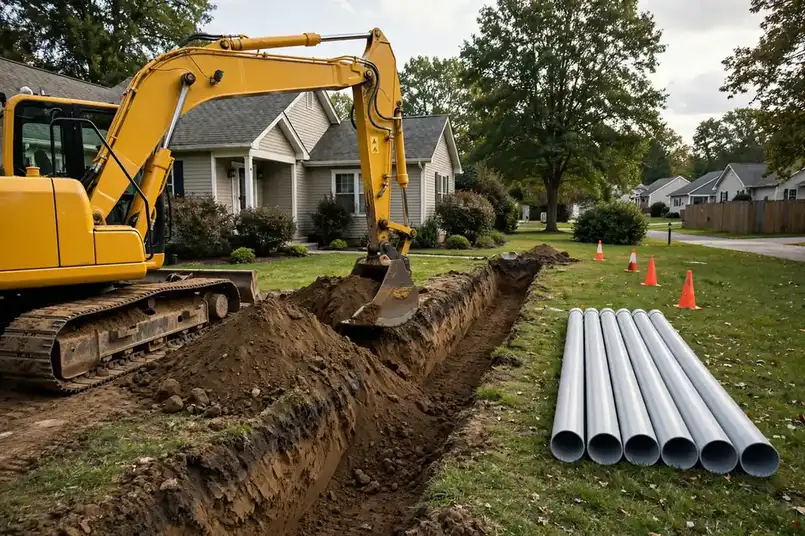
1. Site survey and planning. We walk the property, review plot plans, and determine the most suitable route from the building to the municipal connection, accounting for existing utilities, trees, driveways, and structures. 2. Utility marking and permits. Underground gas, electric, water, and communications lines are marked through the Dig Safe process, and the required municipal permits are secured before any digging begins. 3. Excavation. The trench is opened along the planned route with excavation equipment, with trench protection in place for worker safety at depth. Where conditions allow and the layout suits it, trenchless methods can reduce surface disruption. 4. Bedding and pipe laying. A bed of compacted gravel is prepared, and pipe sections are laid with a consistent downward slope toward the main, checked with a laser level because even small grade errors cause chronic drainage problems. 5. Joint assembly and connections. Watertight joints are assembled to manufacturer specifications, and the building drain and the city tap connection are tied in securely. 6. Testing and inspection. The line is tested for leaks and proper flow, and the installation is left ready for municipal inspection where required. 7. Backfill, compaction, and restoration. The trench is backfilled in lifts and compacted to prevent future settling, then the surface is restored as closely as possible to its original condition.
Pipe Materials and Equipment We Use
Modern sewer installations rely on materials chosen for long service life underground. For most residential laterals we install PVC or SDR-35 pipe, which resists corrosion, has smooth interiors that discourage buildup, and uses gasketed watertight joints that deny tree roots the entry points older clay joints offered. Fittings, couplings, and transition pieces are matched to the pipe system so every joint is as strong as the pipe itself. Bedding gravel and select backfill material protect the pipe from point loads and shifting soil, which matters as much as the pipe choice for longevity.
The equipment side of the job includes compact excavators sized for residential properties, laser levels and grade rods for verifying slope to fractions of an inch, pipe cutters and assembly tools, trench shoring and shielding for safe deep work, and inspection cameras for the final check of the installed line. For projects where open trenching would destroy a driveway, patio, or mature landscaping, we can evaluate trenchless installation techniques that place the new pipe with far less surface disturbance. The right combination of material and method is selected for your soil, depth, and property layout, not forced into a one-size-fits-all approach. After installation, a scheduled sewer maintenance plan keeps the new line performing well for years.
Safety Precautions During Sewer Line Installation
Digging a sewer trench means working around buried hazards and at depths where soil can be unforgiving, so safety planning starts before excavation. Every project begins with utility location: striking a gas or electric line is a preventable catastrophe, and the Dig Safe marking process plus careful hand-digging near marked utilities keeps those strikes from happening. Trenches deeper than a few feet get proper shoring, shielding, or sloping so walls cannot collapse on workers, and spoil piles are kept back from the trench edge to avoid surcharges that push walls inward.
Above ground, the work zone is managed just as carefully. The excavation area is barricaded and marked so family members, neighbors, and pets stay clear of open trenches and equipment swing zones. Equipment operators maintain visual contact with ground crew, and trenches are never left open and unprotected overnight where someone could fall in. Dust, noise, and access disruption are kept to reasonable hours, and at the end of each workday the site is secured. These precautions protect your household and our crew through every phase of the installation.
Installing Sewer Lines in Peabody and the North Shore
Peabody's ground has opinions about underground construction, and an installer who knows them builds a better line. Much of the North Shore sits on glacial till: a dense mix of sand, gravel, and cobbles left by the ice sheets, with ledge rock appearing unpredictably. A route that looks straightforward on a plot plan can hit ledge a few feet down, which changes the excavation plan and sometimes the pipe depth. Local frost depth runs around four feet, so laterals must be buried deep enough that winter cold never reaches them, and the freeze-thaw cycle that heaves our soils each spring punishes any pipe laid without proper bedding and compaction.
Municipal requirements add another local layer. Peabody, like its North Shore neighbors, requires permits and inspections for sewer connections, with specific rules about pipe material, minimum slope, and how the tap into the city main is made. Older neighborhoods may have combined quirks like shared laterals or unusual main depths that only show up during the survey. We plan the route, depth, and materials around these realities, and we handle the permit and inspection coordination so the installation is documented and compliant from the tap at the street to the foundation wall. For an installation estimate and a clear explanation of what your property needs, call (833) 713-2101. You can also return to the Sewer Line Repair Works homepage for an overview of all our services.
Areas Served for This Service
Sewer Line Installation in Beverly
Beverly, MA 01915.
Learn moreSewer Line Installation in Burlington
Burlington, MA 01803.
Learn moreSewer Line Installation in Danvers
Danvers, MA 01923.
Learn moreSewer Line Installation in Essex
Essex, MA 01929.
Learn moreSewer Line Installation in Gloucester
Gloucester, MA 01930.
Learn moreSewer Line Installation in Lynn
Lynn, MA 01902.
Learn moreSewer Line Installation in Lynnfield
Lynnfield, MA 01940.
Learn moreSewer Line Installation in Marblehead
Marblehead, MA 01945.
Learn moreSewer Line Installation in Melrose
Melrose, MA 02176.
Learn moreSewer Line Installation in Middleton
Middleton, MA 01949.
Learn moreSewer Line Installation in Nahant
Nahant, MA 01908.
Learn moreSewer Line Installation in North Reading
North Reading, MA 01864.
Learn moreSewer Line Installation in Reading
Reading, MA 01867.
Learn moreSewer Line Installation in Revere
Revere, MA 02151.
Learn moreSewer Line Installation in Salem
Salem, MA 01970.
Learn moreSewer Line Installation in Saugus
Saugus, MA 01906.
Learn moreSewer Line Installation in Stoneham
Stoneham, MA 02180.
Learn moreSewer Line Installation in Swampscott
Swampscott, MA 01907.
Learn moreSewer Line Installation in Tewksbury
Tewksbury, MA 01876.
Learn moreSewer Line Installation in Wakefield
Wakefield, MA 01880.
Learn moreSewer Line Installation in Wilmington
Wilmington, MA 01887.
Learn moreSewer Line Installation in Woburn
Woburn, MA 01801.
Learn more