
'How long will this take?' is the first question most Peabody homeowners ask after 'what is wrong' — and the honest answer is that sewer work ranges from a couple of hours to several days depending on the method. A simple cleaning is a morning's work; a full lateral replacement is a multi-day project with permits, excavation, and restoration.
The method drives the timeline more than anything else. Trenchless techniques — lining and pipe bursting — compress what used to be week-long digs into a day or two. Open-cut replacement takes longer but handles problems trenchless methods cannot. Understanding the realistic range for each helps you plan around the disruption.
Here is what to expect for each type of sewer work, and the Massachusetts-specific factors that can stretch a schedule.
Cleaning and Inspection: Hours, Not Days
A professional sewer line cleaning — jetting or mechanical clearing of roots, grease, and debris — typically takes a few hours on site for a residential lateral. A sewer camera inspection adds under an hour, often done in the same visit. If cleaning solves the problem and the camera shows a sound pipe, the whole job starts and finishes in one morning.
These are also the quickest services to schedule. Unlike repairs that need permits or utility marking, cleaning and inspection can often be booked within days. For recurring slow drains, this quick turnaround is exactly why starting with cleaning and camera work makes sense — you get answers fast, and many problems end here.
Trenchless Repairs: Usually a Day or Two
Cured-in-place pipe lining for a residential lateral is typically a single-day job: inspection and cleaning in the morning, liner installation and curing through the day, final camera verification before the crew leaves. The line goes back into service the same day, and there is no trench to restore.
Pipe bursting — the trenchless method that replaces the old pipe by fracturing it outward while pulling a new line through — usually takes one to two days for a home lateral. The extra time covers the entry and exit pits, the bursting run itself, and reconnecting the line at the house and the street. Compared with open excavation, both methods trade days of digging and restoration for a much shorter on-site window, which is the core appeal of trenchless sewer repair for busy households.
Full Replacement: Plan on Several Days
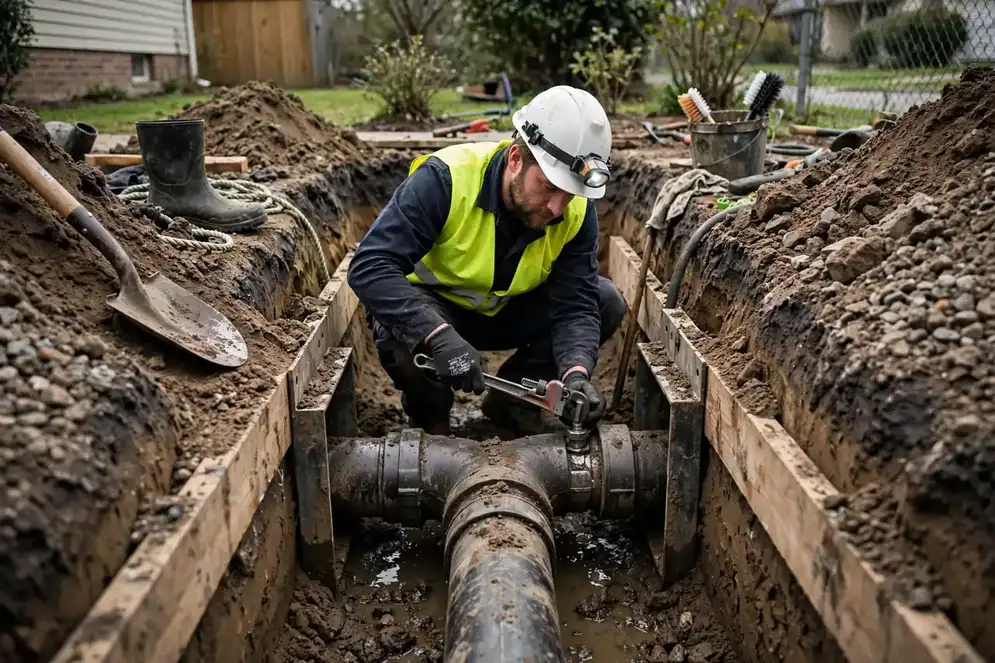
Open-cut sewer line replacement — excavating the full lateral, removing the old pipe, installing new pipe, and backfilling — is measured in days, not hours. A straightforward residential replacement often takes two to four working days: excavation and pipe installation, then backfill, compaction, and surface restoration. Longer or deeper lines, or lines under driveways and patios, add time.
Restoration is the quiet time-eater people forget to budget. The pipe work might finish mid-week, but proper backfill compaction, repaving, re-sodding, or rebuilding a walkway stretches the calendar. A good contractor separates 'line back in service' (often day two or three) from 'property fully restored' (sometimes a week or more) so you know which date actually matters for your planning.
Permits, Utilities, and Massachusetts Realities
In Massachusetts, sewer lateral work typically needs a local permit, and the wait for permit issuance varies by municipality and season — spring is busy everywhere. Utility marking (the call-before-you-dig locate) is required before any excavation and needs its own lead time. These administrative steps run before the crew arrives and can add days to the calendar that have nothing to do with the work itself. Ask your contractor which permits your specific job needs and who pulls them — the answer varies between a simple cleaning and a full lateral replacement.
Weather is the other schedule-maker. Frozen ground in deep winter slows excavation; spring's saturated soils and nor'easter downpours can pause a dig for safety. Trenchless methods are less weather-sensitive, which is one more reason they appeal to New England homeowners. When you get a timeline, ask whether it includes permitting and utility locates — the honest ones do. Questions about scheduling? Call (833) 713-2101 to discuss what your project would involve.
What Can Stretch Any Timeline
Surprises underground are the classic delay: the camera showed a break, but excavation reveals the line is deeper than expected, or the soil is ledge that needs different equipment. Discovering an undocumented utility, a shared lateral with a neighbor, or a connection point that is not where records said it was can each add a day.
Access problems stretch jobs too — a lateral running under a new addition, a yard with no machine access, or a street that needs traffic control for the connection work. In Peabody's older neighborhoods, tight lot lines and shared driveways can add coordination time with neighbors, and work near the street may need a road-opening permit on top of the plumbing permit. None of this is unusual; it is why experienced contractors build contingency into their schedules rather than promising the rosiest case. The most reliable timeline is the one that names what could go wrong, not the one that pretends nothing will.