
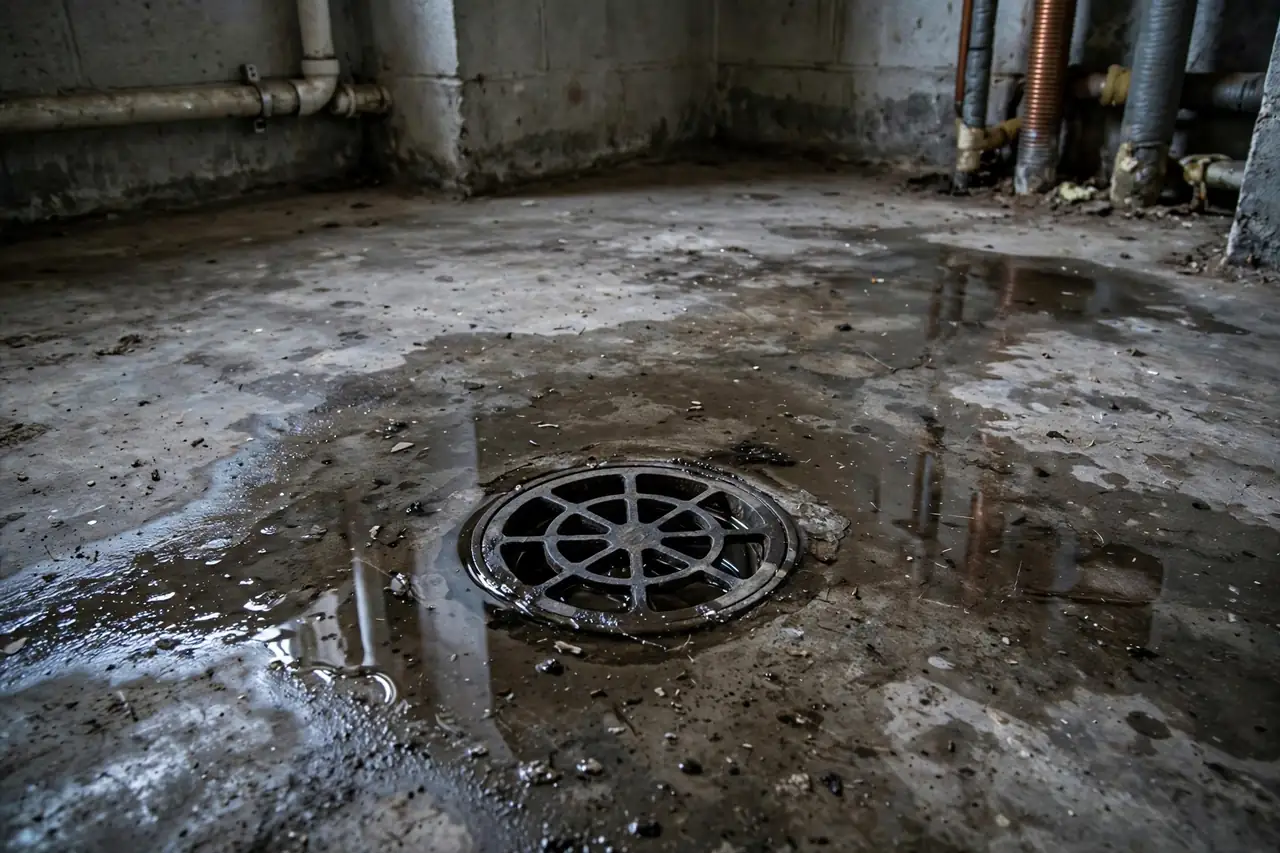
Nothing rearranges your priorities like sewage coming up through a basement drain. It usually starts small — a gurgle from the laundry tub, a toilet that burps when the washer drains — and then, often during a nor'easter or the spring melt when the ground is saturated, it becomes a spreading mess. What you do in the first hour matters more than anything that happens later.
The good news: a sewer backup is manageable if you act fast and in the right order. Stop the inflow, protect people and belongings, document the damage, and get professional help on the way. This guide walks through each step so you are not improvising while sewage spreads.
Read it now, before you need it — and keep your main cleanout accessible year-round.
Step 1: Stop All Water Use Immediately
Every fixture you use sends more water into a blocked lateral, and a blocked lateral sends it back into your home. The moment you suspect a main-line backup, stop: no flushing toilets, no running faucets, no laundry, no dishwasher, no showers. Tell everyone in the house. This single step limits the damage more than anything else you can do.
If the backup started during heavy rain, the municipal system may be contributing — but your water use still adds to the volume inside your home, so the rule holds regardless of cause. If you have a basement bathroom or laundry, those lowest fixtures are where backup appears first; keep clear of them until the line is flowing again.
Step 2: Protect People First — Sewage Is Contaminated
Treat backed-up sewage as what it is: contaminated water carrying bacteria, viruses, and parasites. Keep children, pets, and anyone with health vulnerabilities completely away from affected areas. If you must walk through it, wear waterproof boots and gloves, and wash thoroughly afterward. Do not let anyone wade through it barefoot 'just to grab something.'
Ventilate the area if you safely can — open windows, run fans exhausting outward — because sewer gases and the damp that follows are unpleasant and unhealthy. But do not run your HVAC fan in a way that circulates air from the contaminated area through the whole house; if the basement has its own air handler, shut it off until cleanup is done.
Step 3: Contain It and Protect Belongings
If sewage is still spreading, improvise containment: rolled towels at door thresholds, plastic sheeting over the leading edge, anything that slows the flow toward finished areas, electronics, and HVAC equipment. Move valuables, rugs, and boxes to higher ground — upstairs if you have to. You cannot stop a backup with towels, but you can steer where it goes.
Do not start deep cleanup yet — documentation comes first (see below), and the area needs professional assessment. But moving dry belongings out of harm's way is always worth the effort. Focus on what cannot be replaced: documents, photos, electronics. Furniture and carpeting can be dealt with after.
Step 4: Document Everything, Then Call for Help
Before cleanup begins, photograph and video the damage extensively: the source fixtures, the spread, affected belongings, waterlines on walls. Insurers want to see the damage as found, not after you have mopped. Note the date, time, weather conditions (was it raining?), and what you were doing when it started — all of it feeds the insurance picture.
Then call for emergency sewer repair — (833) 713-2101 — and describe what you see: which fixtures are backing up, whether it is still spreading, and whether multiple drains are affected. While you wait, locate your main cleanout and make sure it is accessible; the technician will need it. If sewage is near electrical panels, outlets, or your furnace, mention that on the call so the crew arrives prepared.
What NOT to Do During a Sewer Backup
Do not pour chemical drain cleaners down a backed-up line. They will not clear a main-line blockage, they create a chemical hazard for the technician who will be working in that line, and they can damage pipes and fixtures. Do not keep flushing 'to see if it clears' — it will not, and each flush adds volume.
Do not run a rented drain snake deep into a main line yourself unless you know exactly what you are doing — an aggressive cable in a fragile old cast iron or clay line can break through the pipe wall and turn a blockage into a collapse. And do not ignore a backup that 'drains away on its own' after the rain stops; a line that backed up once has shown you its weakness, and the next storm will test it again. Schedule a sewer line cleaning with camera verification to find out why it happened.
After the Emergency: Cleanup and Prevention
Cleanup after sewage exposure means disinfection, not just drying. Porous materials — carpet padding, drywall, cardboard, upholstered furniture — that absorbed sewage generally cannot be salvaged and should be removed. Hard surfaces need thorough cleaning followed by disinfection with appropriate products, and the area must be dried completely to prevent mold. Many homeowners bring in a restoration company for this phase; your insurer may require or recommend it.
Prevention is the real payoff. If roots caused the backup, the entry points need repair — not just another clearing. If the line has bellies, breaks, or heavy scale, plan the permanent fix before the next nor'easter. A regular sewer maintenance routine — periodic inspection and cleaning on a schedule that fits your line's condition — is how Peabody homeowners keep a one-time backup from becoming a seasonal event.