
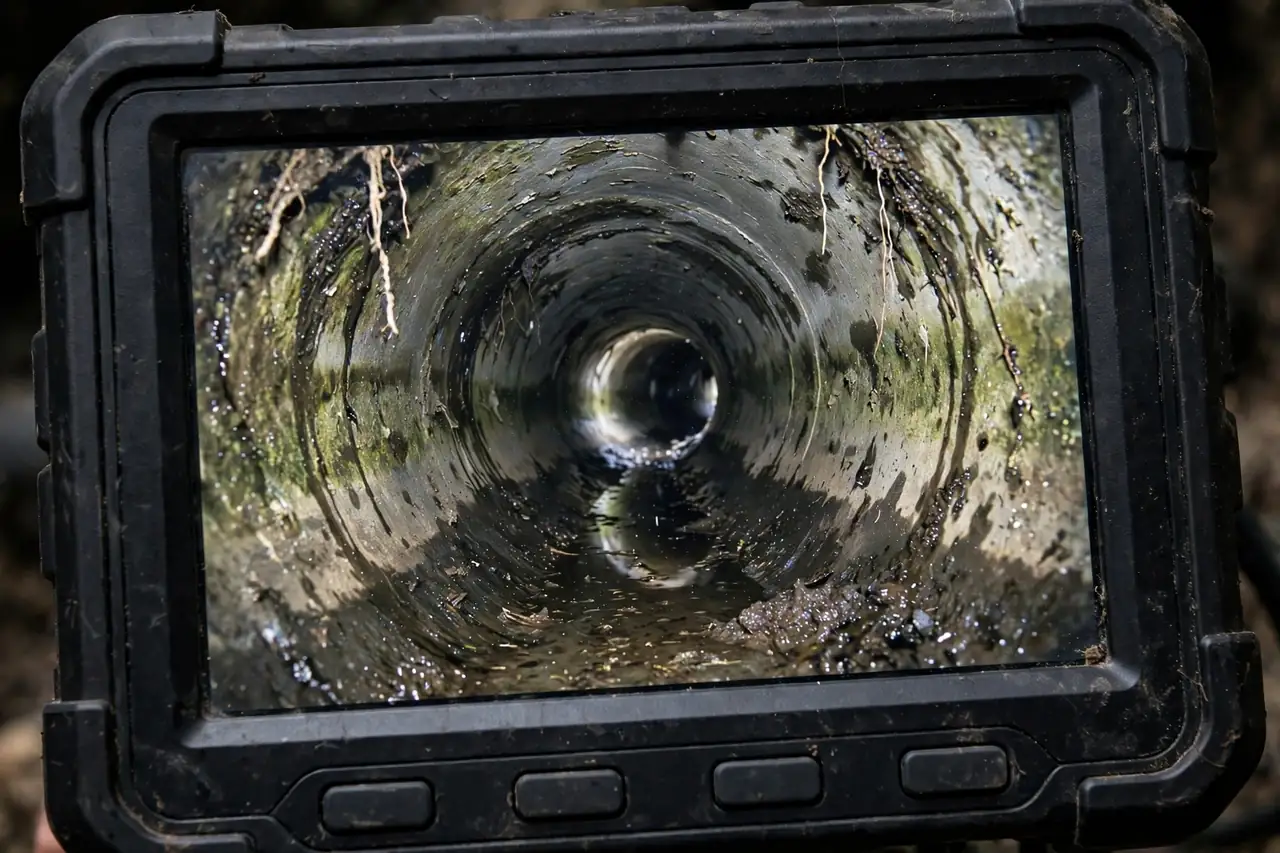
Every good sewer decision starts with the same thing: seeing inside the pipe. A sewer camera inspection sends a small, waterproof camera through your lateral — from the house to the street — and shows you exactly what is happening underground: roots, cracks, bellies, scale, and breaks, in real time, on a screen you can watch yourself.
For Peabody homeowners, where clay and cast iron laterals from the last century are still common and mature trees hunt for every joint, the camera is the difference between guessing and knowing. It turns 'the drains are slow' into a specific diagnosis with a specific location — and that changes everything about choosing a fix.
Here is how the inspection works, what the footage reveals, and when to schedule one.
How the Inspection Works
The equipment is simpler than you might expect: a flexible push-rod with a high-resolution camera head, fed through a cleanout or an access point into the lateral. The technician guides it the full length of the line while watching a live monitor, narrating what the camera passes — joints, turns, connections, and any defects. A built-in locator signal lets the technician pinpoint the camera's position and depth from above ground, so every problem gets mapped to an exact spot in your yard.
Most residential inspections take under an hour. You can watch the monitor alongside the technician, and you should receive a recording of the run — that video is your property's underground record, useful for second opinions, insurance documentation, and planning future work. A proper sewer camera inspection ends with a clear verbal summary plus the footage, not just a bill.
What the Camera Reveals
Roots are the classic find in Peabody: white, hairlike masses entering through joints and cracks, sometimes filling the pipe. The camera also shows structural problems — cracks, fractures, collapsed sections, and offsets where one pipe section has shifted relative to the next. Bellies (low spots where the pipe sags) show up as standing water that the camera has to push through, and heavy scale or grease buildup appears as a narrowed, roughened bore.
Just as valuable is what the camera rules out. A line that looks rough on the outside of the house may be sound underground; slow drains blamed on 'old pipes' may be a single root ball at one joint. The footage separates systemic failure (the whole line is deteriorating) from localized problems (one bad spot), and that distinction drives whether you need a spot repair, trenchless sewer repair, or full replacement.
Technicians also note the pipe material and any transitions — cast iron to clay to PVC patchworks are common in older Peabody laterals — plus the line's depth, length, and connection points. All of it goes into the diagnosis.
When to Schedule an Inspection
Recurring symptoms are the obvious trigger: backups that keep returning, drains that slow across multiple fixtures, gurgling sounds, or sewage odors. But the smartest inspections are preventive. If you are buying an older Peabody home, a camera inspection of the lateral belongs alongside the home inspection — sewer lines are expensive, invisible, and routinely excluded from standard inspections.
Other good moments: before any major landscaping, driveway, or addition project over the lateral's path; after a backup event, to find the cause rather than just clearing the symptom; and on a periodic cycle (every few years) for lines known to have root pressure or aging pipe. If a contractor proposes a major repair without camera footage, get the inspection first — it is the cheapest insurance against fixing the wrong thing. Sewer leak detection methods can complement the camera when the problem is exfiltration rather than blockage.
Reading the Footage: What Matters
You do not need to become a pipe expert, but a few landmarks help you read your own video. Watch the distance counter — it tells you how far each defect is from the access point, which locates it in your yard. Note where water sits (bellies), where the image goes dark or jagged (breaks and heavy roots), and where the pipe material changes.
Ask the technician to distinguish active problems from cosmetic ones: light surface scale in an otherwise sound line is not an emergency; a root mass at a separated joint is a repair waiting to happen. The key questions for any finding are: is it getting worse, what happens if we do nothing, and what fixes it permanently? A good inspection answers all three, in plain language, with the footage to back it up.
Keep the video. When tree root removal or a repair is proposed a year later, comparing new footage against your baseline shows whether the problem is stable, growing, or resolved — and it keeps every contractor honest about what changed.
Limitations: What the Camera Cannot See
The camera is powerful but not omniscient. Heavy standing water can hide the pipe's invert (bottom) where cracks often start; severe grease or debris can block the camera's passage entirely, which is why a cleaning sometimes precedes the inspection. The camera shows the pipe's interior — it does not directly show leaks escaping outward into the soil, though secondary signs (washed-out bedding, voids) can hint at them.
Very old lines with no accessible cleanout may need one installed before a full inspection is possible, and lines with sharp, unmapped turns can limit how far the push-rod travels. A straightforward technician will tell you when the footage is inconclusive and what the next step is, rather than selling certainty the video does not support. To see what is actually happening in your line, call (833) 713-2101 to schedule an inspection.