
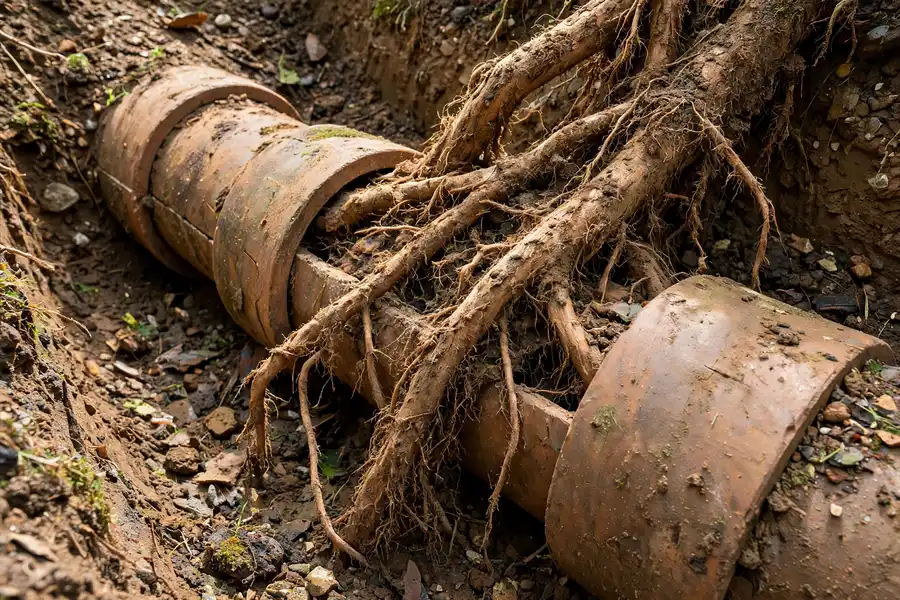
Of all the enemies a sewer line faces, tree roots are the most patient. They do not smash through pipe walls; they find the tiniest opening, slip a hair-fine feeder root inside, and then grow. Year by year the mass thickens until paper, grease, and waste start catching on it, and the homeowner meets the problem as a mysterious recurring clog.
Peabody is prime territory for this slow-motion invasion. Mature maples, oaks, and elms line streets and yards across the North Shore, and many sit directly over clay tile laterals whose mortar joints have been opening for decades. Add freeze-thaw cycles that widen those joints each winter, and roots have both the motive and the opportunity.
This guide explains why roots target sewer lines, which local trees cause the most trouble, how to recognize intrusion, how professionals clear it, and what actually solves the problem for good.
Why Roots Target Your Sewer Line
Roots do not seek out pipes; they seek out water, and a sewer lateral is a constant underground moisture source. Even a watertight line releases vapor through microscopic pores and joints, and root tips can detect that gradient from surprising distances. Once a feeder root finds an opening, the nutrient-rich flow inside encourages explosive growth at exactly the wrong place.
Clay tile laterals are the most vulnerable because every joint is a potential entry point, and decades of frost heave have opened joints all over Peabody's older neighborhoods. Cast-iron lines admit roots at corroded joints and cracks. Even modern plastic is not immune if a connection was poorly sealed. The entry is always small; the resulting mass can eventually fill the pipe's diameter.
The Trees That Cause the Most Trouble in Peabody
Not all trees are equal offenders. Silver maples and Norway maples, common across Peabody yards, combine aggressive shallow root systems with a love of moisture. Willows are notorious seekers of water and should never stand near a lateral. Oaks and elms grow more slowly but their roots are powerful enough to displace pipe sections over time.
Distance is only a rough guide. A large maple forty feet from the house can still reach a lateral, since root zones commonly extend well beyond the canopy. When diagnosing chronic root trouble, technicians map the lateral's route against every significant tree nearby, not just the closest one. If you are dealing with repeat intrusion anywhere on the North Shore, from root removal in Wakefield to Peabody itself, the offending tree is often farther away than the homeowner guesses.
Signs Roots Have Entered Your Line
Root intrusion has a signature rhythm: drains that slow every spring as growth resumes, backups that return a few months after a cleaning cleared them, and gurgling across multiple fixtures when large volumes discharge. Toilets may flush weakly while sinks drain normally, or the lowest drain in the house may weep during laundry day.
Because these symptoms mimic other blockages, the confirmation step matters. A sewer camera inspection shows root intrusion unmistakably on video: white tendrils at a joint in early stages, or a dense fibrous mass filling the pipe in advanced cases. The footage also reveals how many entry points exist, which decides whether cutting will suffice or the pipe itself needs attention.
How Professionals Remove Roots
The standard approach is mechanical: a powered auger with a root-cutting head, or high-pressure hydro jetting with a root-cutting nozzle, run through the line to shred the mass and flush it out. Professional tree root removal clears the full diameter rather than just punching a hole, and it is usually paired with a camera pass afterward to confirm the line is clear and to document the entry points.
Cutting restores flow but does not close the openings, so regrowth is expected. That is why cutting belongs inside a maintenance rhythm rather than standing alone. After clearing, some technicians apply a foaming root treatment that discourages regrowth at the joints, and a follow-up sewer line cleaning on a seasonal schedule keeps the mass from rebuilding to blockage size.
Long-Term Fixes for Chronic Root Problems
When the same joints clog every year, the economics shift from maintenance to repair. Pipe lining creates a seamless inner pipe that seals every joint and crack along the treated section, eliminating entry points in one step. Where the host pipe is too damaged to line, pipe bursting or open-trench sewer line replacement installs fused, jointless pipe that roots cannot penetrate.
Lighter measures help at the margins: root barriers redirect growth away from the lateral's corridor, and replacing a single chronically invaded section can buy years. But barriers do not fix open joints, and spot repairs leave the remaining joints vulnerable. If roots are a yearly event at your Peabody home, call (833) 713-2101 to discuss whether lining, bursting, or replacement fits what your camera footage shows.