
Trenchless sewer repair has earned its reputation: fixing a lateral without tearing up the yard is a genuine improvement over the old dig-everything approach. But the method has boundaries, and knowing them matters as much as knowing the benefits. A trenchless job attempted on the wrong pipe can fail, waste money, and still end in excavation.
Peabody's older housing stock is exactly where those boundaries get tested. Collapsed Orangeburg, bellied clay under settled fill, and cast iron thinned past the point of no return all show up regularly in North Shore camera surveys. This guide explains what trenchless methods need in order to work, the conditions that rule them out, and what the alternatives look like.
An honest contractor starts every trenchless sewer repair conversation with a camera, because the footage is what separates a good candidate from a bad one.
What Trenchless Methods Need in Order to Work
Both main trenchless methods, lining and bursting, depend on the existing pipe more than marketing suggests. Pipe lining inserts a resin-saturated liner that cures into a new pipe inside the old one; it needs the host pipe to hold enough of its original shape for the liner to press against evenly. Pipe bursting pulls a bursting head through the old line, fracturing it outward while drawing in new pipe; it needs a continuous path the assembly can travel.
That shared requirement, a host pipe with remaining integrity, is the first filter. Lines with sound barrels but leaking joints, cracks, or root intrusion are ideal. Lines that have lost their shape are not. The distinction is structural, and only the camera can make it reliably.
Collapsed and Badly Deformed Pipe
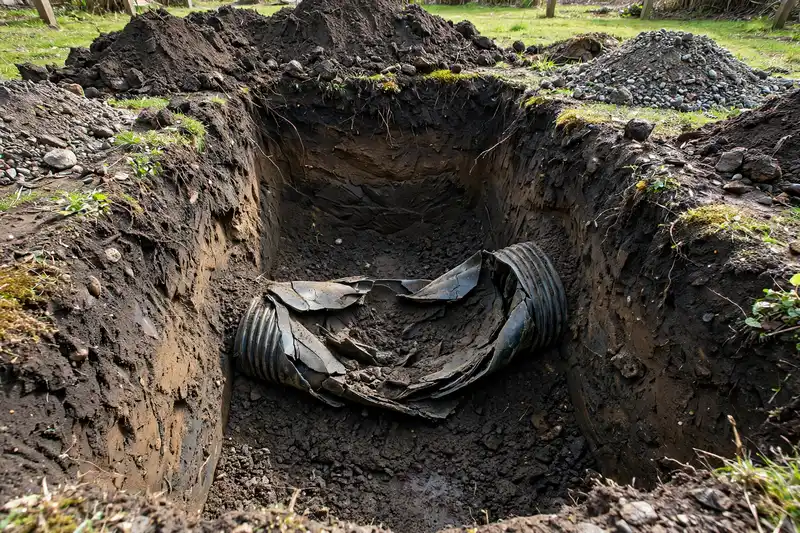
A collapsed section is the clearest disqualifier. Where the pipe has caved in, there is no channel for a liner to follow and no path for a bursting head to travel; the equipment simply cannot pass. Orangeburg fiber pipe, found in some mid-century Peabody-area homes, is especially prone to this kind of failure because the pipe wall softens and ovals under soil pressure until it gives way.
Deformation short of full collapse can also rule out lining. A liner cured inside an ovalized or partially flattened pipe takes on that compromised shape, leaving reduced capacity and weak spots. When the camera shows the pipe losing its round profile, pipe lining stops being a rehabilitation and becomes a gamble. Excavation and replacement of the failed section is the dependable answer.
Severe Bellies, Offsets, and Missing Sections
A belly, a sagging dip where wastewater ponds, defeats lining because the liner conforms to the existing geometry. The new inner surface follows the dip, so water still stands in the low spot after the cure, collecting sediment and slowing flow. Minor sags can be acceptable; pronounced bellies that hold significant water are not.
Severely offset joints, where one pipe section has shifted sideways from its neighbor, create a step the liner cannot bridge smoothly and a path a bursting head may not navigate. Sections that are simply gone, washed out by long-term leaks, leave nothing to line and no continuous channel to burst through. In these cases pipe bursting may still work if the surrounding pipe can guide the head, but the camera footage has to prove it.
Access, Depth, and Site Constraints
Trenchless methods need entry and exit points, typically existing cleanouts or small excavated pits at each end of the run. Lines without accessible cleanouts, or runs where structures, large trees, or utilities block pit locations, can make the setup impractical. Very deep lines or lines running beneath additions and garages add complications that sometimes tip the balance toward a targeted open cut.
Nearby utilities are another constraint. Bursting displaces soil outward as it fractures the old pipe, so gas, electric, and water lines running close alongside need careful locating and clearance. A responsible contractor maps every crossing utility before recommending bursting, and steers toward lining or excavation where clearances are tight.
When Open-Trench Replacement Is the Right Call
None of this makes trenchless a bad option; it makes proper diagnosis essential. When the camera shows collapse, severe bellies, or missing sections, open-trench sewer line replacement is not the fallback, it is the correct primary method. A new pipe laid at proper grade with fused joints solves the structural problems trenchless cannot touch, and it ends the cycle of repeat service calls on a dying line.
The decision should always rest on footage, not assumptions. A sewer camera inspection that documents the line's true condition lets you choose the method with confidence instead of hoping. If a Peabody contractor recommends trenchless without showing you clear video of a qualifying pipe, get a second opinion. To review what your line actually shows, call (833) 713-2101.