
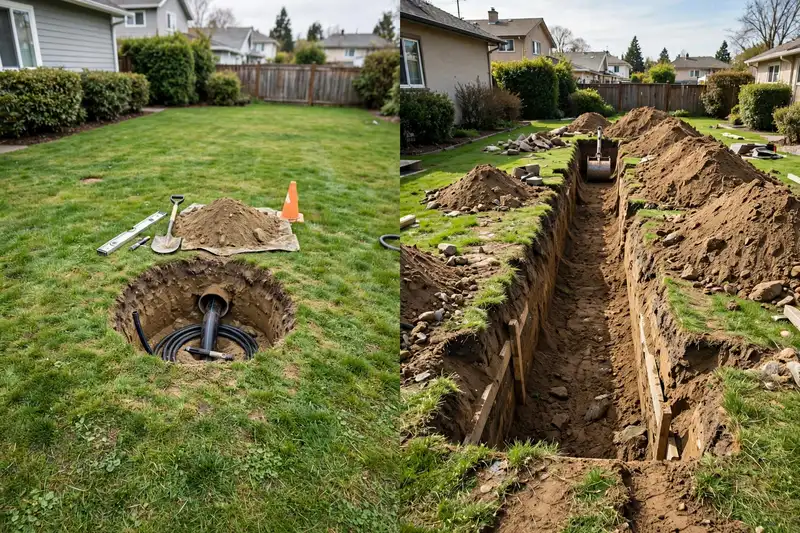
When a sewer lateral needs more than cleaning, Peabody homeowners face a fork in the road: trenchless repair, which rehabilitates the pipe with minimal digging, or traditional open-trench replacement, which excavates and installs new pipe. Both are legitimate. Neither is right for every situation.
The confusion comes from treating them as rivals in a contest with one winner. In practice they are different tools for different pipe conditions, and the camera footage usually makes the choice obvious. Marketing tends to present trenchless as the modern upgrade and traditional as the outdated fallback; the reality is more balanced.
This comparison explains how each method works, how they differ in digging and disruption, how long each takes, and which pipe conditions favor which approach, so you can evaluate a contractor's recommendation with confidence.
How Traditional Open-Trench Repair Works
Traditional repair is straightforward: excavate along the pipe's path, remove the failed sections, lay new pipe at the correct grade with proper bedding, backfill, compact, and restore the surface. It is the method every plumber learned first, and it handles any condition, collapsed pipe, severe bellies, missing sections, because the crew works with the pipe fully exposed.
Its strength is certainty. With the trench open, the crew sees everything: the pipe's true condition, the soil, the grade, and any surprises like unmarked utilities or voids. New sewer line replacement by open trench also allows the grade to be corrected, which matters when the original line was laid too flat or has settled into bellies. The trade-off is the excavation itself, which we will come to.
How Trenchless Repair Works
Trenchless repair fixes the pipe from the inside or replaces it with minimal excavation. Pipe lining inserts a resin-saturated liner into the old pipe and cures it in place, forming a seamless new pipe within the old one that seals every joint and crack. Pipe bursting pulls a bursting head through the old line, fracturing it outward while towing new fused pipe into the void behind it.
Both methods need only small access pits at the ends of the run instead of an open trench along its length. Lining needs a host pipe with enough shape to support the liner; bursting needs a passable channel and clearance from nearby utilities. When those conditions are met, trenchless delivers a renewed line with the yard largely intact.
Digging, Landscaping, and Disruption Compared
This is where the methods differ most visibly. Traditional replacement opens a trench along the full run, which can cross lawns, gardens, driveways, patios, and walkways. Everything in that corridor is disturbed and must be restored afterward. For a lateral running under a mature landscape or a paved driveway, the restoration work is a significant part of the project.
Trenchless work confines digging to entry and exit pits, typically a few feet square at each end. The lawn between them stays untouched, which is why trenchless is popular on landscaped North Shore properties. Less excavation also means less heavy equipment time on your property and a smaller restoration footprint when the crew leaves.
Timelines and What to Expect
Trenchless jobs are often completed faster once work begins, since there is no trench to dig, bed, backfill, and compact, and no surface restoration beyond the access pits. Many residential trenchless projects finish within a day or two of on-site work. Traditional replacement takes longer because excavation, pipe laying, compaction, and surface restoration are sequential steps that cannot be rushed without risking settlement later.
Both methods start the same way: a camera inspection, utility locating, and permits. Do not let timeline pressure drive the method choice, though. A fast trenchless job on a pipe that needed excavation is not a bargain; it is a repair you will pay for twice. The right method on the right pipe, done once, is the outcome that actually holds.
Which Situations Favor Each Method
Trenchless shines when the pipe's structure is largely intact: clay with open joints, cast iron with cracks but sound shape, lines with root intrusion at multiple joints. It is the natural choice when the lateral runs under landscaping, driveways, or patios you want to preserve, and when the camera shows a qualifying host pipe.
Traditional replacement is the answer for collapsed sections, severe bellies that pond water, badly offset joints, missing pipe, and Orangeburg that has deformed. It is also the method that corrects grade problems, since the new pipe is laid fresh at the proper slope. A good trenchless sewer repair contractor will recommend excavation without hesitation when the footage calls for it.
The deciding factor is always the sewer camera inspection, not a preference for one method. Ask any contractor to show you the footage and explain exactly which defects point to their recommendation. If you are comparing quotes in Peabody, call (833) 713-2101 for a second look at what your line actually needs.