
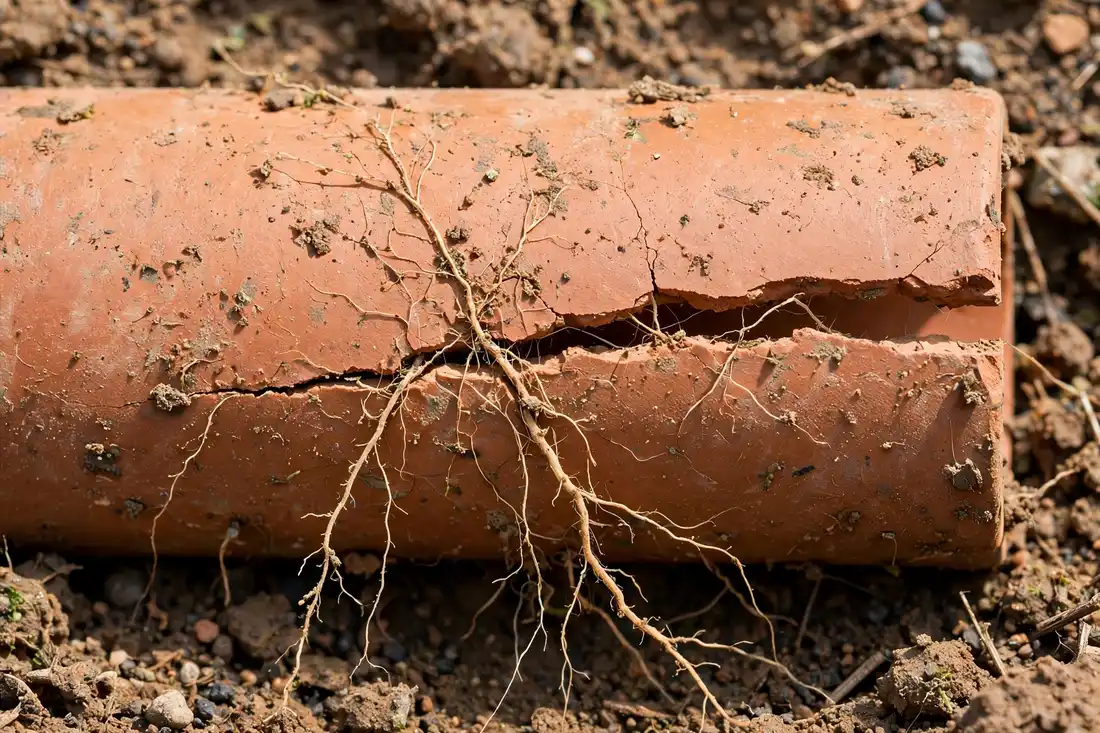
Sewer line damage is almost never a single event. It is an accumulation: roots widening a joint a fraction each year, grease narrowing the bore a layer at a time, frost heave flexing the pipe every winter. By the time symptoms appear, several culprits have usually been at work together for years.
That is actually good news, because every one of those culprits can be slowed, and most can be caught early. But you have to know what to look for, and the list is longer than most homeowners expect.
This guide walks through the most common causes of sewer line damage in Peabody-area homes, from the tree in the yard to the grease in the kitchen, and finishes with the prevention habits that keep small damage from becoming a failed line.
Tree Root Intrusion
Roots are the number-one offender in neighborhoods with mature trees and aging clay laterals, which describes much of Peabody. A feeder root slips through a hairline joint gap seeking moisture, then thickens year after year into a mass that catches paper and waste. The clog is only the first harm; the growing mass also wedges joints wider and can crack or displace pipe sections over time.
Because intrusion is progressive, timing matters. A joint with a few tendrils is a maintenance item; the same joint ignored for five years can be a structural repair. Periodic tree root removal keeps the mass from reaching the destructive stage, and a camera survey shows exactly which joints are affected so treatment targets the real entry points.
Grease, Wipes, and What Goes Down the Drain
The kitchen is the second front. Fats, oils, and grease go down the drain as liquids and congeal on the pipe walls as they cool, building a sticky layer that traps food particles and narrows the bore. In old cast-iron lines with rough scaled interiors, grease buildup accelerates dramatically. So-called flushable wipes do not break down like toilet paper; they snag on roots, scale, and joints, weaving into blockages that jetting must blast apart.
The fix is behavioral and free: wipe pans with a paper towel before washing, collect cooking grease in a container for the trash, and keep wipes, hygiene products, and paper towels out of the toilet. When buildup has already taken hold, professional sewer line cleaning with hydro jetting scours the walls back to full diameter.
Shifting Soil and Freeze-Thaw Cycles
New England ground never sits still. Every winter, moisture in the soil freezes and expands, heaving the earth upward; every spring, the thaw lets it settle back unevenly. Buried pipe rides that movement, and rigid clay and cast iron absorb it as stress at the joints. Over decades of cycles, joints open, sections shift out of alignment, and bedding soil washes into the gaps.
Nor'easters add a violent version of the same force, saturating the ground and loading the pipe with water weight while runoff erodes the bedding. Lines already weakened by age or roots are the ones that fail in these events. There is no stopping the seasons, but knowing your line's condition before winter lets you address weaknesses on your schedule rather than the storm's.
Aging Pipe Materials
Every pipe material has a failure mode, and time activates all of them. Clay joints lose their mortar seals and open to roots. Cast iron corrodes and scales until the wall thins and the bore narrows. Orangeburg softens and deforms under sustained soil pressure. Even the ground itself changes, with fill settling and creating bellies where waste ponds and sediment accumulates.
Age alone is not a diagnosis, though. A 70-year-old clay lateral with tight joints can outlast a 30-year-old line abused by roots and grease. What matters is the line's actual condition, which is why a sewer camera inspection is the starting point for any honest conversation about an aging pipe. The footage replaces assumptions about age with evidence about state.
Preventing Damage Before It Starts
Prevention is a short list of habits. Keep grease and wipes out of the drains. Know where your lateral runs and avoid planting thirsty trees over it or driving heavy equipment across shallow sections. Before any yard project involving digging, have the line located and marked. And put the pipe on a schedule: a sewer maintenance plan with periodic camera surveys and cleaning catches joint openings, root tendrils, and scale buildup while each is still a small job.
None of these habits requires major spending or disruption; they are the sewer equivalent of changing the oil. The expensive failures, collapses, full replacements, emergency backups, almost always trace back to years of unmonitored accumulation. If your Peabody home's line has never been inspected, call (833) 713-2101 to establish a baseline and find out which of these culprits, if any, is already at work.