
Why Sewer Backups in Burlington Hit Harder Than Expected
Burlington is a classic post-war Route 128 suburb — median year built 1963, dominated by 1950s–70s ranches, split-levels, and split-entry homes. The laterals of concern in these houses are cast iron inside with clay-tile or Transite exterior runs, now six-plus decades old: prime territory for root intrusion at clay joints and deteriorating cast iron at the foundation exit. And because full basements are the norm for ranches and split-levels — often finished as living space — a backup here is a high-damage event, not a nuisance.
Split-entry homes add an emergency-response wrinkle: the raised sewer exit often means longer, deeper runs to the street main, so a blockage can back up a surprising volume into the lower level before anyone notices. Brook-adjacent lots along Vine Brook and Sandy Brook, plus the town's extensive wetland corridors in the Ipswich River watershed, carry seasonal high groundwater — meaning spring and storm-season backup calls frequently involve infiltration through cracked laterals, not just a clog. Wetland permitting near protected areas also shapes how fast an open-trench repair can be mobilized, which is one reason trenchless lining is so valuable here: it avoids disturbing the buffer and the finished basement above.
For emergency work in Burlington, the playbook is diagnose first with a camera — especially to map root-packed clay joints and cast-iron transitions — then contain and restore flow, with watertight trenchless repair as the default on brook-corridor properties where groundwater is a factor. Day or night, storm or freeze, call (833) 713-2101 for rapid response.
Emergency Repair for Burlington's Finished Basements and Long Laterals
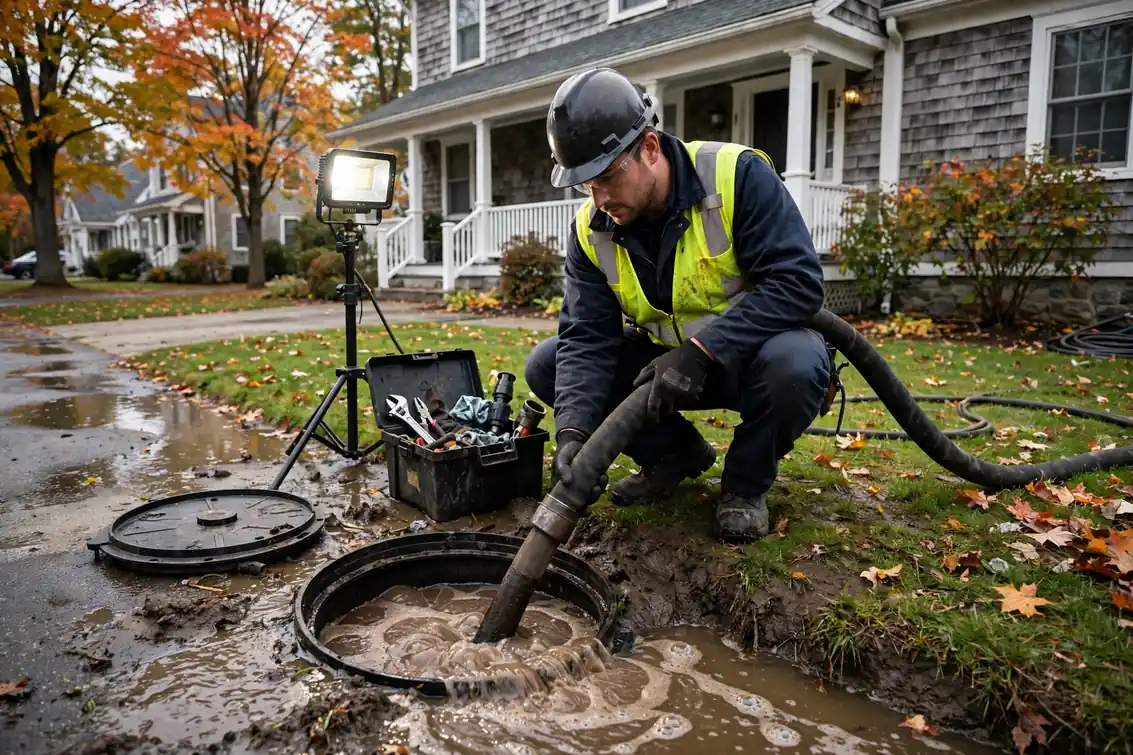
Burlington's emergency sewer work revolves around one fact: full basements are the norm in the town's ranches and split-levels, and those basements are usually finished living space. A backup here floods carpet, drywall, and stored belongings — so the emergency sequence leads with containment. Crews arrive with portable pumping to halt wastewater entry, then diagnose with a camera before committing to any repair method. Because these basements double as living space, every emergency response includes moisture mapping of affected walls and floors so the homeowner's recovery starts from documented conditions.
The town's dominant pipe generations — cast iron inside with clay-tile or Transite exterior runs from the 1950s–60s core — fail at joints and transitions. Split-entry homes often have longer, deeper runs from the raised sewer exit to the street main, which the camera maps end to end so the repair targets the actual failure instead of the whole run. Root intrusion at clay joints under driveways and lawns is the signature find. The 1963 ranch at 20 Arlington Road sits almost exactly at the town's median year built — a useful reference: homes near that vintage typically carry the same cast-iron-and-clay generation failing in the same ways.
Brook-adjacent lots along Vine Brook and Sandy Brook add seasonal high groundwater to the emergency picture, and town wetland buffers constrain open excavation near protected areas. That combination makes trenchless lining the practical emergency default: it seals infiltration along the full run, needs no trench through the buffer, and leaves the finished basement — and the landscaping above — intact. Ongoing storm-drainage projects on Wheeler Road and Hilltop Drive show the town actively fighting water — private laterals in those corridors get extra infiltration scrutiny during emergency calls.
Burlington's Sewer Patterns: a Post-War Cohort Aging Together
Burlington is a quintessential Route 128 post-war suburb with a median year built of 1963, dominated by 1950s–70s ranches, split-levels, and split-entry homes. The laterals of concern are cast iron with clay-tile or Transite exterior runs — six-plus decades old and failing in predictable places: root-packed clay joints, deteriorating cast iron at the foundation exit, and Transite sections weakened by age. Later infill colonials along the major corridors run newer pipe, but the 1950s–70s core of ranches, split-levels, and split-entries is where the emergency density sits.
The split-entry design common here creates a distinctive geometry: the raised sewer exit produces longer, deeper runs to the street main, so backups can deliver surprising volumes into the lower level before anyone notices. Later infill colonials along the major corridors run newer pipe, but the core stock is aging on the same schedule — which is why one street can produce several backup calls in a single season. Crawl spaces appear in some slab-adjacent ranch variants, which changes access planning — crews confirm the foundation type on the triage call rather than discovering it at the door.
Water shapes the calendar. Northeastern Burlington lies in the Ipswich River watershed, and lots near Vine Brook, Long Meadow Brook, and Sandy Brook see seasonal high groundwater that infiltrates cracked laterals every spring. Freeze-thaw frost heave shifts shallow joints each winter, and summer cloudbursts add sudden inflow. Emergency calls peak in spring melt and after heavy storms — when infiltration and blockage arrive together. Town wetland regulations protect marshes, wet meadows, bogs, and vernal pools — emergency work near any of them stays trenchless to keep the permitting clock from ever starting.
How a Burlington Sewer Emergency Gets Handled
Call and triage
You describe where the backup is appearing and when it started. Dispatch notes whether the home is a split-entry or ranch — the run geometry matters — and sends a diagnostic crew around the clock.
Camera mapping
The camera travels the full lateral, mapping root-packed joints, cast-iron transitions, and infiltration points along the long run to the street main. Brook-corridor properties get an infiltration check as standard.
Contain and restore flow
Pumping and flow control protect the finished basement while the blockage is cleared. The crew stabilizes the situation before any permanent work begins.
Trenchless permanent repair
The failed joints or sections are lined or point-repaired trenchless, sealing out seasonal groundwater and avoiding open trenches through wetland buffers, driveways, and finished lower levels.