
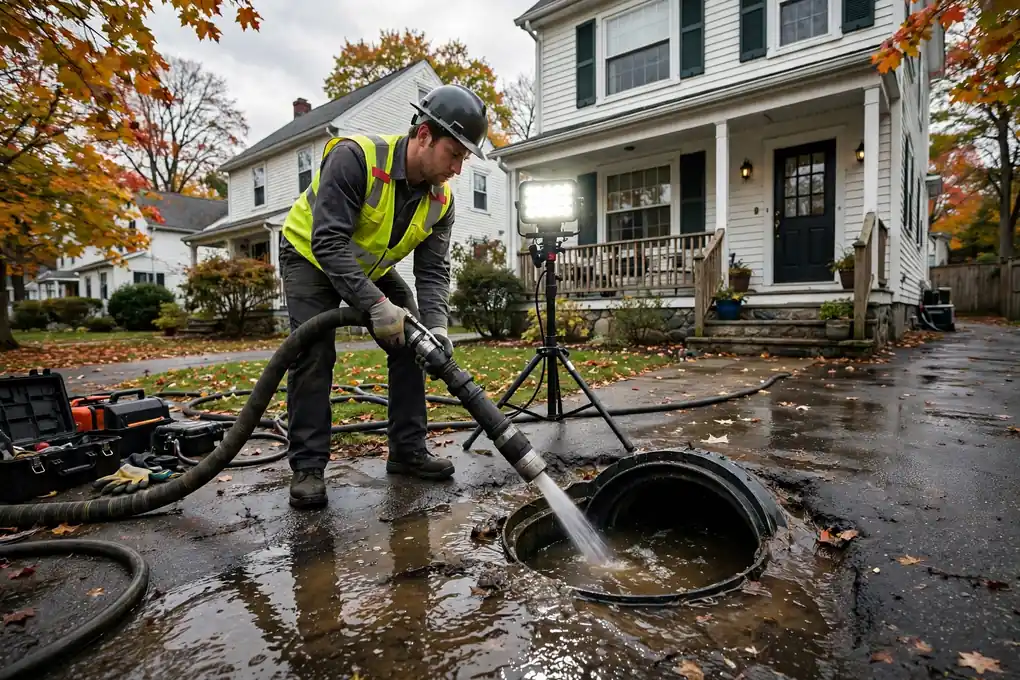
In Middleton, a 'Sewer Emergency' Is Usually a Septic Building-Sewer Emergency
Middleton is the outlier of the North Shore, and emergency response here has to start from one critical fact: roughly 99% of homes have septic systems, not public sewer. So when a Middleton homeowner reports a sewer backup, the work is almost entirely building-sewer (house-to-septic-tank) diagnostics and replacement — not municipal lateral work. The older farmhouses (14% of units pre-1939, including Colonial survivors) combine stone-rubble foundations and original cast-iron building sewers with later septic retrofits, and the cast-iron-to-PVC transition at the foundation wall is the classic failure point. In the post-2000 subdivisions (24% of units — one of the newest stocks in the area), the work skews toward inspection, root intrusion at tank inlets, and grading or drainage fixes around newer PVC lines.
The ground complicates everything. Middleton's wetland-rich terrain — a documented red maple swamp complex with peat bog and nine interconnected ponds — means seasonally high water tables, poorly drained till soils, and wetland buffer constraints on any excavation. Emergency crews plan for shallow, saturated trenches and for the possibility that the backup is a drowned leach field surcharging the building sewer from the far end, not a break near the house. Low-lying lots near wetlands and meadow ponds flood seasonally, and spring melt can push both systems at once.
Middleton jobs also run under the town Board of Health's on-site-system rules — installer permits, inspections, pressure testing of sewer lines — which shape how emergency work is documented and completed. For rapid diagnosis of a building-sewer failure, containment, and repair that respects both the septic system and the wetlands around it, call (833) 713-2101 — dispatch runs around the clock.
Emergency Building-Sewer Repair for Middleton's Septic Town
Middleton changes the definition of a sewer emergency: with roughly 99% of homes on septic systems, the emergency is almost always the building sewer — the line from the house to the septic tank — not a municipal lateral. Diagnosis targets the cast-iron-to-PVC transition at the foundation wall in older farmhouses (the classic failure point), root intrusion at tank inlets, and grading or drainage problems around newer PVC lines in the post-2000 subdivisions. Harold Parker State Forest borders a town where large wooded lots hide long building-sewer runs threading through root zones.
Emergency work here runs under the town Board of Health's on-site-system rules — installer permits, inspections, and pressure testing of sewer lines — so even urgent repairs are documented to code. Crews plan for shallow, saturated trenches in the town's wetland-rich terrain and for the possibility that the backup is a drowned leach field surcharging the building sewer from the far end, not a break near the house. The farm country around Richardson's Ice Cream sits amid the older farmhouse stock with stone-rubble foundations.
After-hours dispatch covers nights, weekends, and spring melt — when high water tables stress both the building sewer and the leach field at once. The emergency order stays the same: contain the backup, camera-diagnose the house-to-tank line, then repair with methods that respect both the septic system and the wetland buffers around it. Trenchless-first approaches keep excavation out of protected resource areas. The Ferncroft multifamily area and the estate subdivisions represent the post-2000 stock where tank-inlet roots are the typical find.
Middleton's Sewer Patterns: Septic Lines in Wetland Country
Middleton is the outlier of the North Shore: about 99% of homes use septic systems, so sewer-line work here means building-sewer diagnostics and replacement plus leach-field-adjacent drain work. The housing mixes older farmhouses (14% of units pre-1939, including Colonial survivors) with one of the area's newest stocks — 24% of units built in 2000 or later, in estate-style subdivisions on large lots.
In the older farmhouses, stone-rubble foundations meet original cast-iron building sewers and later septic retrofits, and the cast-iron-to-PVC transition at the foundation wall is where emergencies start. In the post-2000 subdivisions, the work skews toward inspection, root intrusion at tank inlets, and drainage fixes around newer PVC — failures of grading and roots rather than age. The Philip Knight House (c. 1753) is typical of the Colonial survivors whose retrofits created the foundation-wall transition failures.
The terrain complicates every job: a documented red maple swamp complex with peat bog and nine interconnected ponds, seasonally high water tables, poorly drained till soils, and wetland buffer constraints on excavation. Low-lying lots near wetlands and meadow ponds flood seasonally, and spring melt can surcharge a leach field and a shallow building sewer simultaneously — which is why Middleton backup calls get a system-wide diagnosis, not just a line check.
How a Middleton Sewer Emergency Gets Handled
Call and triage
You describe the backup and confirm the property is on septic. Dispatch notes the home's era — farmhouse or subdivision — and sends a crew versed in building-sewer diagnostics, day or night.
System-wide diagnosis
The camera inspects the house-to-tank line, the foundation-wall transition, and the tank inlet, while the crew assesses whether the leach field is surcharging the line from the far end.
Contain and document
Pumping contains the backup while the failure is isolated. Findings are documented to Board of Health standards — permits, inspection points, and pressure-test requirements shape the repair plan from the start.
Code-compliant repair
The failed section is repaired or replaced per on-site-system rules, with trenchless-first methods near wetland buffers and pressure testing to verify the line before closeout.