
Why Pipe Bursting Suits Beverly's Century-Old Clay Laterals
Beverly carries one of the oldest housing stocks on the North Shore: 43 percent of its homes were built before 1939, and most of them were served by vitrified clay tile laterals. A century of freeze-thaw heave has shifted those clay joints, invited tree roots, and left sections offset far enough that a liner simply cannot bridge the gap. That is the textbook case for pipe bursting — a hydraulic head fractures the old clay outward while pulling a continuous length of HDPE pipe directly behind it, so even laterals with missing or collapsed sections get fully replaced without opening a trench.
Beverly's ground shapes the job as much as its housing. Upland streets sit on Essex-series gravelly sandy loam with dense till just 20 to 30 inches below the surface — compact material that holds the burst cavity open and lets the head displace pipe fragments instead of collapsing back in. That same density is what makes open excavation punishing here: cutting a trench through dense till across a front yard is slow, messy work. Closer to the harbor, conditions flip to very poorly drained tidal-marsh muck with a high water table, where open trenches fill with groundwater as fast as they are dug and bedding gets undermined.
Then there is the streetscape. Narrow downtown streets around Cabot Street leave almost no room to stage excavators and soil stockpiles, and many of Beverly's Victorians and colonials have been divided into apartments — so a torn-up front yard inconveniences several households at once. Pipe bursting works from two small pits at the ends of the run, keeping the street passable and the yard largely intact. And because the replacement is fused, joint-free HDPE, it seals out the harbor-side groundwater infiltration that plagued the old clay bells and joints.
How a Bursting Head Turns a Failed Lateral Into a New HDPE Line
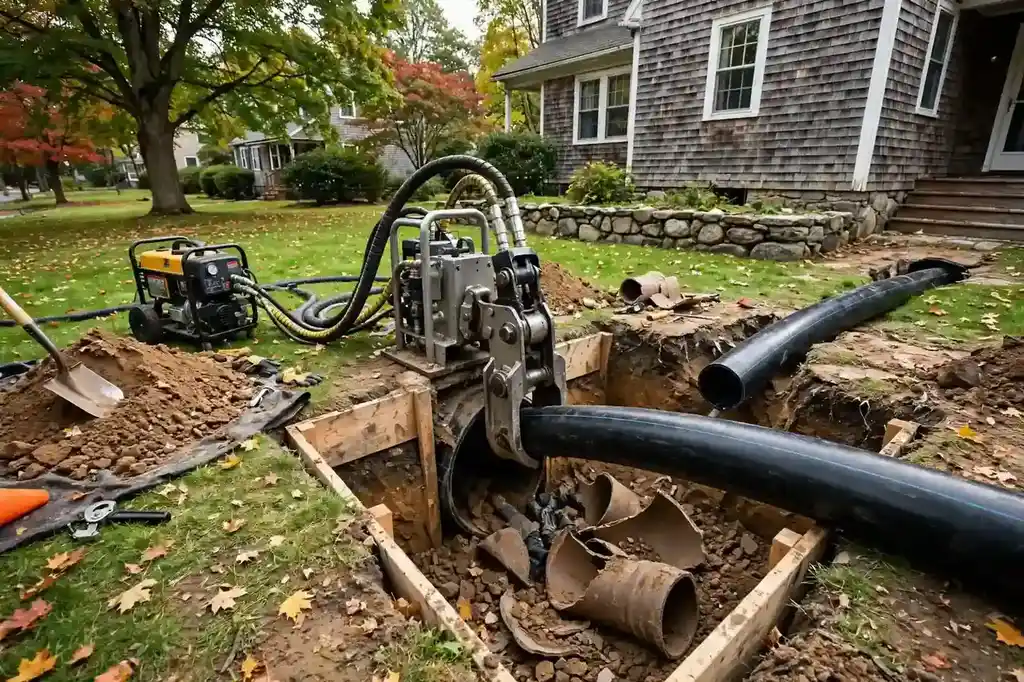
In Beverly's older neighborhoods, the typical bursting job starts with a camera run that finds exactly what 43-percent-pre-1939 housing predicts: shifted clay joints, root masses at the bells, sometimes a section that has collapsed outright. Pipe bursting is chosen precisely for this profile. A cone-shaped bursting head enters the old pipe and shatters it outward into the surrounding soil, while the new high-density polyethylene (HDPE) pipe is fused to the back of the head and drawn through the same bore in one continuous pull. The old pipe never has to come out of the ground — it becomes the guide path for its replacement.
The replacement material matters as much as the method. HDPE is heat-fused section to section, so the new lateral has no joints at all: no bells for roots to find, no hubs for harbor-side groundwater to infiltrate, and enough flexibility to ride out freeze-thaw soil movement that cracked rigid clay bells. Where the old line ran at four inches, the burst can upsize the diameter slightly, which helps on Beverly's divided Victorians and colonials where one lateral now serves multiple households. The fused line is also chemically indifferent to the salt-influenced soil conditions near the harbor that attack old iron connections.
Bursting is the right call — rather than lining or spot repair — when the pipe is too damaged to save: offset joints beyond what a liner can bridge, missing or collapsed sections, or clay tile so riddled with root entries that the pipe is structurally finished. Lining preserves the old diameter and needs an intact host pipe; bursting assumes the host pipe is gone and builds new. On a century-old Beverly lateral with multiple failures along its run, a single bursting pull resolves all of them at once instead of chaining point repairs that each leave the next weak joint untouched.
Beverly's Soil and Streetscape Push Jobs Toward Bursting
Beverly's ground argues for trenchless on almost every street. The upland neighborhoods sit on Essex-series gravelly sandy loam over dense subglacial till just 20 to 30 inches down — compact material that holds the burst cavity open so the head can displace old clay fragments. That same density is exactly what makes open excavation punishing here: cutting a full trench through dense till across a front yard is slow, expensive, and messy work. Near the harbor the profile inverts to very poorly drained tidal-marsh muck with a chronically high water table, where open trenches slump and fill with groundwater as fast as they are dug.
The housing stock gives bursting steady demand: 43 percent of Beverly homes were built before 1939, another 23 percent between 1940 and 1959, and the dominant pre-1940 build used cast iron inside and vitrified clay tile laterals outside. Full basements are standard in pre-1960 homes — fieldstone or rubble in the oldest — which means laterals run deep under established properties. Nor'easter-driven freeze and spring melt keep heaving those clay joints year after year, and the oceanfront Victorians face saltwater-influenced corrosion on top. These are aging-out systems, not maintenance problems, and bursting replaces rather than patches.
Then there is access. The narrow downtown streets around Cabot Street leave almost no room to stage excavators and spoil piles, and many of Beverly's older colonials and Capes have been divided into apartments or condos — so one torn-up front yard inconveniences several households at once. Two small pits, one at the house and one at the curb, keep the street passable and neighbors undisturbed while the new line goes in. The waterfront landmarks — Lynch Park, the Cabot Street corridor, the Endicott and Montserrat campuses — all sit in that same older-street grid.
What a Bursting Job Looks Like in Beverly
Camera mapping and mark-out
A technician runs a camera the full length of the lateral, locates every offset, collapse, and root entry, and marks the pipe path, depth, and utility crossings on the surface. The pull is only scheduled if the line is a genuine bursting candidate — too far gone for lining but with a traceable path.
Digging the two pits
Crews open a small launch pit at the house connection and a receiving pit at the street main, sized to the equipment rather than the run length. Because the work stays inside the old pipe's footprint, the rest of the yard — lawn, plantings, walkway — stays in place.
The bursting pull
The hydraulic head is fed into the old line and drawn through by the surface rig, fracturing the failed clay or iron outward and pulling the fused HDPE replacement behind it in one continuous run. Roots, collapsed sections, and offset joints are eliminated together; where sizing allows, the diameter is increased a step.
Reconnect and restore
The new HDPE line is tied into the house stack and the street main, flow-tested, and the two pits are backfilled, compacted, and finished to match. The yard shows two patch-sized work areas instead of a trench line across the property.