
Pipe Bursting for Burlington's Post-War Ranch and Split-Level Laterals
Burlington is the classic Route 128 post-war suburb — median year built 1963 — and its dominant housing forms are 1950s-to-1970s ranches, split-levels, and split-entries. That core stock was typically built with cast iron inside and clay tile or Transite laterals outside. Transite in particular is brittle with age: it cracks and collapses rather than flexing, which rules out lining and makes it a natural candidate for pipe bursting, since the bursting head fractures the old pipe regardless of material and pulls new HDPE through in the same pass. Because whole subdivision streets were built in the same decade, these laterals are aging out together — cluster failures by street are common.
The split-entry design adds its own wrinkle: the raised sewer exit makes for longer, deeper runs from the house to the street main, which means more feet of pipe to cross and more finished basement to protect. In Burlington those basements typically double as living space, so a sewer backup is a high-damage event — and tearing up a finished lower level to reach a failed line is the outcome homeowners want to avoid. Pipe bursting enters and exits through two pits at the ends of the run, replacing the full length under the slab, the lawn, and the driveway without disturbing the finished space above it.
Groundwater and regulation matter here too. Wetland buffers and brook corridors — Vine Brook, Sandy Brook, Long Meadow Brook — carry seasonally high water tables, and town bylaws protect the surrounding wetlands, marshes, and vernal pools. Bursting keeps the work inside the existing pipe envelope, so there is no open cut through a protected buffer and no wetland-permit fight over a trench. The fused HDPE replacement is joint-free, which also seals out the seasonal infiltration that finds its way into old clay and Transite joints every spring.
Why Brittle Pipe Like Transite Bursts Instead of Getting Lined
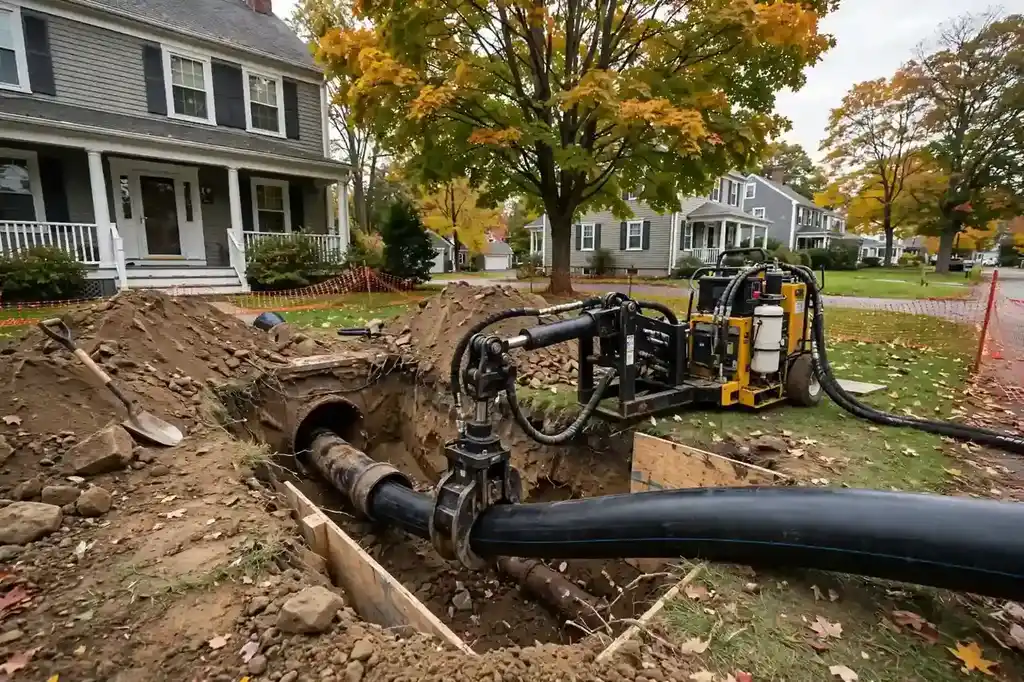
Burlington's post-war subdivisions carry a pipe material that makes the bursting-vs-lining decision easy. Transite — the asbestos-cement pipe used widely in 1950s and 60s laterals — does not flex, stretch, or host a liner reliably once it has aged: it cracks, delaminates, and collapses. The same goes for clay tile laterals with joints offset past the point of no return. Pipe bursting does not need the old pipe to be salvageable. A hydraulic bursting head, pulled by a surface winch through the existing run, shatters the brittle material outward into the surrounding soil and pulls a new high-density polyethylene (HDPE) line through the bore in the same pass — material-independent replacement.
HDPE earns the job on its properties, not just the installation method. It is heat-fused into one continuous length, so there are no joints for roots to invade — the signature failure in Burlington's mature-subdivision tree lines — and no bells for seasonal groundwater to infiltrate. It flexes with freeze-thaw soil movement instead of cracking like Transite, and where the original run was undersized for a split-level's fixture load, the bursting pull can increase the diameter a step. On longer split-entry runs that dive deep from house to street, one pull covers the full distance without intermediate pits.
The right-call test for bursting comes down to three questions a camera inspection answers: Is the pipe structurally failed (collapsed, crushed, or offset beyond a liner's bridge capacity)? Is the material wrong for lining (Transite, Orangeburg, heavily scaled iron)? And is replacement, not repair, the economical choice given the line's age? In Burlington's 1960s subdivisions, where whole streets are aging out together, the answer is routinely yes — one bursting replacement solves the street's repeating backup pattern instead of patching joints one household at a time.
Burlington's Subdivision Stock and Wetland Edges Favor Bursting
Burlington is the classic Route 128 post-war suburb — median year built 1963 — and its ranches, split-levels, and split-entries went in with cast iron inside and clay tile or Transite laterals outside. Because entire subdivision streets were built in the same decade, these laterals are aging out together, and cluster failures by street are common: when one home's Transite lateral collapses under a maple's roots, the neighbors' lines are the same age and in the same condition. Bursting replaces each failed run outright in a single pull rather than patching joints that are all failing at once.
The split-entry design common here adds depth and length to every job: the raised sewer exit produces longer, deeper runs from house to street main, crossing more feet of ground and more finished basement to protect. Burlington basements typically double as living space, so a sewer backup is a high-damage event — and the bursting entry and exit pits sit at the ends of the run, replacing the full length under the slab, lawn, and driveway without disturbing the finished space above it. Wetland buffers along Vine Brook, Sandy Brook, and Long Meadow Brook, with their seasonally high water tables, further punish open trenches that would need dewatering and wetland-permit fights.
Town bylaws protect the wetlands, marshes, and vernal pools around those brook corridors, and bursting keeps the work inside the existing pipe envelope — no open cut through a protected buffer, no soil stockpile on a sensitive corridor. The fused HDPE replacement then seals out the springtime infiltration that old clay and Transite joints admit every year, cutting the groundwater load the system would otherwise carry.
How a Bursting Replacement Runs in Burlington
Inspection and utility mark-out
A camera run maps root entries, cracks, collapses, and offsets, and the crew marks the pipe path, depth, and all crossing utilities. The method is confirmed only if the line is a true bursting candidate — failed beyond lining, with a followable route.
Pit setup at both ends
A launch pit at the house and a receiving pit at the curb are opened, sized to the rig. On deep split-entry runs the pits are deeper, but the count stays at two — the long run between them is never opened.
The pull
The hydraulic head is drawn through the old lateral, fracturing the Transite, clay, or iron outward and pulling the fused HDPE line in behind it. Upsizing happens in this same pass where the design calls for it, giving split-levels the capacity their fixture loads need.
Tie-in and backfill
The new line is connected to the house stack and the street main, tested for flow, and both pits are backfilled and restored. Driveways and landscaping between the pits are left exactly as found.