
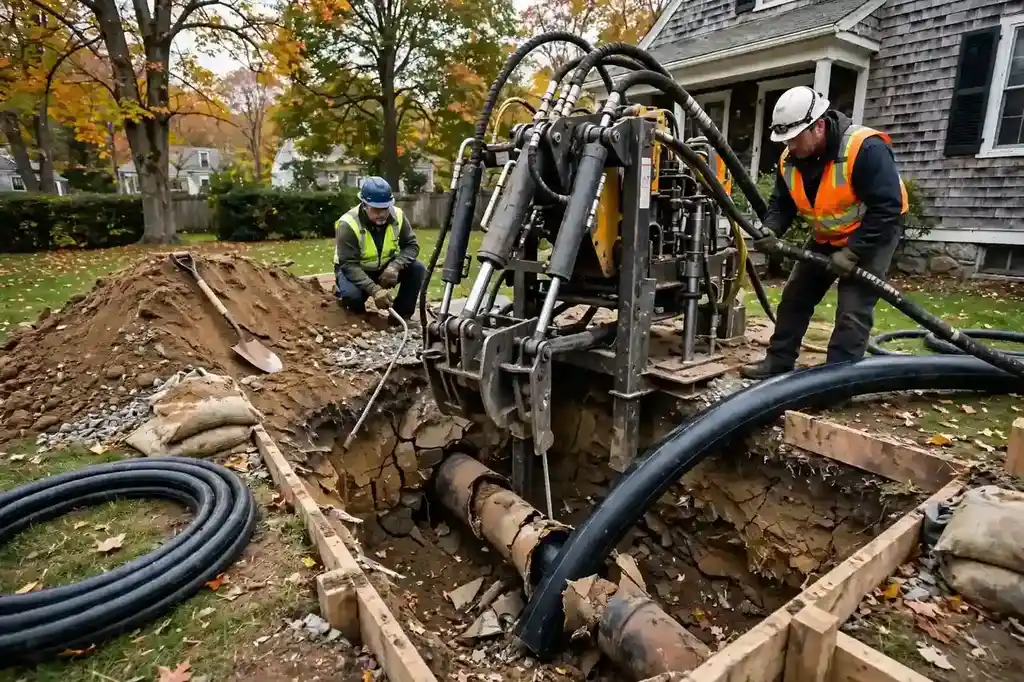
Pipe Bursting Across Danvers' Two Housing Eras
Danvers is a two-era town, and pipe bursting earns its keep in both. In the older south — the First Period farmhouses near landmarks like the Rebecca Nurse Homestead, with fieldstone and rubble foundations and shallow stone cellars — the underground piping is whatever was installed during 20th-century modernization, often in phases, so laterals exit at unusual angles and depths. Bursting handles that irregularity well: the head follows the existing pipe's path and fractures whatever material it meets — clay, brittle cast iron, early concrete — replacing phased retrofits with one continuous HDPE line. In the 1950s-to-1970s tract stock in the north, the job is more straightforward: aging clay-tile laterals with root intrusion, replaced in a single pull under lawns and driveways.
Freeze-thaw is the dominant failure driver here. Heaved joints and offset clay tile are the most common camera finds in Danvers, and the Ipswich River basin's drought-then-deluge cycles make it worse — drought-shrunk soils followed by sudden storms shift old pipes and pry joints open. A fused, joint-free HDPE replacement tolerates that soil movement far better than rigid clay bells ever did, because there are no joints left to heave apart.
On the historic properties, the method's small footprint matters as much as the pipe itself. Fragile rubble foundation walls do not take kindly to excavation alongside them, so bursting from two pits keeps digging away from the stone. Camera inspection stays mandatory on these homes since their pipe history is retrofit rather than original — but once the path is mapped, one pull typically finishes what decades of phased repairs never could.
One Pull That Replaces Phased Retrofits With a Single Line
In Danvers the sewer line under a house is rarely one pipe from one era — it is a 20th-century modernization layered over a much older property, sometimes installed in phases with different materials and odd angles. Pipe bursting is unusually well suited to that reality because the method does not care what it is fracturing. The hydraulic head, drawn through the run by a surface rig, shatters clay tile, brittle cast iron, and early concrete alike, pulling a continuous high-density polyethylene (HDPE) line behind it. Whatever mix of materials the phases left behind, the burst leaves one uniform pipe in its place.
That uniformity is the real product. HDPE is heat-fused into a jointless run, which removes the failure inventory the old line accumulated: no joints for Ipswich-basin drought-and-deluge soil shifts to pry apart, no hubs for roots to colonize, no brittle sections waiting for the next freeze-thaw heave to finish them. The material flexes where rigid clay cracked, and the fused line tolerates the ground movement that Danvers' soils impose every winter. Where the existing diameter is too small for today's household load, the pull can step the size up without a second operation.
Bursting earns the job over lining in two clear situations that Danvers produces constantly. First, the collapsed or missing section: a liner needs an intact host pipe to press against, and phased retrofits often include a section that is simply gone. Second, the irregular path: burst heads follow the existing pipe's route — its angles and depth changes included — while a liner wants a reasonably straight, sound host. When the camera shows a retrofit history instead of a clean original run, bursting is the method that finishes the job.
Two Danvers Eras, One Ground Problem
Danvers is genuinely a two-era town for sewer work. In the older south, First Period farmhouses near landmarks like the Rebecca Nurse Homestead sit on fieldstone and rubble foundations with shallow stone cellars, and their underground piping is whatever 20th-century modernization installed — often in phases, exiting at unusual angles and depths. In the 1950s-to-1970s tract stock in the north, the inventory is more uniform: aging clay-tile laterals with root intrusion under lawns and driveways. Bursting handles both in the same way, because the head follows the existing path and fractures whatever material it meets.
Freeze-thaw is the dominant failure driver across both eras. Heaved joints and offset clay tile are the most common camera finds in Danvers, and the Ipswich River basin's drought-then-deluge cycles make it worse — drought-shrunk soils followed by sudden storms shift old pipes and pry joints open a little further each year. A fused, joint-free HDPE replacement tolerates that movement because there are no joints left to heave apart; the failure mode the camera kept finding simply stops recurring.
On the historic properties the method's footprint matters as much as the pipe. Fragile rubble foundation walls do not take kindly to excavation alongside them, so bursting from two pits keeps all digging away from the stone — no trench undermining a fieldstone wall, no heavy equipment against a 300-year-old foundation. Camera inspection stays mandatory on these homes since the pipe history is retrofit rather than original, but once the path is mapped, one pull typically finishes what decades of phased repairs never could.
The Bursting Sequence on a Danvers Property
Camera survey and route confirmation
The full lateral is televised to document materials, phase changes, angles, collapses, and root masses. On historic homes this also maps where the retrofit piping meets the stone foundation, so the pit can be placed to avoid the masonry.
Launch and receiving pits
Two small pits are opened — one at the house exit, one at the main — sized to the rig, not to the run. The lawn, driveway, and plantings between them are never opened.
Burst and replace in one pass
The hydraulic head travels the old line's route, fracturing clay, iron, and early concrete alike, while the fused HDPE line follows in one continuous length. Offsets, collapsed sections, and root masses are removed together in this single pass.
Connections and finish
The new line is joined to the house stack and the street main, flow-tested, and the pits are backfilled and graded. The property keeps its landscaping; the only evidence of the work is two restored pit areas.