
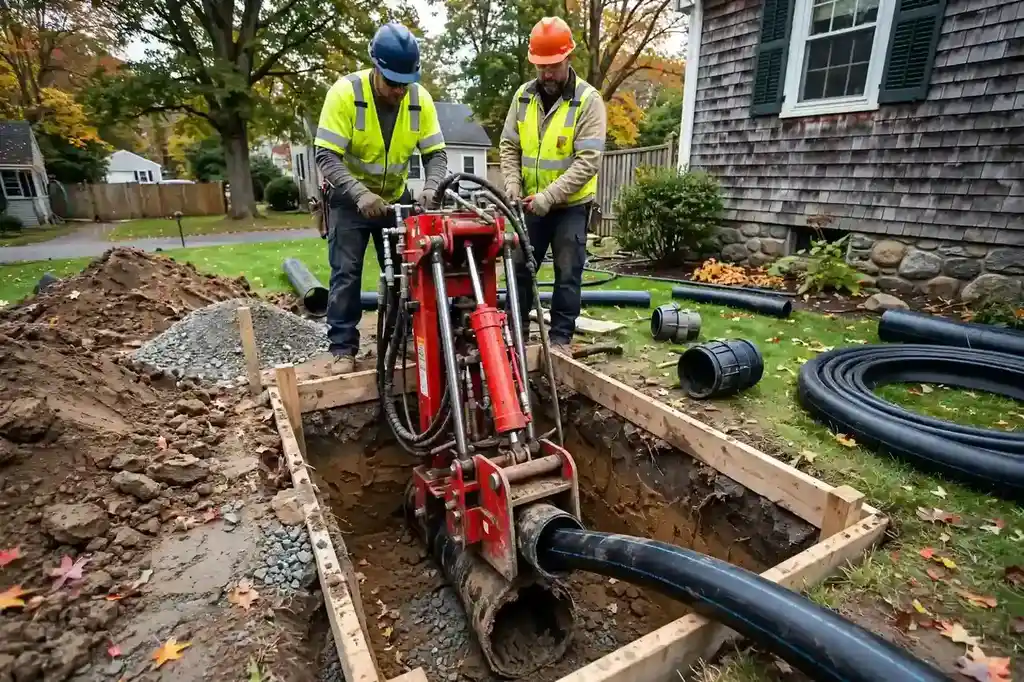
Pipe Bursting in Essex's High-Water-Table Marsh Terrain
Essex sits beside the Great Marsh — more than 20,000 acres of it, the largest salt marsh in New England — on tidal-marsh muck soils that are very poorly drained, with a chronically high water table across much of the town. Open a trench in that ground and it slumps and fills with groundwater as fast as it is dug. Pipe bursting sidesteps the problem entirely: the head fractures the old pipe and pulls the new HDPE through along the existing path, so saturated muck stays where it is and no continuous trench ever needs to stand open. For the town's pre-1940 housing stock — clay tile laterals now 60 to 100-plus years old — that difference decides whether a replacement is practical at all.
Infiltration is the dominant complaint here, not just blockage. Groundwater pours into cracked clay joints around the clock, and tidal surge up the Essex River can back-flood low laterals from the receiving end. A fused, joint-free HDPE line cuts infiltration at the source, because there are no joints left for groundwater to enter. On the low-lying streets near the river, a backwater valve pairs naturally with the new line to handle the tidal-surge side of the problem.
Access argues for trenchless too. Narrow Main Street and Route 133 frontage, plus the antiques-district traffic, make a full excavation a neighborhood event — two small pits are far less disruptive. And open-cut work near the marsh runs into wetland jurisdiction; bursting stays inside the existing pipe envelope, keeping the repair out of the protected resource areas. In the oldest homes, where shallow stone foundations demand hand-careful work, the small-pit approach keeps digging well clear of fragile masonry.
Fracturing the Old Pipe In Place Instead of Digging It Out
The core idea of pipe bursting is simple enough to state in one sentence: instead of excavating the failed pipe, you destroy it underground and let its path guide the replacement. A hydraulic bursting head is pulled through the old lateral by a surface rig, shattering clay tile, cast iron, or early concrete outward into the surrounding soil, while a new high-density polyethylene (HDPE) pipe fused to the head's trailing end is drawn through the bore in one continuous run. In Essex, where opening a trench means fighting saturated muck that collapses as fast as it is dug, that in-place destruction is not a convenience — it is what makes the replacement practical at all.
The replacement line's construction is what solves Essex's dominant complaint. HDPE sections are heat-fused into a single joint-free pipe, so groundwater has no joints to enter — the infiltration that pours into cracked clay bells around the clock simply has no way in. The material is flexible enough to ride out seasonal soil movement, and it does not corrode in the marsh-influenced groundwater that eats at old iron. Where the run can take it, the pull also steps the diameter up, which helps on low-lying streets where the line doubles as a conduit for tidal-influenced flow.
Bursting is chosen over lining when the pipe is beyond lining's reach: collapsed or missing sections, clay so degraded it cannot host a liner, or joints offset past what any liner can bridge. Essex's pre-1940 laterals, now 60 to more than 100 years old, routinely present exactly that profile. Lining preserves diameter and needs an intact host; bursting assumes the old pipe is finished and builds new — one pull replacing the full failed run instead of a sequence of spot repairs that each leave the next bad joint in place.
Marsh Ground and Old Clay Make Essex a Bursting Town
Essex sits beside the Great Marsh — more than 20,000 acres, the largest salt marsh in New England — on tidal-marsh muck soils that are very poorly drained, with a chronically high water table across much of the town. Open a trench in that ground and it slumps and fills with groundwater as fast as it is dug; bedding gets undermined and the trench walls will not stand. Pipe bursting sidesteps the problem entirely: the head fractures the old pipe along its existing path while saturated muck stays where it is, and no continuous trench ever needs to stand open.
The housing stock gives the method its workload: pre-1940 homes with clay tile laterals now 60 to 100-plus years old, their joints long since shifted by a century of freeze-thaw. Infiltration is the dominant complaint here rather than simple blockage — groundwater pours into cracked clay joints around the clock, and tidal surge up the Essex River can back-flood low laterals from the receiving end. A fused, joint-free HDPE line cuts that infiltration at the source, and on the low streets near the river a backwater valve pairs naturally with the new line to handle the tidal-surge side.
Access and regulation seal the argument. Narrow Main Street and Route 133 frontage, plus the antiques-district traffic, turn a full excavation into a neighborhood event; two small pits are far less disruptive. And open-cut work near the marsh runs into wetland jurisdiction, while bursting stays inside the existing pipe envelope, keeping the repair out of the protected resource areas. In the oldest homes, where shallow stone foundations demand careful hand work, the small-pit approach keeps digging well clear of fragile masonry.
A Bursting Job in Essex's Marsh Terrain
Camera inspection and tidal check
The lateral is televised to map collapses, offsets, and infiltration points, and the crew notes tidal influence on the line — in low areas the camera can show surge-driven backflow that the repair plan must account for.
Two pits, no trench
A launch pit at the house and a receiving pit at the main are opened. Because saturated muck will not hold an open cut, the pits are kept compact and shored as needed; the run between them is never opened.
Fracture and pull
The hydraulic head is drawn through, shattering the old clay and pulling the fused HDPE line behind it in one continuous length. The old pipe's fragments stay buried; the new line occupies the same envelope, sealed against groundwater at every former joint.
Tie-in, valve, and restore
The new line is connected at both ends and flow-tested; where tidal backflow was documented, a backwater valve is discussed with the homeowner. Pits are backfilled, compacted, and finished to grade.