
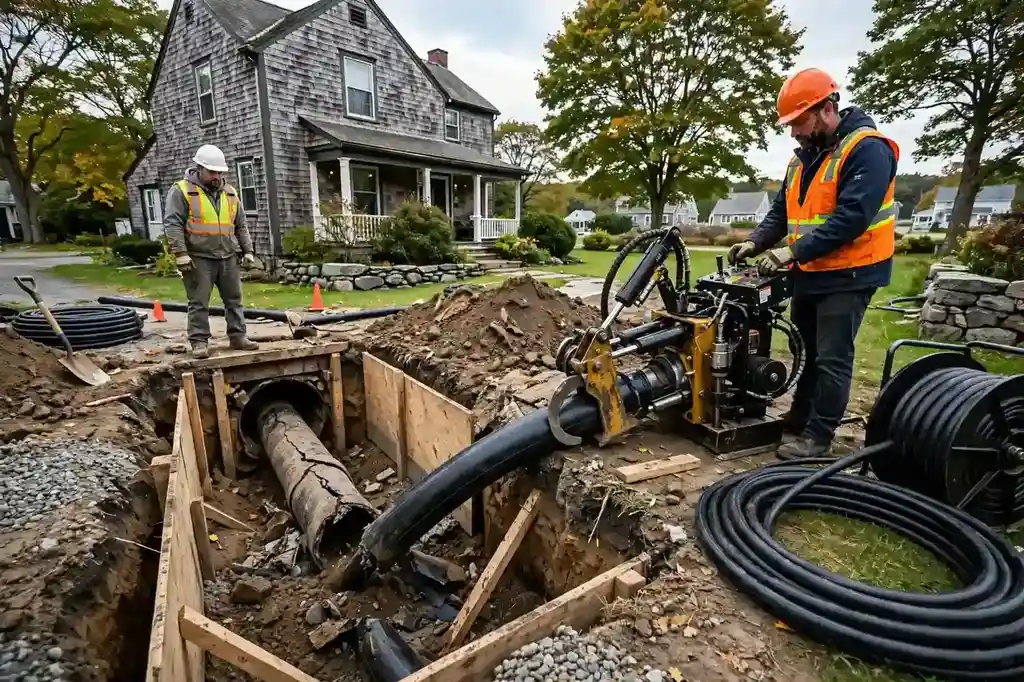
Pipe Bursting Where Trenching Meets Cape Ann Granite
Gloucester is the ledge town. Cape Ann granite sits close to the surface nearly everywhere, and the native soil — the USDA's Annisquam series was typed in Gloucester itself — is a thin, rocky fine sandy loam over dense till just 20 to 30 inches down, carrying 5 to 25 percent cobbles and stones. Trenching for a full lateral replacement routinely turns into rock excavation, which is why open-cut is the expensive exception here and trenchless is the practical default. Pipe bursting follows the existing pipe's path, fracturing the old line and pulling new HDPE through — the granite around the old trench confines the burst instead of needing to be excavated itself.
The harbor-adjacent homes are the highest-risk combination in town: 150-to-300-year-old stone foundations with shallow or partial basements, plus retrofitted clay and cast-iron laterals, sitting over high groundwater near the Inner Harbor. Camera inspection is mandatory before any work — infiltration from that groundwater has to be mapped, not guessed at — and the fused, joint-free HDPE that bursting installs seals out the infiltration the old joints were admitting.
Staging argues for compact equipment as well. The steep, narrow streets of the East Gloucester hills and Rocky Neck leave little room for excavators, and the dense sea-captain-era streetscapes around East Gloucester Square do not forgive a torn-up road. A bursting rig works from two pits with a fraction of the footprint, and on low harbor streets a backwater valve belongs in the same conversation, since storm-surge backflow is a genuine exposure here rather than a theoretical one.
Replacing Pipe Through Rock Without Excavating Rock
In most towns, a failed sewer lateral is a digging job. In Gloucester it is a rock job, and pipe bursting exists precisely to skip the rock. The method's logic is inverted from open excavation: instead of digging a new path for the replacement pipe, the replacement travels the old pipe's path. A hydraulic bursting head is pulled through the existing lateral, fracturing clay tile, cast iron, or early concrete outward into the soil, while a new high-density polyethylene (HDPE) pipe fused behind the head fills the same bore in one continuous run. The Cape Ann granite that makes trenching brutal becomes an ally — the surrounding rock confines the burst and keeps the bore stable while the head works.
The HDPE line that results is built for Gloucester's specific punishments. It is heat-fused into a single jointless pipe, so the high groundwater near the Inner Harbor has no joints to infiltrate — the camera-mapped infiltration that plagues old clay bells simply ends. The material flexes with freeze-thaw ground movement instead of cracking, and it does not corrode in salt-influenced soil and spray that attack exposed cast iron. Because the bore already exists, the whole operation runs from two compact pits — a staging footprint that fits Gloucester's steep, narrow streets where a full excavation spread cannot.
Bursting is the right call here whenever the line is too far gone for lining and the ground is too hard to trench — which describes most failed laterals in this town. Collapsed sections, missing pipe, offsets beyond a liner's reach: all are bursting cases, not lining cases. And where the original diameter is too small for the household it serves, the pull can upsize in the same pass. On a ledge town, the method that never asks the rock to move is the method that keeps the job predictable.
Cape Ann Granite and Harbor Water Tables Shape Every Job
Gloucester is the ledge town. Cape Ann granite sits close to the surface nearly everywhere, and the native soil — the USDA's Annisquam series was typed in Gloucester itself — is a thin, rocky fine sandy loam over dense till just 20 to 30 inches down, carrying 5 to 25 percent cobbles and stones. Trenching a full lateral replacement routinely turns into rock excavation, which is why open-cut is the expensive exception and trenchless is the practical default. Bursting follows the existing pipe's path with no new rock trench to dig and no ledge to blast; camera inspection first maps exactly where the pipe dives under ledge so the pull can be planned around it.
The harbor-adjacent homes are the highest-risk combination in town: 150-to-300-year-old stone foundations with shallow or partial basements, retrofitted clay and cast-iron laterals, sitting over high groundwater near the Inner Harbor. Infiltration from that groundwater must be mapped, not guessed at, and the fused, joint-free HDPE that bursting installs seals out the infiltration the old joints were admitting. On low harbor streets, storm-surge backflow is a genuine exposure rather than a theoretical one, so a backwater valve belongs in the same conversation as the replacement.
Staging argues for compact equipment as well. The steep, narrow streets of the East Gloucester hills and Rocky Neck leave little room for excavators, and the dense sea-captain-era streetscapes around East Gloucester Square do not forgive a torn-up road. A bursting rig working from two pits needs a fraction of the footprint, and the short surface disruption keeps the neighborhood intact while the new line goes in below.
Bursting a Lateral Through Gloucester Ledge
Camera mapping with ledge notes
The lateral is televised end to end, with the crew noting where the pipe passes under or alongside ledge outcrops and where infiltration enters. The pull plan is built around the rock, not through it.
Compact pit setup
A launch pit at the house and a receiving pit at the main, kept small to fit tight streets and steep grades. Spoil volume stays minimal because the run between pits is never opened.
Breaking pipe along the rock corridor
The hydraulic head fractures the old line along its existing route — the surrounding granite confining the burst — and the fused HDPE follows in one continuous length. Collapsed clay, broken iron, and root masses are eliminated in the pass.
Tie-in and surface restore
The new line is connected to the house stack and the street main, flow-tested, and the two pits are backfilled and finished. Streetscapes, curbs, and walkways remain as they were.