
Pipe Bursting Under Lynn's Dense Triple-Decker Lots
Lynn's housing stock is old and dense: median year built 1925 citywide, and 1910 in the Lynn English neighborhood, with block after block of two- and three-family houses, workers' cottages, and multifamily walk-ups from the shoe-factory boom. The laterals under those lots are typically vitrified clay tile with cast-iron house stacks — and they have had a century of freeze-thaw movement and root intrusion to work on the joints. Clay-tile joints from this era are the classic failure point: they shift, crack, and admit roots until sections offset or collapse beyond what any liner can bridge. That is where pipe bursting takes over, fracturing the failed pipe outward and pulling new HDPE through in its place.
Digging is the hard part in Lynn, and it is tight. Small lots, narrow side yards, and shared driveways mean a full open trench would tear out walkways, fences, and neighbor-adjacent plantings — and stall a driveway shared with another household. Pipe bursting works from two pits, one at the house and one at the curb, keeping the footprint small enough to fit the lot and keeping shared driveways in use while the work happens.
The coastal pockets near Lynn Shore Drive add a second wrinkle: high seasonal water tables and salt-influenced, corrosive soil. Saturated trenches slow excavation to a crawl and the salt air and brackish groundwater corrode cast-iron house connections faster than inland equivalents. Bursting avoids the open saturated trench entirely, and the replacement pipe — fused HDPE with no joints — is immune to the salt-driven corrosion eating the old iron. Shallow cover over old lines near the shore also makes these laterals vulnerable to surface disturbance, and a guided underground pull disturbs the surface far less than grading a trench across it.
Full Replacement That Fits Inside a Triple-Decker Lot
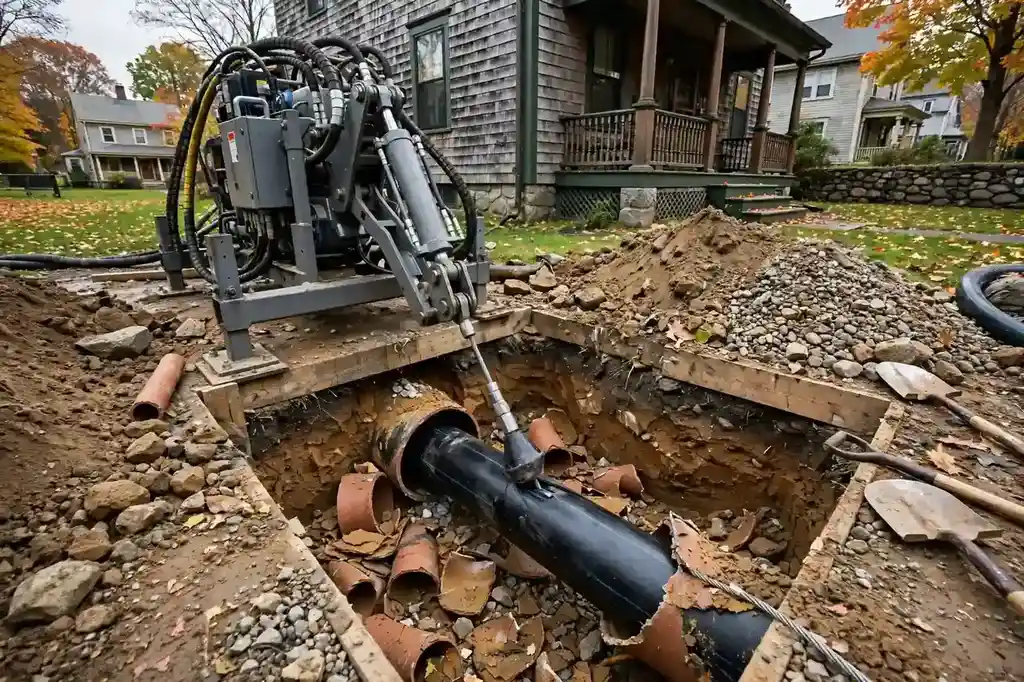
The constraint on a Lynn sewer job is rarely the pipe — it is the lot. Small parcels, narrow side yards, and driveways shared with the next household make a full open trench impractical before the first shovel hits ground. Pipe bursting inverts the geometry: the replacement travels the old pipe's underground path, so the surface footprint shrinks to two pits — one at the house, one at the curb. A hydraulic head, pulled by a surface rig, fractures the failed vitrified clay or cast iron outward into the soil while a new high-density polyethylene (HDPE) line fused to the head's trailing end follows through the same bore in one continuous pull.
The HDPE that replaces Lynn's old clay is built for what the camera keeps finding. It is heat-fused into one jointless length, so roots can no longer enter at the bells and offsets that a century of freeze-thaw heave opened up, and the salt-influenced groundwater near Lynn Shore Drive has no joints to infiltrate. The material flexes with ground movement instead of cracking, and it is immune to the salt-air corrosion that eats old cast-iron house connections. Where a multi-family line is undersized for the households it serves, the pull can step the diameter up in the same pass.
Bursting takes the job over lining precisely when the camera shows what Lynn's oldest lines show: joints shifted, cracked, and root-packed past the point where a liner could bridge them, or sections collapsed outright. Lining needs an intact host pipe and preserves the old diameter; bursting assumes the pipe is finished and builds a new line to modern standards. On a block of 1910s triple-deckers in Lynn English or downtown, where every lateral is the same age and in the same condition, that one-pull replacement is the repair that ends the repeating backup cycle instead of deferring it.
Dense Lots, Old Clay, and Salt Air Define Lynn's Bursting Jobs
Lynn's housing stock is old and dense: median year built 1925 citywide, 1910 in the Lynn English neighborhood, with block after block of two- and three-family houses, workers' cottages, and multifamily walk-ups from the 1850–1920 shoe-factory boom. The laterals under those lots are typically vitrified clay tile with cast-iron house stacks — and they have had a century of freeze-thaw movement and root intrusion working on the joints. Clay-tile joints from this era shift, crack, and admit roots until sections offset or collapse beyond what any liner can bridge, which is the classic bursting trigger.
Digging is tight here by simple geometry. Small lots, narrow side yards, and shared driveways mean a full open trench would tear out walkways, fences, and neighbor-adjacent plantings — and stall a driveway shared with another household. Bursting's two pits keep the footprint small enough to fit the lot and keep shared driveways in use while the work happens. Some triple-deckers and small cottages sit on shallow crawl spaces or piers, which further complicates any excavation approach near the building.
The coastal pockets near Lynn Shore Drive add a second wrinkle: high seasonal water tables and salt-influenced, corrosive soil. Saturated trenches slow excavation to a crawl and brackish groundwater corrodes cast-iron house connections faster than inland equivalents; shallow cover over old lines near the shore also makes these laterals vulnerable to surface disturbance. Bursting avoids the open saturated trench entirely, and the fused HDPE replacement is indifferent to salt-driven corrosion. A guided underground pull disturbs the surface far less than grading a trench across it.
How Bursting Works on a Lynn Lot
Camera inspection and path marking
The lateral is televised to document offsets, collapses, root masses, and the house-connection condition. The pipe route is marked on the surface so both pits land exactly on the line with no exploratory digging.
House pit and curb pit
A small pit at the house connection and one at the curb or main. On shared driveways the pits are placed to keep the driveway passable — the work zone is the pit, not the whole lot.
The underground pull
The hydraulic head fractures the failed clay or iron along the existing route while the fused HDPE line follows in one continuous length. Roots, collapsed sections, and offset joints are replaced together; upsizing happens in this same pass where the design calls for it.
Reconnect, test, restore
The new line is tied into the house stack and the street main, flow-tested, and the pits are backfilled, compacted, and finished. Walkways, fences, and plantings between the pits are untouched.