
Pipe Bursting Around Marblehead's Shallow Bedrock and Historic-District Rules
Marblehead is a sewer contractor's hardest geology on the North Shore. The town sits on hard Proterozoic rhyolite of the Lynn volcanic complex with frequent bedrock outcrops, covered by only thin glacial till — laterals often lie in shallow rock trenches with poor cover. Open-trench replacement here regularly turns into rock excavation, which is why trenchless methods are so often the practical path: pipe bursting follows the existing pipe's route, fracturing the old line and pulling new HDPE through, with no new rock trench to dig and no ledge to blast. Camera inspection maps exactly where the pipe dives under ledge so the pull can be planned around it.
Nearly 300 homes in Marblehead survive from before the American Revolution, clustered in the narrow, twisting streets of the Old Town historic district — and the district's exterior-alteration approval requirements mean any surface disturbance faces preservation review. Bursting leaves the streetscape untouched: no torn-up granite curbs, no lifted historic walkways, no excavator parked on a 17th-century lane. Compact rigs and minimal-dig methods are a practical necessity for both permitting and staging on those tight lot lines.
Near the harbor and the Neck, the water table is documented as running high — town standards note areas where finished grade sits less than four feet above it — and nor'easter surge adds saltwater pressure on top. Saturated trench conditions make open excavation miserable and infiltration-driven backups a storm-season reality. The fused, joint-free HDPE that bursting installs seals out that infiltration at the source, and on low harbor streets the backup-prevention conversation matters as much as the pipe replacement itself.
The Trenchless Answer to Shallow Rock and Historic Streets
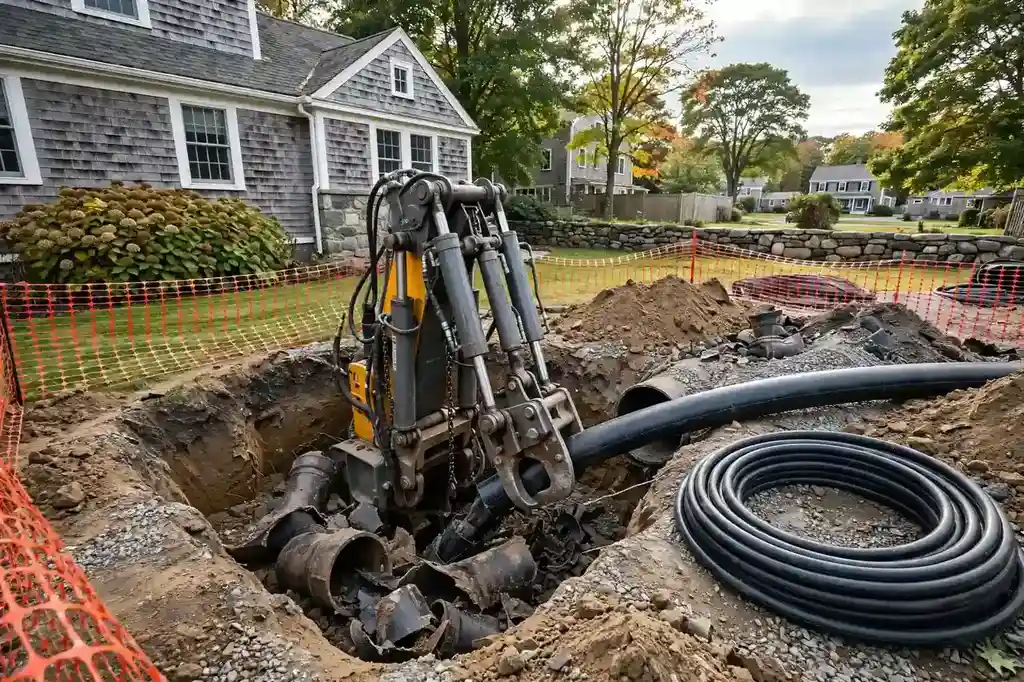
Marblehead presents the two conditions that make open excavation the worst option at once: rock near the surface and a historic district that punishes surface disturbance. Pipe bursting answers both with the same move. The replacement does not need a new path — it travels the old pipe's existing route. A hydraulic bursting head, drawn through the lateral by a surface rig, fractures clay tile, cast iron, or early concrete outward into the soil while a new high-density polyethylene (HDPE) pipe fused to the head's trailing end follows through the same bore in one continuous run. No new rock trench is dug, no ledge is blasted, and no historic walkway is lifted.
The resulting HDPE line is specified for Marblehead's waterfront punishments. It is heat-fused into a single jointless pipe, so the documented high water table near the harbor and the Neck has no joints to infiltrate — the infiltration-driven backups that follow nor'easter season simply lose their entry points. The material flexes with freeze-thaw ground movement instead of cracking like the rigid clay it replaces, and it does not corrode in salt spray and sea air that attack exposed cast iron. The bore already exists under the rock, so the operation stages from two compact pits sized for Old Town's tight lot lines.
Bursting wins over lining in Marblehead's two recurring cases: the shallow rock trench where laterals lie with poor cover and the line is too degraded to host a liner, and the collapsed or missing section that lining cannot bridge at all. Lining also preserves the old diameter; bursting can upsize in the same pass where the household's loads demand it. On a peninsula where every open cut is either rock excavation or a preservation review, the method that does neither is the practical default.
Rhyolite Bedrock, 300 Pre-Revolution Homes, and High Water Tables
Marblehead is a sewer contractor's hardest geology on the North Shore. The town sits on hard Proterozoic rhyolite of the Lynn volcanic complex with frequent bedrock outcrops, covered by only thin glacial till — laterals often lie in shallow rock trenches with poor cover. Open-trench replacement here regularly turns into rock excavation, which is why trenchless methods are the practical path: bursting follows the existing pipe's route with no new rock trench to dig. Camera inspection maps exactly where the pipe dives under ledge so the pull can be planned around it.
Nearly 300 homes survive from before the American Revolution, clustered in the narrow, twisting streets of the Old Town historic district — and the district's exterior-alteration approval requirements mean any surface disturbance faces preservation review. Bursting leaves the streetscape untouched: no torn-up granite curbs, no lifted historic walkways, no excavator parked on a 17th-century lane. Compact rigs and minimal-dig methods are a practical necessity for both permitting and staging on those tight lot lines.
Near the harbor and the Neck, the water table is documented as running high — town standards note areas where finished grade sits less than four feet above it — and nor'easter surge adds saltwater pressure on top. Saturated trench conditions make open excavation miserable and infiltration-driven backups a storm-season reality. The fused, joint-free HDPE that bursting installs seals out that infiltration at the source, and on low harbor streets the backup-prevention conversation matters as much as the pipe replacement itself.
Bursting Without Touching the Streetscape
Camera survey with rock and water notes
The lateral is televised to map collapses, offsets, root entries, and infiltration points, with the crew noting where the pipe passes under ledge and where the high water table is entering. The pull is planned around both.
Two compact pits
A launch pit at the house and a receiving pit at the main, kept small for tight Old Town lot lines. No trench crosses the street, the sidewalk, or the yard between them.
Bursting over shallow bedrock
The hydraulic head fractures the old line along its existing route and the fused HDPE follows in one continuous length. The work happens entirely underground; the streetscape above sees only the two pit work areas.
Tie-in and invisible finish
The new line is connected at both ends, flow-tested, and the pits are backfilled and finished to match. Granite curbs, historic walkways, and landscaping remain exactly as they were.