
Pipe Bursting for Middleton's House-to-Septic-Tank Building Sewers
Middleton is the outlier in this service area: about 99 percent of homes run on septic systems, not public sewer, so sewer-line work here overwhelmingly means the building sewer — the line from the house to the septic tank. In the town's older farmhouses, that line is often original cast iron, and the classic failure point is the cast-iron-to-PVC transition at the foundation wall, where decades of movement and corrosion open the joint. Where the iron has scaled shut or collapsed, lining cannot restore it — but pipe bursting can: the head fractures the deteriorated iron outward and pulls a new HDPE building sewer through in one pass, re-establishing full bore from the foundation to the tank.
The ground here argues for trenchless on its own merits. Middleton's terrain is wetland-rich — a documented red maple swamp complex with peat bog and nine interconnected ponds at the former golf course site — with seasonally high water tables and poorly drained till soils. Open trenches go saturated fast, and any excavation near the tank or leach field risks disturbing the drainfield the whole system depends on. Bursting keeps the work inside the existing pipe footprint: two pits, no long open cut, and the leach field stays untouched.
Regulation shapes every job too. Middleton Board of Health on-site-system rules — installer permits, inspections, pressure testing of sewer lines — govern this work, and trenchless methods keep the repair within the already-disturbed pipe corridor, which simplifies the wetland-buffer picture considerably. In the post-2000 subdivisions, where the stock is newer PVC, the work skews toward inspection, root intrusion at tank inlets, and grading fixes — but on the older farmhouses with failing iron, bursting remains the cleanest full replacement available.
Bursting the Building Sewer: House to Tank in One Pull
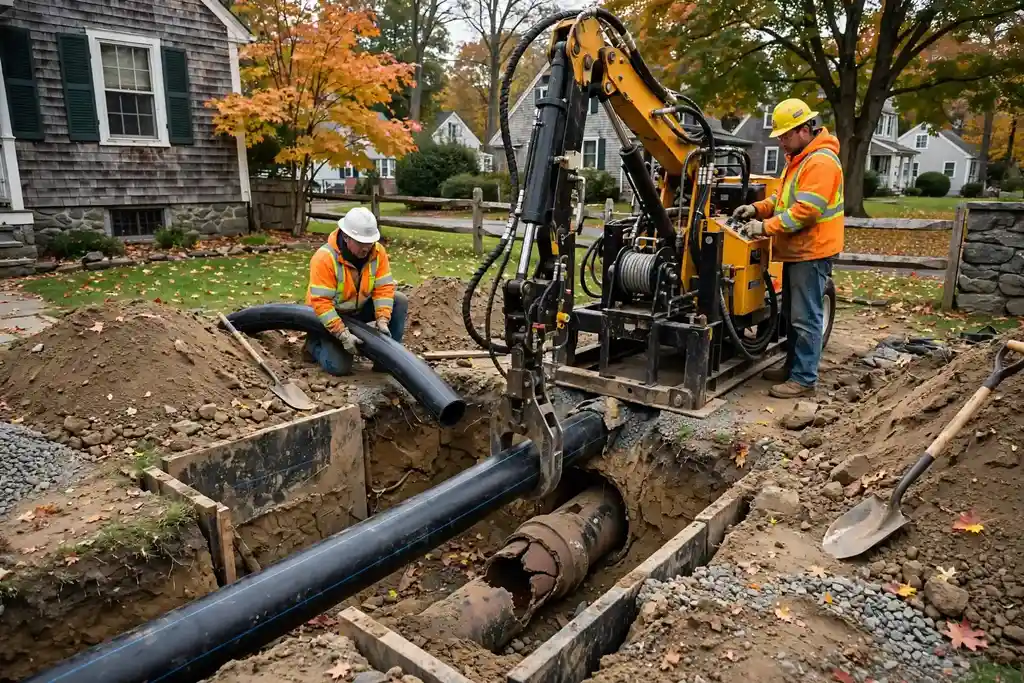
In Middleton, 'sewer line' work almost never means a municipal lateral — it means the building sewer, the line from the house to the septic tank. The failure profile is specific: original cast iron in older farmhouses, with the classic break at the cast-iron-to-PVC transition where the line exits the foundation wall. Where that iron has scaled shut, corroded through, or collapsed, lining cannot restore a bore that no longer exists. Pipe bursting can. A hydraulic head, pulled by a surface rig from a pit at the house toward a pit at the tank, fractures the deteriorated iron outward into the soil while a new high-density polyethylene (HDPE) building sewer fused behind the head follows through the same bore in one continuous pull.
The HDPE replacement is specified for what a septic-side line endures. It is heat-fused into a jointless run, so roots cannot re-enter at the tank inlet — the recurring Middleton failure — and there are no joints for the seasonally high water table to infiltrate. The smooth bore restores full flow from foundation to tank, and the material's flexibility tolerates the soil movement that keeps cracking rigid iron at the foundation exit. Because the pull runs house-to-tank, the leach field beyond the tank is never touched: the entire job stays in the already-disturbed pipe corridor.
Bursting is the right call when the building sewer is structurally finished rather than merely leaking: scaled-shut iron, collapsed sections, or a transition joint so deteriorated that lining would seal a pipe with no remaining strength. On post-2000 subdivision homes with newer PVC, the work skews toward inspection and grading fixes instead — but on the older farmhouses with failing iron, one bursting pull re-establishes the full-bore connection the system depends on, without an open cut across the yard or anywhere near the drainfield.
Septic Country: Wetlands, Old Farmhouses, and Health-Department Rules
Middleton is the outlier in this service area: about 99 percent of homes run on septic systems, not public sewer, so sewer-line work here overwhelmingly means the building sewer — the line from the house to the septic tank. In the town's older farmhouses, that line is often original cast iron, and the classic failure point is the cast-iron-to-PVC transition at the foundation wall, where decades of movement and corrosion open the joint. Where the iron has scaled shut or collapsed, lining cannot restore it — but pipe bursting fractures the deteriorated iron outward and pulls a new HDPE building sewer through in one pass.
The ground argues for trenchless on its own merits. Middleton's terrain is wetland-rich — a documented red maple swamp complex with peat bog and nine interconnected ponds at the former golf course site — with seasonally high water tables and poorly drained till soils. Open trenches go saturated fast, and any excavation near the tank or leach field risks disturbing the drainfield the whole system depends on. Bursting keeps the work inside the existing pipe footprint: two pits, no long open cut, and the leach field stays untouched.
Regulation shapes every job too. Middleton Board of Health on-site-system rules — installer permits, inspections, pressure testing of sewer lines — govern this work, and trenchless methods keep the repair within the already-disturbed pipe corridor, which simplifies the wetland-buffer picture considerably. In the post-2000 subdivisions, where the stock is newer PVC, the work skews toward inspection, root intrusion at tank inlets, and grading fixes — but on the older farmhouses with failing iron, bursting remains the cleanest full replacement available.
How a House-to-Tank Burst Runs in Middleton
Camera inspection of the building sewer
The line from the foundation exit to the septic tank is televised to map the transition joint, scaling, collapses, and root entries at the tank inlet. The tank's location and the leach field boundary are confirmed so the work stays clear of both.
Pits at house and tank
A small pit at the foundation exit and one at the tank inlet are opened. The yard between them — and the drainfield beyond — is never trenched.
Pulling the new building sewer
The hydraulic head fractures the failed cast iron along the existing house-to-tank route while the fused HDPE building sewer follows in one continuous length. The full bore is re-established from foundation wall to tank in a single pass.
Reconnect, test, and restore
The new line is tied into the house stack and the tank inlet, pressure-tested per Board of Health requirements, and flow-tested. The pits are backfilled and restored; the leach field and landscaping are untouched.