
Pipe Bursting in Revere's Saturated Filled-Marsh Ground
Revere's sewer work starts with geology you can read in a single sentence from city history: the ground below is marsh. Roughly 43 percent of the neighboring Rumney Marsh was filled between 1803 and 2007, and Revere's filled-marsh neighborhoods sit on compressible, saturated fill with a water table that often runs near basement-floor level. Laterals here run through ground that will not hold a trench — excavation walls slump in the loose fill, shoring is standard practice, and dewatering a trench that refills from the water table is a losing battle. Pipe bursting does not need a standing trench at all: the head pulls the new pipe through the existing path while the ground stays put, which is the fundamental reason it fits Revere better than open excavation.
Infiltration here is chronic rather than seasonal. Groundwater pushes upward through any defect year-round, and the early-1900s beachfront multi-families stack the wastewater loads of several households onto short clay runs with century-old joints. Tidal and surge-driven groundwater adds pressure from below during coastal storms. In those conditions, post-repair sealing matters more than raw pipe strength — and the fused, joint-free HDPE that bursting installs is watertight in a way sectional clay pipe never was.
Near the marsh itself, the regulatory picture favors trenchless just as strongly. Rumney Marsh is an Area of Critical Environmental Concern, and the city Conservation Commission has enforced against unauthorized fill near it — any open-cut work near the marsh edge faces permit scrutiny. Bursting stays inside the existing pipe envelope, which keeps the repair out of that jurisdiction entirely. For the beachfront blocks and the marsh-adjacent streets alike, the smallest possible surface footprint is not just convenient; it is the difference between a straightforward job and a permitted one.
Replacing Pipe in Ground That Will Not Hold a Trench
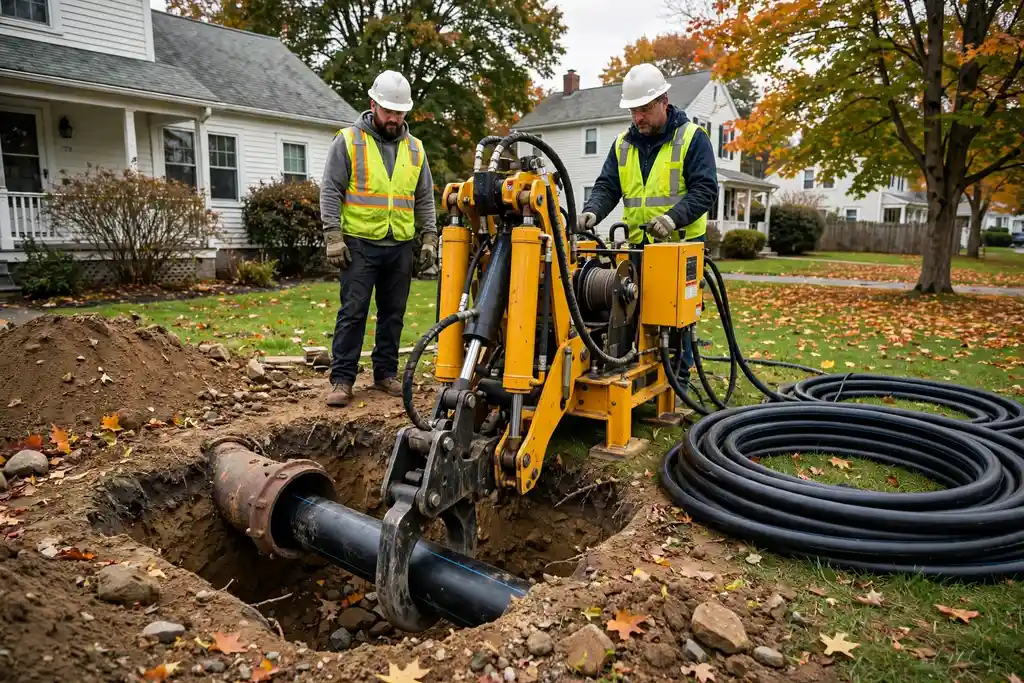
Revere's defining ground condition — saturated, compressible filled marsh — is the reason pipe bursting is specified here more often than anywhere else in the service area. The method's entire premise is that no standing trench is needed: instead of excavating the failed pipe, a hydraulic head is pulled through the existing lateral by a surface rig, fracturing the old clay or iron outward into the fill while a new high-density polyethylene (HDPE) line fused to the head's trailing end follows through the same bore in one continuous pull. In ground that slumps the moment it is opened, the replacement must travel the pipe's existing path — and bursting is the method that does exactly that.
The HDPE line answers Revere's second condition: chronic infiltration. Groundwater pushes upward through any defect year-round here, not just in spring, and the early-1900s beachfront multi-families stack several households' wastewater onto short clay runs with century-old joints. The new line is heat-fused into a single jointless pipe, so infiltration has no joints to enter — post-repair sealing matters more than raw pipe strength in this town, and a fused line is watertight in a way sectional clay pipe never was. The material also resists the salt-influenced corrosion that attacks old iron connections near the beach.
Bursting is the right call over lining when the camera shows what Revere's oldest stock shows: clay joints shifted by compressible fill, sections collapsed in loose ground, or multi-family laterals undersized for the stacked loads they carry. Lining needs an intact host pipe and preserves the old diameter; bursting replaces the pipe entirely and can upsize it in the same pass. And near Rumney Marsh — an Area of Critical Environmental Concern where the Conservation Commission has enforced against unauthorized fill — the method's in-pipe footprint keeps the repair out of permit jurisdiction that an open trench would trigger.
Filled Marsh, High Water Tables, and Stacked Multi-Family Loads
Revere's sewer work starts with geology you can read in a single sentence from city history: the ground below is marsh. Roughly 43 percent of the neighboring Rumney Marsh was filled between 1803 and 2007, and Revere's filled-marsh neighborhoods sit on compressible, saturated fill with a water table that often runs near basement-floor level. Laterals here run through ground that will not hold a trench — excavation walls slump in the loose fill, shoring is standard practice, and dewatering a trench that refills from the water table is a losing battle. Bursting needs no standing trench at all, which is the fundamental reason it fits Revere better than open excavation.
Infiltration here is chronic rather than seasonal. Groundwater pushes upward through any defect year-round, and the early-1900s beachfront multi-families stack the wastewater loads of several households onto short clay runs with century-old joints. Tidal and surge-driven groundwater adds pressure from below during coastal storms. In those conditions, post-repair sealing matters more than raw pipe strength — and the fused, joint-free HDPE that bursting installs is watertight in a way sectional clay pipe never was.
Near the marsh itself, the regulatory picture favors trenchless just as strongly. Rumney Marsh is an Area of Critical Environmental Concern, and the city Conservation Commission has enforced against unauthorized fill near it — any open-cut work near the marsh edge faces permit scrutiny. Bursting stays inside the existing pipe envelope, which keeps the repair out of that jurisdiction entirely. For the beachfront blocks and the marsh-adjacent streets alike, the smallest possible surface footprint is not just convenient; it is the difference between a straightforward job and a permitted one.
Bursting in Saturated Fill: The Revere Sequence
Camera inspection with infiltration mapping
The lateral is televised to map collapses, offsets, and root entries, with the crew documenting where groundwater is entering — in Revere the infiltration pattern often matters as much as the blockage. Multi-family load sizing is checked against the existing diameter.
Two compact pits, no dewatering
A launch pit at the building and a receiving pit at the main are opened. Because the fill will not hold an open cut, the pits stay compact and the run between them is never trenched — no dewatering operation, no shoring along a trench line.
Pulling through marsh fill
The hydraulic head breaks the old clay or iron apart along the existing route while the fused HDPE line follows right behind in one continuous length. The saturated fill stays in place; the old pipe's fragments stay buried; the new line occupies the same envelope, sealed at every former joint.
Tie-in, test, and restore
The new line is connected at both ends, flow-tested under the building's real multi-family load, and the pits are backfilled and restored. The street and sidewalk show two small work areas, not a trench line.