
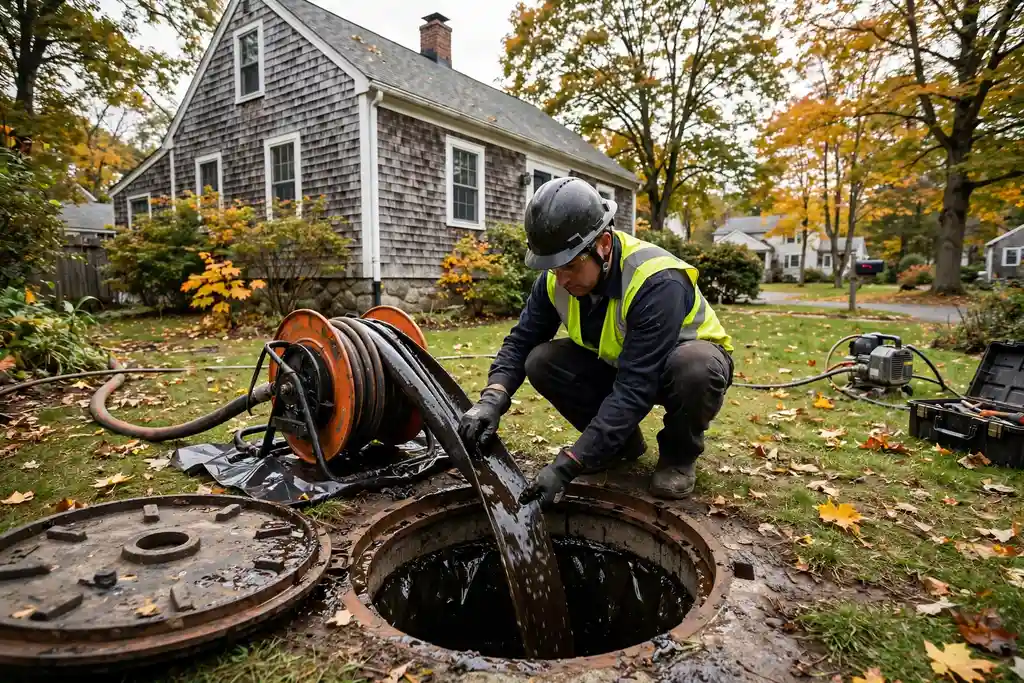
Lining Century-Old Clay Laterals in Beverly's Harbor Neighborhoods
Beverly has one of the oldest housing stocks on the North Shore, with 43% of homes built before 1939, so cured-in-place pipe lining here works on a very specific kind of pipe: vitrified clay tile laterals whose joints have had a century of root intrusion, freeze-thaw movement, and offset settlement. Camera inspection is non-negotiable before any lining job in Beverly, because a liner needs a structurally viable host pipe — and many of these lines have bellies, heavy scale in their cast-iron house connections, or fully separated joints that only show up on video. Lining is the right answer when the pipe is cracked and root-invaded but still holds its shape; collapsed runs need a different approach entirely.
The second Beverly variable is water. Low streets near the harbor and tidal inlets sit on very poorly drained tidal-marsh muck soils with a water table that runs high year-round, so infiltration checks precede every trenchless lining job here. Groundwater inflow can defeat a liner installation if the joints are not sealed properly first, and a resin-saturated liner cures most reliably under controlled conditions — meaning technicians verify saturation levels, groundwater pressure, and cure times against actual site readings rather than assumptions. Oceanfront and marsh-adjacent properties also merit a corrosion assessment on older cast iron, since saltwater-influenced soils work on exterior pipe walls over decades.
The third factor is pure logistics. Downtown streets around Cabot Street are narrow, and many oceanfront Victorians and converted basement apartments sit on tight lots with limited equipment staging. That is exactly where CIPP earns its keep: a cured-in-place liner goes in through one or two access points with a compact rig, so homeowners in dense blocks near downtown get a new pipe-within-a-pipe without an open trench across a brick sidewalk or a landscaped front yard. For a Beverly homeowner, the difference between lining and digging is often the difference between a three-day project and a three-week yard restoration.
How Cured-in-Place Pipe Lining Renews Old Beverly Laterals
Cured-in-place pipe lining, usually shortened to CIPP, rebuilds a sewer lateral without removing it. Technicians insert a resin-saturated felt or fiberglass tube into the old pipe — inverted with air or water pressure, or pulled in with a winch — then cure it with steam, hot water, or UV light. The resin hardens into a smooth, jointless pipe-within-a-pipe that carries flow through the lateral's renewed service life, usually installed through one or two small access points.
The method has a firm boundary: the host pipe must still hold its shape. Cracked clay tile, offset joints, heavy root masses, and scale in cast-iron house connections are all problems a liner can bridge, because the resin tube conforms to the interior and seals every opening it covers. A collapsed run, a fully separated joint with missing pipe, or a severe belly that ponds water are different — a liner cannot rebuild a pipe that has lost its structural envelope, so those runs call for pipe bursting or open replacement instead. That distinction is why the camera inspection comes first and the recommendation comes second.
Beverly adds its own wrinkle to the cure. Near the harbor, the water table runs high and marsh-muck soils drain poorly, so groundwater can push into open joints during installation. Crews seal or grout the worst joints first, then verify resin saturation, groundwater pressure, and cure time against actual site readings. The cast-iron house connection is descaled and hydrojetted first, since a liner adheres well to a clean, round interior.
What Beverly's Ground and Housing Stock Mean for Lining
Beverly carries one of the North Shore's older housing stocks — 43 percent of units predate 1939 — and that age shows up underground as vitrified clay tile laterals with joints a century old, paired with cast-iron house piping inside the home. The failure pattern is consistent: freeze-thaw heave in the glacial till has shifted hubs a little at a time for decades, opening joints that tree roots then packed full. When the camera goes down a Beverly lateral, technicians usually find the classic candidacy picture — a pipe that is cracked and root-invaded along its length but still essentially round and continuous, which is exactly what a liner needs.
Soil decides how carefully the job must be run. Much of Beverly sits on Essex-series sandy loam over dense till, but the low streets near the harbor and the tidal inlets sit on very poorly drained marsh muck with groundwater riding high year-round — the conditions where infiltration checks become mandatory. A lateral that takes on groundwater between storms behaves differently during installation than one in dry till: the crew stages joint sealing first, plans the cure around the water pressure readings, and sometimes schedules the work for a drier window. That front-loaded caution is the difference between a liner that bonds and one that fights the water table all day.
Access is the third reason lining wins here. Downtown around Cabot Street, streets are narrow, lots are tight, and many oceanfront Victorians have converted basement apartments sitting directly over the lateral's path. CIPP goes in through existing cleanouts or a single small pit, which keeps the work inside the property's footprint. For dense blocks, the trenchless option is often the only practical one.
The Lining Process on a Beverly Property
Camera survey and infiltration check
A camera travels the full lateral from the house connection to the street main, mapping joints, offsets, root masses, and bellies. On harbor-side lots the technician also runs an infiltration check, because a liner installed into a line actively taking on groundwater needs its worst joints sealed before resin ever enters the picture.
Cleaning and descaling
Roots are cut out mechanically and the cast-iron house connection is descaled and hydrojetted until the interior is round and clean. This step confirms the host pipe is continuous enough to accept a liner — a collapse or missing section found here reroutes the plan before any material is committed.
Liner installation and cure
The liner is measured to the mapped run, saturated with resin, inserted through the access point, and cured with steam or hot water while pressure is held steady. Crews verify saturation, groundwater pressure, and cure time against live site readings, with extra attention on the marsh-soil blocks near the water.
Final camera pass and documentation
Once cured, the camera goes back through to verify the new pipe-within-a-pipe: smooth interior, sealed joints, clear transitions at both ends. The homeowner gets the video record showing the lined run from house to main.