
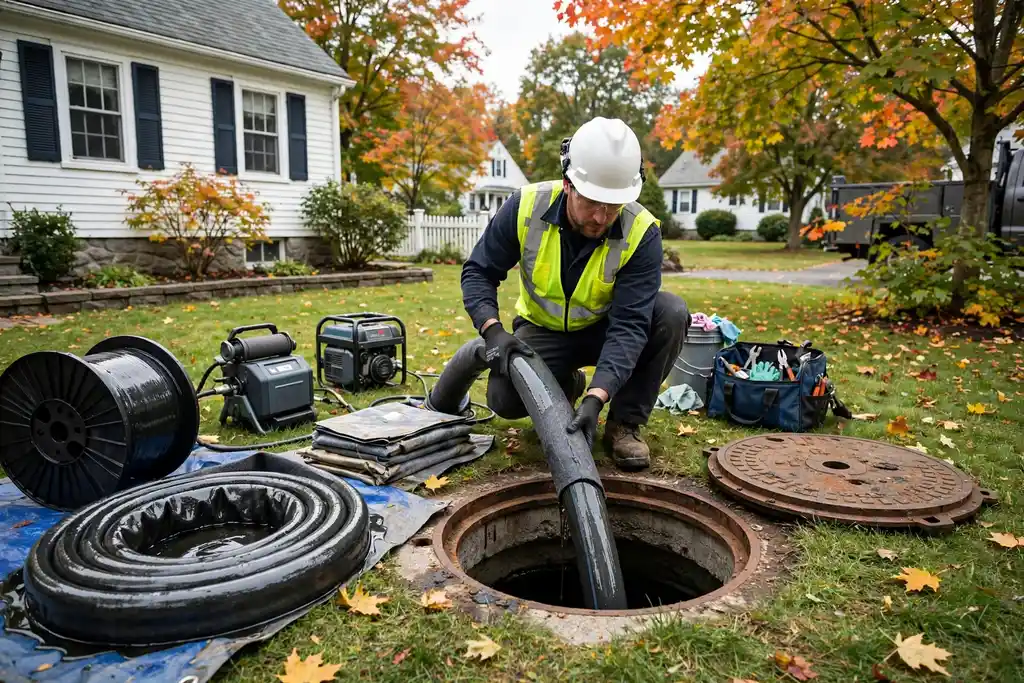
Lining Long Laterals Under Burlington's Finished Basements
Burlington's housing stock is overwhelmingly 1950s and 1960s ranches, split-levels, and split-entry homes — the median year built sits around 1963 — which means its sewer laterals are largely clay tile or Transite with cast-iron interiors, all reaching the end of their service life at roughly the same time. These are prime candidates for cured-in-place lining: cracked but not collapsed, root-invaded at the joints, and run under finished basements that turn open-trench repair into an expensive interior demolition project. CIPP creates a new pipe-within-a-pipe from small access points, so a homeowner with a finished lower level keeps their walls, flooring, and rec room intact while the old line gets renewed.
Split-entry homes add a wrinkle that matters for lining scope: because the sewer exits from the raised level, the lateral run to the street main is often longer and deeper than in a standard ranch. That longer run is precisely where lining's per-foot economics shine — trenching 80 or more feet through a landscaped yard, a paved driveway, and mature trees costs far more in restoration than it does in lining, and every extra foot of trenchless work adds only incremental installation effort rather than a whole new segment of excavation. A proper camera survey maps the full run first, so the liner length matches reality.
Then there is groundwater. Lots along the Vine Brook and Sandy Brook corridors sit in wetland buffers with seasonal high water tables, and Burlington's protected marshes, wet meadows, and vernal pools are no-mans-land for open excavation without permits. Lining works inside the existing pipe envelope, which keeps the project out of wetland buffer jurisdiction entirely and avoids dewatering saturated trenches. Technicians do verify liner curing conditions against actual groundwater readings on these lots, since cold, wet soil slows resin cure — but that is a scheduling detail, not a stopper, and it beats pumping a trench for a week.
How Cured-in-Place Lining Works on Burlington's Post-War Laterals
Cured-in-place pipe lining rebuilds the lateral from within: a felt or fiberglass sleeve saturated with thermosetting resin is placed inside the old pipe and cured with steam or hot water until it hardens into a smooth, seamless tube. That new inner pipe spans every cracked hub and root-packed joint along the run, effectively giving the lateral a continuous interior wall where the old one had a joint every few feet. On Burlington's typical four- to six-inch residential lines, the liner usually enters through an existing cleanout or a single small excavation, so the work stays almost entirely underground.
The failure modes lining answers here are specific to the town's building era. Vitrified clay tile fails at its joints — shifting, cracking, and admitting roots — while Transite pipe grows brittle with age and fractures under soil movement, and cast-iron interiors narrow with scale. All three are liner-friendly conditions as long as the pipe is still structurally continuous. Where the pipe has fully collapsed, where a section is missing, or where a deep belly traps standing water, the host is gone and the answer becomes pipe bursting or a short open repair at that spot — a call the camera footage makes, not the sales visit.
Groundwater shapes the installation on the wetter lots. Along the Vine Brook and Sandy Brook corridors, seasonal water tables run high, and cold, saturated soil slows resin cure — so technicians verify cure conditions against actual site readings and schedule the work for a window the ground allows. Roots and scale are cleared first by mechanical cutting and hydrojetting, because the liner's bond depends on a clean, round host. None of this stops the job; it just means the crew plans around what the lot is doing that week.
Why Burlington's Lots and Wetlands Make Lining the Practical Route
Burlington is a post-war suburb with a median year built of 1963, and its laterals — clay tile or Transite outside, cast iron inside — are reaching the end of service life at roughly the same time across whole neighborhoods. The era's full basements, many of them finished into living space, turn a lateral backup into a high-damage event rather than a nuisance. Lining answers that risk profile directly: the new pipe goes in from small access points, so a homeowner keeps their walls, flooring, and rec room intact while the line beneath gets renewed. No interior demolition, no trench through the basement slab.
Split-entry homes add the wrinkle that makes lining's per-foot math work. Because the sewer exits from the raised level, the run to the street main is often longer and deeper than in a standard ranch — eighty feet or more through a landscaped yard, a paved driveway, and mature trees. Trenching that distance costs far more in restoration than the pipe work itself, while each extra foot of trenchless lining adds only incremental installation effort. The camera survey maps the run first, so the liner length matches the real geometry instead of a guess.
Then there is the ground the town protects. Burlington's bylaws guard extensive freshwater wetlands, marshes, wet meadows, and vernal pools, and open excavation near those buffers invites wetland permitting and review. Lining works inside the existing pipe envelope, which keeps the project out of that jurisdiction entirely and avoids dewatering saturated trenches. For brook-corridor lots, staying inside the pipe is the compliance-friendly path as well as the practical one.
The Lining Process on a Burlington Property
Full-run camera survey
The camera maps the entire lateral from the house exit — including the longer, deeper runs typical of split-entry homes — to the street main, recording joints, offsets, root masses, and any bellies. On lots near the brook corridors, the technician also notes groundwater behavior, since active infiltration changes the preparation steps that follow.
Mechanical cleaning and descaling
Root masses are cut out, and scale in the cast-iron sections is removed by descaling and hydrojetting until the interior is round and open. This pass confirms the pipe is continuous enough to line; a collapse or missing section found now reroutes that segment to a different repair method.
Liner placement and curing
The liner is cut to the measured run, saturated with resin, placed through the access point, and cured with steam or hot water under steady pressure. Near the wetland corridors, crews confirm saturation and cure time against live groundwater readings, because cold, wet soil slows the resin's set.
Post-cure verification
A final camera pass confirms the new jointless interior, sealed joints, and clean transitions at both ends of the lined run. The homeowner receives the video record documenting the renewed lateral from house to main.