
Freeze-Thaw, Heaved Joints, and Why Danvers Clay Laterals Line So Well
Danvers is a two-era town, and pipe lining fits one era much better than the other. The 1950s–1970s tract neighborhoods in the north and northwest are the sweet spot for CIPP: their clay-tile or ABS/PVC laterals are now at the classic age for joint failure — cracked hubs, root-packed joints, and lines that have settled into bellies — but the pipe walls themselves are usually still structurally viable, which is exactly what a cured-in-place liner needs to form a new pipe-within-a-pipe. These are cookie-cutter subdivisions with predictable lateral routes, so a camera pass followed by a full-length liner handles the whole run cleanly.
The dominant failure driver here is freeze-thaw. Winter frost heave shifts the glacial-till soils around shallow clay laterals, and over decades that seasonal movement opens joints and offsets hubs — the most common thing technicians find on camera in Danvers. Lining is especially well suited to this failure mode because the liner bridges every opened joint along the run and cures into a single continuous tube with no joints left to heave apart. Where a spot repair would leave the next joint to fail next winter, a full-length liner removes the mechanism.
The Ipswich River basin adds a cyclical wrinkle: documented summer drought stress shrinks the same soils that later flood when storms arrive, and that drought-then-deluge cycle produces spikes in joint-separation callouts. For the older south-end properties — stone-foundation farmhouses whose below-grade piping is a patchwork of mid-century retrofits — camera inspection is mandatory before anyone talks about lining, since their pipe history is layered rather than original. But for the tract-home stock that dominates the town's laterals, CIPP turns Danvers' biggest weather liability into a solved problem in a single visit.
Cured-in-Place Lining and Danvers' Freeze-Thaw Problem
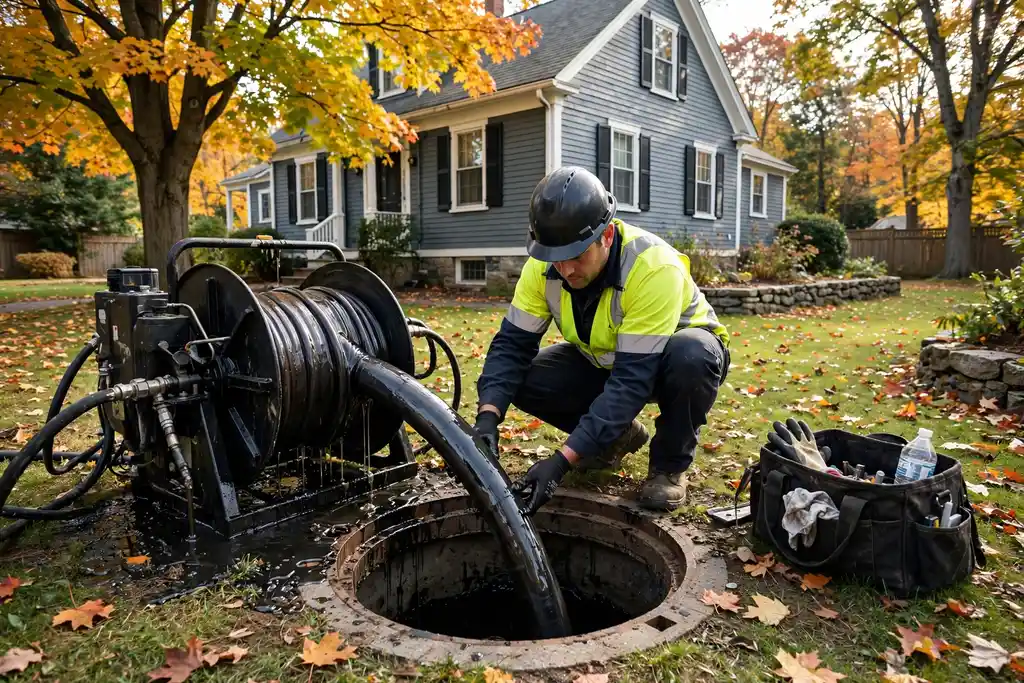
Cured-in-place lining creates a new pipe inside the old one: a resin-soaked felt or fiberglass tube is inverted or winched into the lateral, then hardened with steam, hot water, or UV light into a smooth, jointless conduit. The cured tube spans cracked hubs, offset joints, and root masses along the entire run, removing every seam the old pipe had. For Danvers' typical four- to six-inch residential laterals, installation usually needs only one or two small access points, so the yard, driveway, and street stay untouched.
That jointless result is exactly what answers Danvers' dominant failure driver. Winter frost heave shifts the glacial-till soils around shallow clay laterals, and over decades that seasonal movement opens joints and offsets hubs — then roots and groundwater move in. A spot repair replaces one bad joint and leaves the next one to heave apart the following winter; a full-length liner cures into a single continuous tube with no joints left to separate. The failure mechanism itself is gone, not patched.
The boundary cases matter as much as the fit. A liner needs a host pipe that still holds its shape: collapsed runs, fully separated joints with missing pipe, and deep bellies that pond water cannot be lined, and those segments get pipe bursting or a short open repair instead. The Ipswich River basin's drought-then-deluge cycle — shrunken summer soils followed by sudden storms — moves old pipes and opens joints, so the camera survey here is read with that cycle in mind. The video decides; the lining follows the video.
Where Danvers Pipe Lining Fits — and Where It Doesn't
Danvers is a two-era town, and lining fits one era far better than the other. The 1950s–70s tract neighborhoods in the north and northwest are the sweet spot: clay-tile or ABS laterals now at the classic age for joint failure — cracked hubs, root-packed joints, settled bellies — but with pipe walls usually still structurally viable. These subdivisions have predictable lateral routes, so a camera pass followed by a full-length liner handles the whole run cleanly, often in a single visit.
Freeze-thaw is the leading failure driver, and the soil tells why. Essex-series sandy loam over dense till 20–30 inches down gives frost a firm medium to heave against, and shallow clay laterals take the movement joint by joint. Add the Ipswich basin's documented pattern — summer drought shrinking the same soils that later flood — and Danvers gets cyclical joint-separation spikes that spot repairs chase forever. A continuous liner is the one repair that removes the joint as a concept rather than fixing it as a location.
The south end is the exception that proves the inspection rule. First Period farmhouses — the Rebecca Nurse Homestead dates to about 1700 — sit on fieldstone and rubble foundations with laterals that are mid-20th-century retrofits done in phases, not original systems. Lateral geometry there can be unusual, with odd angles and depths, so camera inspection is mandatory before anyone discusses lining. Where the retrofitted pipe proves continuous, it lines like anything else; where the history is too layered, the camera shows that too.
The Lining Process on a Danvers Property
Camera survey of the full run
The camera travels the lateral from the house connection to the street main, recording heaved joints, offsets, root masses, and bellies. In the south-end historic properties, the survey also maps unusual retrofit geometry, so the liner plan matches the pipe that actually exists underground.
Cutting, descaling, and drying the host
Root masses are cut out and scale removed by hydrojetting until the interior is round and clean. The crew confirms the pipe holds its shape along the full run — a collapse or missing section found here reroutes that segment to bursting or a short open repair.
Liner insertion and cure
The liner is sized from the survey, saturated with resin, then placed through the access point to cure under steady pressure. Technicians check saturation and cure time against site conditions, accounting for wet-season groundwater that can press into open joints before sealing.
Final inspection and video record
A closing camera pass verifies the continuous new interior, sealed joints, and clean transitions at both ends. The homeowner keeps the video documenting the lined run — the before-and-after evidence that the joints are gone.