
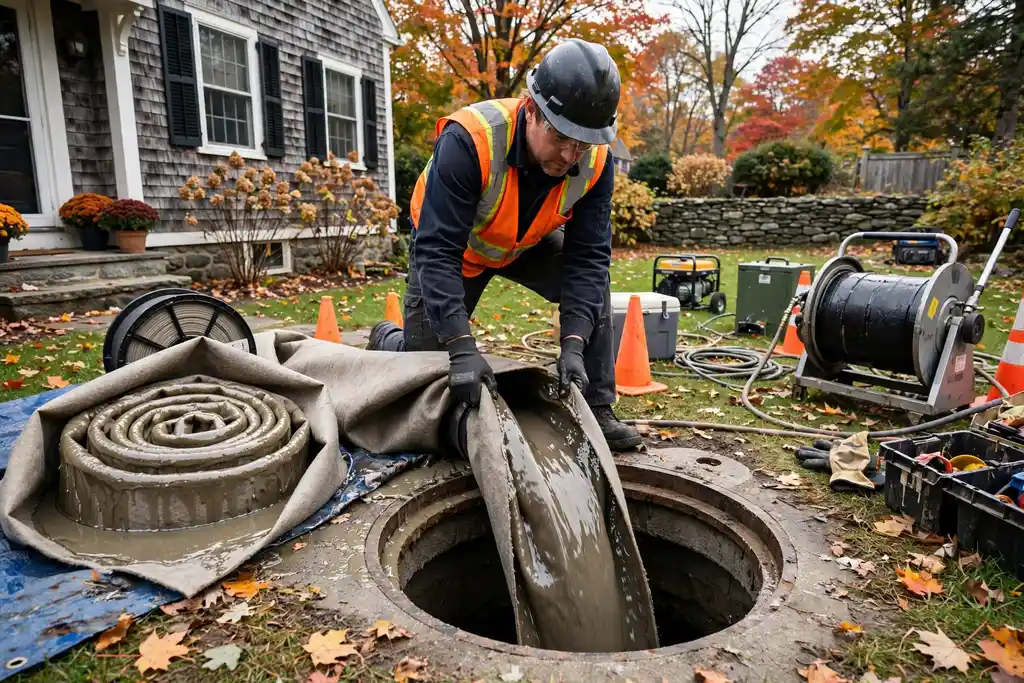
Lining Clay Lines Beside the Great Marsh Without Disturbing It
Essex presents the toughest groundwater equation of any town in this set: a pre-1940 housing stock whose clay-tile laterals are 60 to 100-plus years old, sitting over a chronically high water table beside the Great Marsh. Infiltration — groundwater pushing in through every cracked joint — and root intrusion dominate the failure picture here, and tidal surge up the Essex River can even back-flood low-lying laterals from the receiving end. This matters for CIPP because a liner cures most reliably under controlled conditions, so every Essex lining job starts with a camera pass plus an infiltration assessment to confirm groundwater inflow will not compromise the installation. When the pipe is viable and the inflow is mapped, lining is the fix that actually addresses infiltration: the liner seals every joint along the full run, not just the worst one.
The town's oldest homes add another reason to line rather than dig. Seventeenth- and eighteenth-century farmhouses along Main Street sit on shallow stone and rubble foundations that demand hand-careful work — open excavation next to a 300-year-old rubble wall is a risk few homeowners should take. CIPP installs from access points, leaving those foundations untouched. Narrow Main Street and Route 133 frontage, plus the antiques-district traffic that defines the town's center, make the low-disruption trenchless approach the practical default rather than a luxury option.
One boundary worth knowing: marsh-adjacent streets fall under wetland jurisdiction, and open-trench work near the marsh faces permit scrutiny. Lining stays inside the existing pipe envelope, so the project footprint never touches the protected resource. For Essex homeowners, that combination — no heavy excavation beside fragile foundations, no wetland permitting, and a continuous watertight liner against a water table that never really drops — is why trenchless lining, done after proper inspection, is usually the first recommendation here rather than the last resort.
Cured-in-Place Lining Beside the Great Marsh
Cured-in-place pipe lining rebuilds a lateral from within by placing a resin-saturated tube inside the old pipe and curing it — with steam, hot water, or UV — into a hard, seamless inner pipe. The cured liner bridges cracked clay hubs, offset joints, and root masses along the whole run, leaving one continuous conduit where the original had a joint every few feet. For Essex's typical four- to six-inch residential laterals, the work usually enters through one or two small access points, which matters in a town where the oldest homes sit on hand-laid stone foundations that no one wants to disturb.
Essex is the highest-risk card in this region for groundwater-driven sewer trouble, and the method has to be run accordingly. Tidal-marsh muck soils drain very poorly and the water table sits chronically high, so groundwater inflow can push into open joints during installation and interfere with resin cure. The answer is sequencing, not avoidance: infiltration assessment first, joint sealing or grouting where the camera shows active inflow, and cure conditions verified against real pressure readings rather than assumed dry ground. Done in that order, the liner bonds as designed even in the wettest blocks.
Candidacy follows the same rule it follows everywhere: the host pipe must be structurally continuous. Cracked, root-invaded, offset clay — the modal Essex condition after sixty to a hundred-plus years of service — lines well. Collapsed runs, fully separated joints with missing pipe, or tidal-surge-damaged sections that have lost their envelope do not line; those get pipe bursting or a short open repair. The camera survey, paired with the infiltration check, draws that line before any liner is ordered.
Why Essex Laterals Are Built for Lining — Carefully
The housing stock makes the case on its own. Essex is predominantly pre-1940 single-family homes — First Period landmarks like the Coffin House (c. 1678) and the Choate House (c. 1730) stand along Main Street — and the modal underground asset is an original vitrified clay tile lateral, sixty to a hundred-plus years old, with cast-iron interiors inside the house. After that much service the signature is unmistakable on camera: joints opened by freeze-thaw and root-packed, scale in the iron, but pipe walls still round and continuous. That is the textbook lining candidate, repeated house after house.
The ground is what demands the care. Essex sits on the Essex River within the Great Marsh — the largest salt marsh in New England, more than 20,000 acres — and its tidal-marsh soils are muck-textured and very poorly drained. The water table runs high across much of the town, tidal influence brings saltwater exposure to low areas, and storm surge can back-flood laterals from the receiving end. Salt-laden groundwater also works on exterior pipe walls over the decades, which is why a corrosion-aware read of the camera footage matters here more than inland. None of this rules lining out; it rules sloppy sequencing out.
Then there is what sits above the pipe. Stone and rubble basements in the 17th–19th-century homes are shallow and often damp, and marsh-adjacent houses sit on elevated or raised foundations where flooding is a known risk. Open-trench replacement through those foundations and saturated yards means hand-careful excavation, dewatering, and spoil handling in muck — while a liner goes in through small access points and leaves the foundation alone. For the oldest homes on Main Street and Route 133, that difference decides the project.
The Lining Process on an Essex Property
Camera survey plus infiltration assessment
The camera maps the full lateral from house to main — joints, offsets, roots, bellies — while the technician assesses infiltration, because a line taking on marsh groundwater needs its active joints sealed before resin enters the picture. Low-lying streets near the river get this assessment as a matter of course.
Cleaning and joint preparation
Roots are cut out mechanically and the line hydrojetted until the interior is round and clean. Where the survey showed active inflow, joints are sealed or grouted first; the crew confirms the host is continuous enough to accept a liner before any resin is committed.
Liner placement with groundwater-aware cure
Measured to the surveyed run, the liner is wet out with resin and placed through the access point for curing under steady pressure. Saturation, water pressure, and cure time are checked against live site readings — the cure plan assumes the marsh water table, not dry ground.
Final camera pass and video record
The finished liner gets a final inspection on camera: jointless interior, sealed joints, clean transitions at both ends. The homeowner receives the video showing the lined run from house to main, including how the inflow points were handled.