
When Granite Ledge Makes CIPP the Economical Choice in Gloucester
Gloucester is the ledge town: thin, rocky glacial soil sits over granite that is often only 20 to 30 inches down, so open-trench sewer replacement routinely turns into rock excavation — and that cost math should be stated plainly in every estimate. Cured-in-place lining sidesteps the problem completely. A resin-saturated liner inverts into the existing pipe and cures into a new pipe-within-a-pipe regardless of what sits above the line, which means the granite that makes digging prohibitive has no bearing on a lining job. For the 18th- and 19th-century homes whose below-grade systems are mid-century retrofits, and for the dense sea-captain neighborhoods of East Gloucester, lining is frequently the only economical path rather than a premium option.
The second Gloucester variable is water from below. Harbor-adjacent homes with 150- to 300-year-old stone foundations combine retrofitted clay and cast-iron laterals with high groundwater near the Inner Harbor — infiltration must be ruled out by camera inspection before any liner goes in, because groundwater inflow can defeat the installation. Where the pipe is viable, though, the liner's continuous watertight wall is exactly what these saturated low pockets need, and salt-air corrosion on aging cast iron makes a strong case for getting the old metal out of the wastewater equation entirely.
Steep, narrow streets on the East Gloucester hills and around Rocky Neck constrain equipment staging to compact rigs — another point in favor of lining, which stages at one or two access points instead of along an open trench. And on low harbor streets, storm-surge backflow protection belongs in the same conversation as lining: a watertight liner plus a backwater valve addresses both the pipe and the surge that pushes against it. In a town where the bedrock says no to digging, lining is simply the way sewer work gets done.
Cured-in-Place Lining Where the Ledge Is Never Far
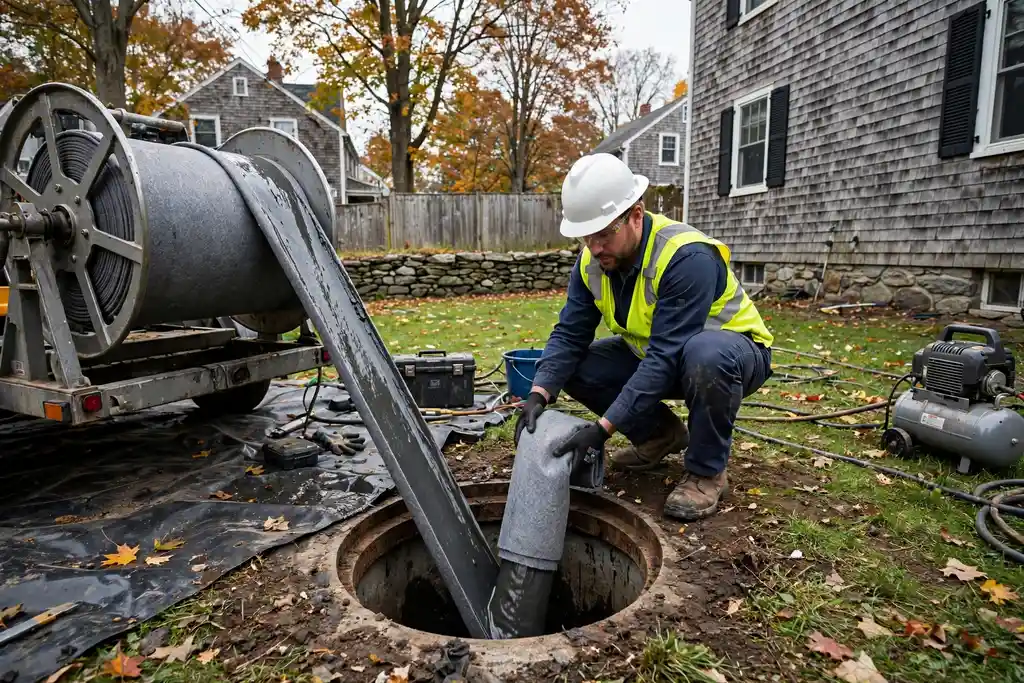
Cured-in-place lining rebuilds the lateral inside its existing path: technicians place a resin-saturated felt or fiberglass tube into the old pipe and cure it with steam, hot water, or UV light until it hardens into a smooth, jointless inner pipe. The cured tube spans cracked clay hubs, offset joints, and root masses along the entire run. In Gloucester, where Cape Ann granite ledge sits close to the surface and trenching routinely turns into rock work, staying inside the existing pipe envelope is the difference between a straightforward project and an excavation problem.
The method's candidacy rule is structural: the host pipe must still hold its shape. Cracked clay tile, heaved joints, root-packed hubs, and scaled cast iron all line well, because the resin tube conforms to the interior and seals every defect it covers. Collapsed runs, fully separated joints with missing pipe, and sections where the ledge has crushed the line do not line — those call for pipe bursting or a short open repair at that spot. The camera survey draws the line between the two before any liner is cut.
Harbor-adjacent lots add a water variable. High groundwater near the Inner Harbor can push into open joints during installation, so infiltration is assessed up front and active joints are sealed or grouted before the liner goes in. Cure conditions are then verified against actual site readings rather than assumed dry soil. The cleaning pass — mechanical root cutting plus descaling and hydrojetting of the iron — also confirms the host is round and continuous enough to accept the liner.
Gloucester's Rock, Harbor Water, and Old Pipes
Gloucester is the ledge town of this set, and that geology decides the repair method before anything else. Thin, rocky glacial soils — the USDA Annisquam series was typed in Gloucester itself: fine sandy loam over dense till just 20 to 30 inches down, with 5 to 25 percent cobbles and stones — sit over granite ledge outcrops that are never far below. Open-trench lateral replacement here routinely hits rock, which is why trenchless lining or bursting is the practical default and open-cut is the expensive exception. The estimate should say that plainly.
The housing stock layers four centuries of pipe. Eighteenth- and nineteenth-century homes around East Gloucester Square and Middle Street carry retrofitted systems — typically mid-20th-century cast iron plus clay tile — while early-to-mid-20th-century stock runs cast iron with clay laterals as built. Harbor-adjacent homes combine 150- to 300-year-old stone foundations with those retrofitted lines, and infiltration from high groundwater near the Inner Harbor has to be ruled out on every job. Camera inspection is mandatory here twice over: for the pipe condition and for mapping exactly where the line dives under ledge.
Access and preservation shape the work above ground. Dense 19th-century blocks around East Gloucester Square, narrow lanes in Lanesville and Magnolia, and seasonal cottages on tight lots all limit equipment staging — exactly the conditions where a liner placed through one or two small access points wins. Coastal flood and storm-surge exposure around the harbor and coves also means low laterals can surcharge from the receiving end, so backwater protection deserves a conversation on the lowest streets during the same project.
The Lining Process on a Gloucester Property
Camera survey with ledge mapping
The camera maps the full lateral from house to main — joints, offsets, roots, bellies — and notes where the pipe runs shallow over ledge or dives under it. Harbor-side lots also get an infiltration assessment, since groundwater near the Inner Harbor changes the preparation sequence.
Root cutting and descaling
Roots are cut mechanically and cast-iron sections are descaled and hydrojetted until the interior is round and clean. This pass verifies the host is continuous enough to line; a crushed or missing section found here sends that segment to pipe bursting or a short open repair.
Liner placement and cure
Cut to the surveyed length, the resin-saturated liner is placed through the access point and cured under steady pressure. Active infiltration joints are sealed beforehand, and cure conditions are checked against live site readings rather than standard charts.
Final survey and video record
A closing camera pass confirms a smooth, jointless interior with sealed joints and clean transitions at both ends. The homeowner keeps the video record of the lined run from house to main.