
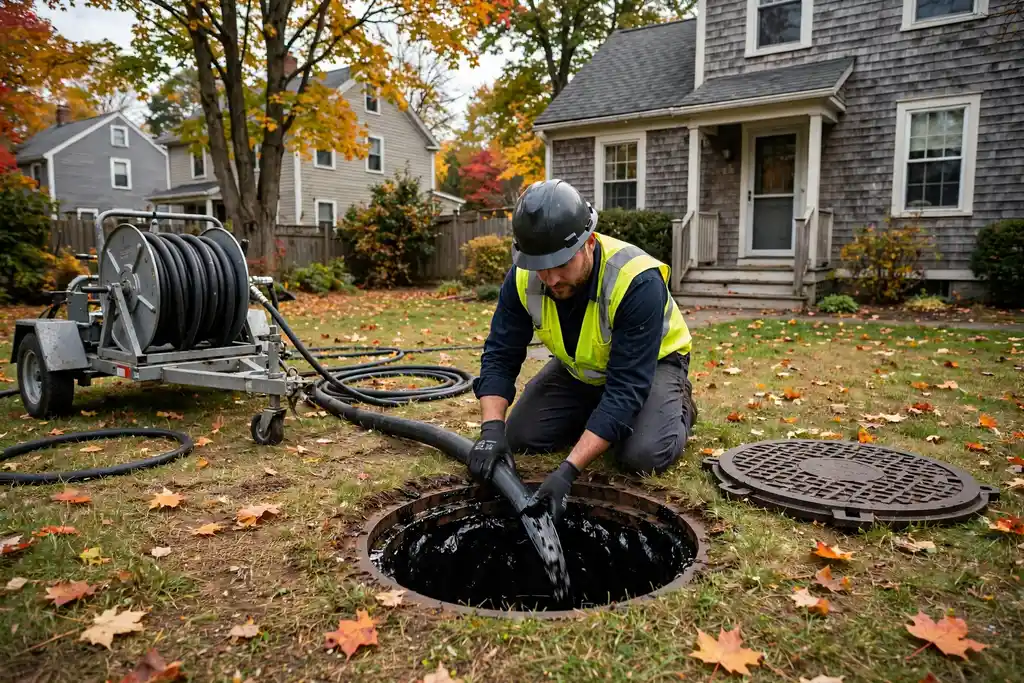
Lining Clay Tile Under Lynn's Dense Triple-Decker Lots
Lynn's sewer story starts with age: a citywide median build year of 1925, and just 1910 in the Lynn English neighborhood, means most laterals in the 01902 area are original vitrified clay tile with cast-iron house connections. Those clay joints have endured a century of freeze-thaw movement and root intrusion — the classic failure pattern of shifting, cracked, root-packed joints. Cured-in-place lining is built for exactly this: the liner bridges every failed joint along the run and cures into a continuous jointless tube, so a line that camera shows as thirty feet of bad joints becomes one new pipe without a single excavation.
Density is the second reason lining fits Lynn. Two- and three-family houses sit on small lots with narrow side yards and shared driveways, so open-trench replacement often means negotiating access across a neighbor's property or tearing up a driveway two households depend on. Lining installs from small access points — typically the existing cleanout and one entry pit — which keeps the project inside the property line and off the shared pavement. For landlords and owner-occupants in the downtown and English neighborhoods, that also means tenants are not displaced by a week of heavy equipment in the yard.
The third variable runs along the shore. Pockets near Lynn Shore Drive sit at low elevation with a high seasonal water table, and the coastal soils carry salt-influenced corrosion that works on older cast-iron house connections. Technicians here expect saturated conditions during storms and plan liner curing accordingly, and any lining scope on these lots usually includes a close look at the cast-iron transition at the foundation, where corrosion, not roots, is often the real problem. Age, density, and water — Lynn hands CIPP all three, and it handles each one from the same two access points.
Cured-in-Place Lining for Lynn's Century-Old Clay Laterals
Cured-in-place lining gives an old lateral a new interior: a resin-saturated felt or fiberglass tube is inverted or pulled into the existing pipe, then cured with steam, hot water, or UV light into a hard and seamless pipe-within-a-pipe. The cured liner spans every cracked hub, offset joint, and root mass along the run, so the lateral that had a joint every few feet becomes one continuous conduit. For Lynn's typical four- to six-inch residential laterals, installation usually happens through a cleanout or a single small pit — the kind of access that fits where a backhoe does not.
Lynn's failure pattern is a century in the making. Vitrified clay laterals under the city's two- and three-family houses have endured freeze-thaw movement, root intrusion, and shifting joints since the shoe-factory boom era — the English neighborhood's median build year is 1910, downtown's 1924. Cracked, offset, root-packed clay with walls still round and continuous is the textbook lining candidate. Collapse, fully separated joints with missing pipe, or deep bellies holding water are not; those segments get pipe bursting or a short open repair, and the camera survey marks exactly where.
Preparation here is about cleaning and confirming. Root masses are cut mechanically, cast-iron stacks and connections descaled and hydrojetted, and the interior verified round and open before resin is committed. On coastal lots along the Lynn Shore Drive corridor, where the water table runs high seasonally, infiltration is checked first and active joints sealed — groundwater pressing into the line during cure is a preparation problem, solved before the liner goes in, not a reason to dig.
Why Lining Fits Lynn's Dense Lots and Old Housing
Lynn's housing density is the argument for trenchless work. The citywide median year built is 1925, and the dominant stock — two- and three-family houses, workers' cottages, and multifamily walk-ups from the 1850–1920 boom — sits on small lots with narrow side yards and shared driveways. Laterals under these blocks are original clay tile with a century of joint failure behind them, and there is simply nowhere to stage open-trench equipment without tearing up the neighbor's access too. A liner placed through existing cleanouts solves the pipe without touching the lot lines.
The pipe material story is straightforward: vitrified clay laterals and cast-iron interior stacks in the pre-1940 majority, with clay-tile joints as the classic failure point — they shift, crack, and admit roots. Later 20th-century replacements added cast iron and early PVC/ABS, but the original clay runs are the ones now due. Because lots are small, laterals here are typically short runs, which keeps lining scopes tight; the camera survey confirms the length and condition in one pass.
Coastal exposure adds the water check. The Lynn Shore Drive corridor sits low with exposure to storm-surge flooding and a high seasonal water table near the harbor, while inland blocks deal with freeze-thaw heave and spring snowmelt raising the water table. On the shore side, infiltration assessment precedes the liner; inland, the focus stays on heaved joints and root masses. Either way, the rocky coastal soils that were historically difficult to farm are one more reason excavation is the last resort here rather than the first.
The Lining Process on a Lynn Property
Camera survey of the short dense run
The camera maps the lateral from the house connection to the street main — joints, offsets, roots, bellies — and records the exact length, which on these small lots is often shorter than owners expect. Shore-corridor lots also get an infiltration check for the high seasonal water table.
Root cutting and descaling
Roots are cut out mechanically and cast-iron sections descaled and hydrojetted until the interior is round and clean. The crew confirms the host is continuous enough to line; a collapse or missing section found here reroutes that segment to a different repair.
Liner placement and cure
The liner is sized to the surveyed run, saturated with resin, placed through the cleanout or small pit, and cured under steady pressure. Where active infiltration was found, joints are sealed first and cure conditions verified against live site readings.
Final camera pass and documentation
The job closes with a camera verification of the lined lateral — smooth jointless interior, sealed joints, clean transitions at each end. The homeowner receives the video record of the lined lateral from house to main.