
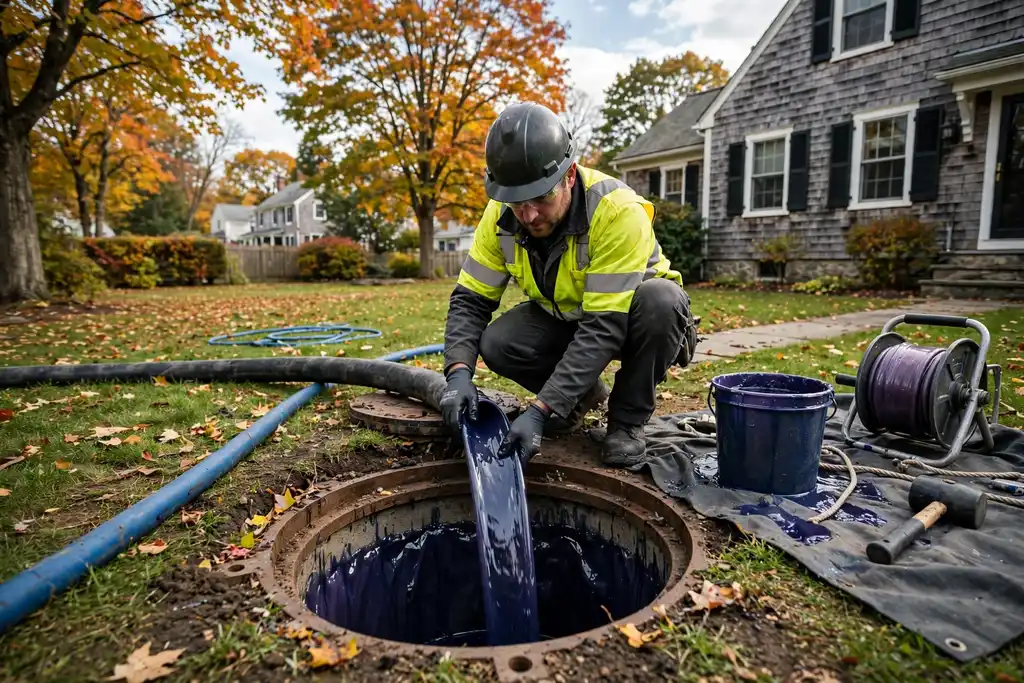
Long Driveway Runs: Lining 60-to-100-Foot Laterals in Lynnfield
Lynnfield's defining feature for sewer work is lot size. With a median lot near 24,000 square feet, laterals here routinely run 60 to 100-plus feet from the house to the street main — often threading under mature shade trees, long paved driveways, and expensive landscaping. Those are the exact conditions where cured-in-place lining changes the economics of the repair: trenching a hundred feet of yard means restoring a hundred feet of yard, while a liner installs the full run from two access points. For the town's signature failure — root intrusion at clay joints under lawns and driveways — lining also solves the cause, not just the symptom, by leaving no joints behind for roots to find.
The second feature is timing. Lynnfield's core stock is 1950s–1960s cast-iron stacks with vitrified clay laterals, a full subdivision cohort aging out together — so cluster failures by street are common. When three neighbors on the same block need lateral work in the same year, lining is the approach that keeps every property's front yard, irrigation, and driveway intact. Video-camera inspection comes first on every one of these, since the runs are long and the failure points — joint offsets, root masses, bellies — are mapped to the foot before the liner is sized.
The third feature is what sits above the pipe. Split-levels and raised ranches here commonly have deep, finished basements, and the house connection plus the cast-iron stack transition under the basement slab is a frequent trouble spot. Lining through the interior access avoids tearing up finished floors, and where the run exits under a slab, the trenchless approach means the basement stays a basement instead of becoming a construction zone. In Lynnfield, the value of CIPP is measured in everything the homeowner does not have to rebuild afterward.
Cured-in-Place Lining for Lynnfield's Long, Tree-Lined Laterals
Cured-in-place pipe lining renews the lateral without excavating it: a resin-saturated felt or fiberglass tube is placed inside the old pipe — inverted with pressure or pulled in with a winch — and cured with steam, hot water, or UV light into a hard, seamless inner pipe. The cured liner spans cracked clay hubs, offset joints, and root masses across the entire run, turning a pipe that had a joint every few feet into one continuous conduit. For Lynnfield's long residential laterals, the liner is simply cut to the measured length, so distance adds installation effort rather than a longer trench.
The town's 1950s–60s systems are reaching end of life as a cohort, and their failure signature is consistent: cast-iron main stacks with vitrified clay laterals, joints shifted by freeze-thaw, roots packed into every opening, scale narrowing the iron. Cracked, offset, root-invaded clay with walls still round and continuous is the textbook lining candidate. Collapse, fully separated joints with missing pipe, or deep bellies holding standing water are not — those segments are handled with pipe bursting or a short open repair, and the camera survey draws that boundary before any liner is ordered.
Cleaning determines the bond. Root masses are cut out mechanically, iron sections descaled and hydrojetted, and the interior verified round and open before resin is committed. Lynnfield's mature street and shade trees make root cutting a bigger pass here than on newer lots — the camera often shows the full length of the run packed at the joints. Once clean, the liner installation itself is routine: measured, saturated, placed, cured under steady pressure, with cure conditions checked against site readings.
Why Lynnfield's Big Lots Make Lining the Smart Route
Lynnfield developed chiefly in the late 1950s through the 1970s as a post–Route 128 suburb — it had the highest growth rate of any Bay State community from 1951 to 1953 — and the median year built sits at 1960. The stock is predominantly single-family Colonials, raised ranches, and split-levels on generous lots with a median around 24,000 square feet. That means the laterals of concern are 1950s–60s cast-iron-plus-clay systems aging out simultaneously: a full subdivision cohort reaching end of life together, so cluster failures by street are common. Lining answers a cohort problem efficiently, house after house, without repeating the same trench.
The large lots are what make the economics work. Laterals here often run 60 to 100-plus feet from the house to the curb, threading under mature shade trees, across wide lawns, and beneath long driveways. Root intrusion at clay joints under those driveways and lawns is the signature failure — the camera survey exists precisely to map that route. Open-trenching a hundred-foot run through established landscaping costs far more in restoration than the pipe work; a liner covers the same distance from small access points. Video-camera inspection and trenchless lining are especially valuable on exactly these lots.
The town's drainage adds a planning note. Glacial-till uplands with bedrock near the surface in places, and drainage flowing to tributaries of the Saugus and Ipswich River systems, mean seasonal water tables and big flat yards that shed heavy storm runoff toward low basements. Where a lateral runs through a wet pocket, infiltration is checked before the liner goes in and active joints sealed first. It is the same sequencing discipline as anywhere with high seasonal groundwater — planned for up front, not discovered mid-installation.
The Lining Process on a Lynnfield Property
Camera survey of the long run
The camera travels the full lateral — often 60 to 100-plus feet on these large lots — from house to main, recording joints, offsets, root masses at the tree crossings, and any bellies. The survey produces the measured length the liner will be cut to, so nothing is estimated blind.
Full-length cleaning and root removal
Root masses are cut mechanically along the whole run and iron sections descaled and hydrojetted until the interior is round and clean. On tree-lined lots this is the longest step; the crew confirms the host is continuous enough to line before any resin is committed.
Liner sizing, placement, and cure
The liner is cut to the surveyed length, saturated with resin, placed through the access point, and cured under steady pressure. Where the survey showed infiltration, joints are sealed first; cure conditions are verified against live site readings.
Final camera pass and video record
A final camera survey walks the full lined length, verifying the jointless interior, sealed joints, and clean transitions at both ends. The homeowner receives the video documenting the renewed lateral from house to curb.