
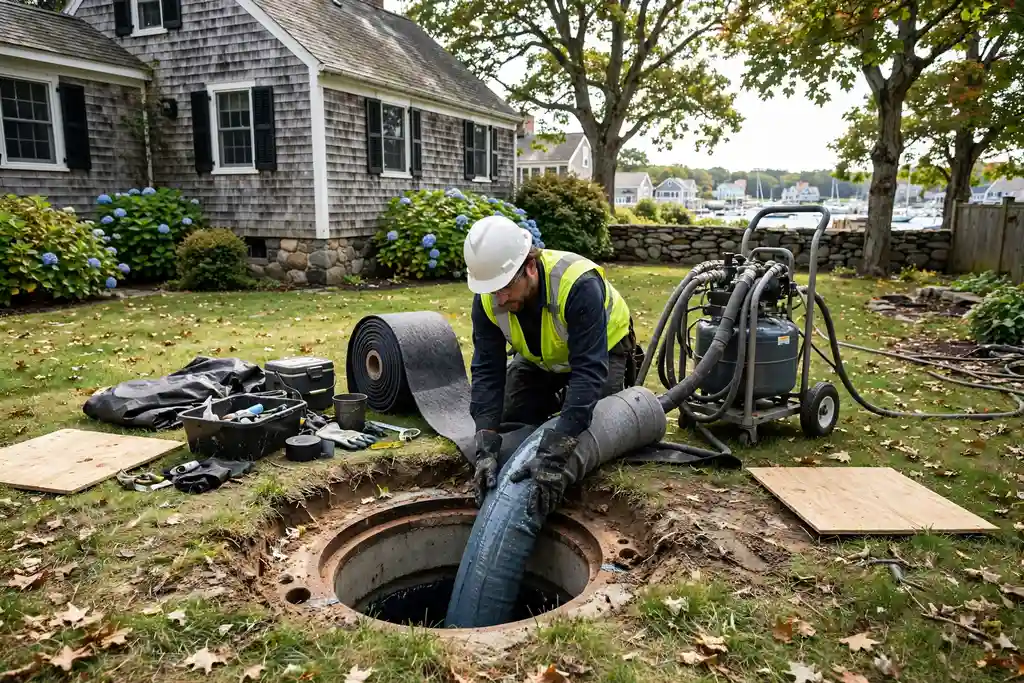
Shallow Rock Trenches Make Trenchless Lining the Practical Path in Marblehead
Marblehead is one of the hardest places on the North Shore to dig. The peninsula sits on hard Proterozoic rhyolite with bedrock outcrops everywhere, and the thin glacial till over it means laterals often lie in shallow rock trenches with poor soil cover. Open-trench replacement here routinely becomes rock excavation, so cured-in-place lining — which inverts a resin-saturated liner into the existing pipe and cures it into a new pipe-within-a-pipe — is frequently the only economical path, not just a gentler one. Camera inspection has to map exactly where the pipe runs before anything is decided, because shallow bedrock and ledge turns every foot of the route into a question digging cannot answer cheaply.
Old Town adds a second layer of difficulty. Nearly 300 homes survive from before the American Revolution along narrow, twisting streets, and the historic district's safeguards mean any surface disturbance can require preservation approvals. Lining installs from access points with compact rigs — no torn-up cobblestones, no lifted brick sidewalks, no restoration hearings over a trench. For owners of 17th- and 18th-century houses whose below-grade piping is actually the 20th-century clay-and-cast-iron generation, that means the sewer gets renewed without the historic streetscape ever knowing work happened.
The third Marblehead variable is documented locally: areas where finished grade sits less than four feet above the water table, requiring subdrains, plus nor'easter surge and harbor flooding that saturate trenches and drive infiltration through cracked joints. A continuous watertight liner is exactly the defense for that combination, and backup prevention — sealed joints plus backwater-valve conversations — belongs in the same scope as the lining itself. Shallow rock below, high water alongside: lining answers both without moving either.
Cured-in-Place Lining on Marblehead's Rocky Peninsula
Cured-in-place lining rebuilds the lateral along its existing route: a resin-saturated felt or fiberglass tube is inverted or winched into the old pipe and cured — with steam, hot water, or UV — into a hard, seamless pipe-within-a-pipe. The cured tube bridges cracked clay hubs, offset joints, and root masses across the whole run, leaving one continuous conduit. In Marblehead, where hard Proterozoic rhyolite sits close to the surface and laterals often lie in shallow rock trenches with poor cover, staying inside the existing pipe is what keeps the project from becoming a rock-excavation job.
Candidacy is structural, not cosmetic. Cracked, offset, root-invaded clay and scaled cast iron with walls still round and continuous line well; the resin tube conforms to the interior and seals every defect it covers. Collapsed runs, fully separated joints with missing pipe, and sections crushed where the pipe meets shallow bedrock do not line — those get pipe bursting or a short open repair at that spot. The camera survey draws that line, and in Marblehead it also maps exactly where the pipe dives under ledge, which decides more than the liner does.
Water and access shape the installation. The town's own design standards note areas where finished grade sits less than four feet above the water table, requiring subdrains — high water tables near the harbor are documented locally, so infiltration is assessed before the liner goes in and active joints sealed first. Old Town's narrow winding streets, tight lot lines, and the historic district's exterior-alteration approvals make surface disturbance something to avoid; a liner placed through one or two small access points keeps the streetscape exactly as the district requires.
Bedrock, Old Town, and Why Marblehead Lines Instead of Digs
Marblehead's geology is the hardest on the North Shore for sewer work, and it is the reason lining is frequently the only economical path. The town sits on hard Proterozoic rhyolite of the Lynn volcanic complex with blocky fracture and frequent bedrock outcrops, overlain by thin glacial till and swamp deposits. Shallow bedrock and thin soil mean limited cover over pipes — laterals often lie in shallow rock trenches — so open-trench replacement regularly turns into rock excavation. Trenchless lining or pipe bursting avoids the rock entirely by working inside the pipe that is already there.
The housing stock compounds the case. Nearly 300 homes survive from before the American Revolution — among the largest concentrations of 17th- and 18th-century homes in the country — clustered in the narrow, twisting streets of the Old Town historic district, and 46.5 percent of all units predate 1939. What lies underground today is typically the 20th-century clay-and-cast-iron generation, re-piped over the centuries. Colonial-era homes have stone, rubble, or brick foundations with shallow, often damp cellars; the historic district's safeguards mean any surface disturbance needs preservation approvals. A liner that enters through small access points sidesteps that entire approval burden.
Salt and water complete the picture. Direct Atlantic exposure drives storm surge and harbor flooding, freeze-thaw cycles work the cracked joints, and salt spray accelerates corrosion of exposed cast-iron components. Near the harbor, high water tables are documented in the town's own standards, so the infiltration check is routine rather than exceptional. The camera read here is corrosion-aware on the iron sections and water-aware on the low streets — the two Marblehead variables that decide how the liner is sequenced.
The Lining Process on a Marblehead Property
Camera survey with ledge and water mapping
The camera maps the full lateral from house to main — joints, offsets, roots, bellies — noting where the pipe runs in shallow rock trench or under ledge. Near the harbor, the technician also assesses infiltration, since the documented high water table changes the preparation sequence.
Cleaning, descaling, and joint sealing
Root masses are cut out mechanically and iron sections descaled and hydrojetted until the interior is round and clean. Where the survey showed active inflow, joints are sealed or grouted first; the crew confirms the host is continuous enough to line before resin is committed.
Liner placement and cure
Sized from the survey, the liner is saturated with resin, placed through the access point, and cured under steady pressure. Cure conditions are verified against live site readings, with the water-table and corrosion observations from the survey folded into the plan.
Final camera pass and documentation
Post-cure, the camera makes a final pass to confirm a jointless interior, sealed joints, and clean transitions at both ends. The homeowner receives the video record — documentation that also suits the historic district's preference for undisturbed streetscapes.