
Root Intrusion on Melrose's Tree-Lined Streets: A Lining Case Study
Melrose's defining sewer failure is written in its street trees. The Victorian and Colonial Revival neighborhoods near downtown and the Common — median build year 1926 — carry century-old clay-tile laterals that run directly under mature street trees, and root intrusion at offset joints and cracked hub connections is the failure mode technicians see more than any other. Cured-in-place lining is the direct answer to that pattern: instead of cutting roots at one joint this year and the next joint the year after, the liner seals every joint along the full run and cures into a continuous tube that leaves roots nothing to enter. On Melrose's narrow lots, where an open trench would take out the same front-yard trees causing the problem, that distinction matters.
Fixture load is the second Melrose variable. Downtown two-families and converted apartment buildings — median apartment build 1965 — put higher wastewater volume through single aging laterals than those lines were sized for, so lining scopes here should include a capacity check alongside the structural repair. A liner slightly reduces internal diameter, and on an already undersized or grease-compromised line that tradeoff needs an honest camera-based assessment rather than a default assumption. Where the pipe is undersized, pipe bursting — the other trenchless option — may be the better recommendation.
The third variable collects around Ell Pond and the low-lying streets near it, where the seasonal water table runs high and spring infiltration overwhelms cracked lines every year. Here the liner's watertight, jointless wall does double duty: it renews the pipe and it seals out the groundwater that floods in through every old joint each spring. Lining plus sealed joints plus a backwater-valve conversation with the homeowner is the complete Melrose package — fixing the break is only half the job when the pond-side water table is the other half.
Cured-in-Place Lining Under Melrose's Mature Street Trees
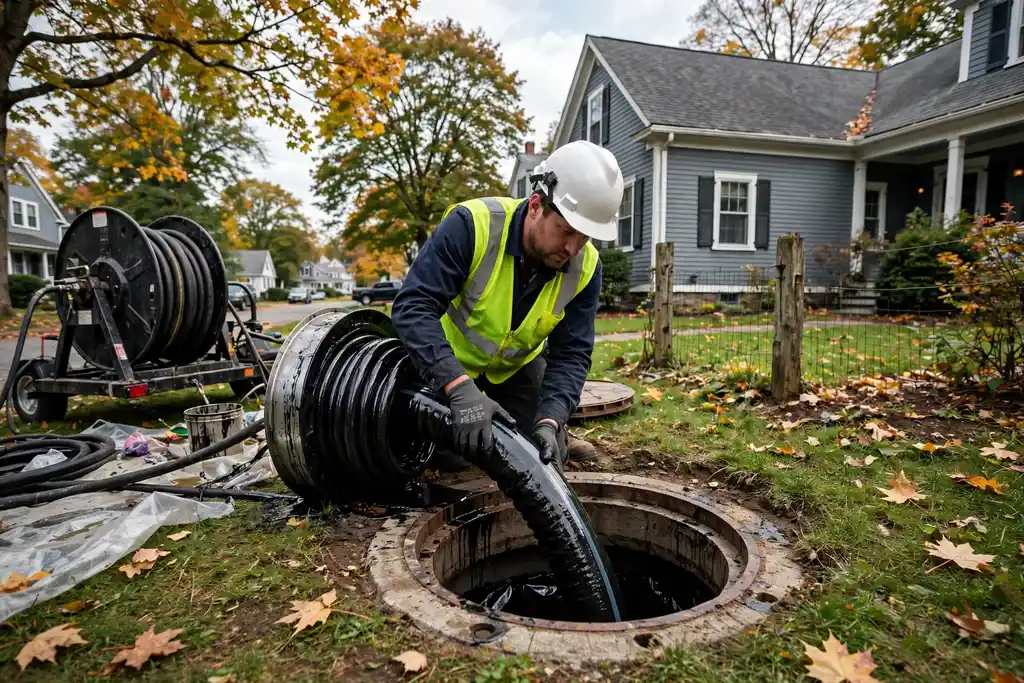
Cured-in-place lining rebuilds a lateral from the inside out: a resin-saturated felt or fiberglass tube is inverted or winched into the old pipe, then cured with steam, hot water, or UV light into a hard, seamless pipe-within-a-pipe. The cured tube spans cracked hubs, offset joints, and root masses across the entire run, so a lateral that admitted roots at every joint becomes one continuous conduit with no entry points left. For Melrose's typical four- to six-inch residential laterals, the liner usually enters through a cleanout or a single small pit, keeping the street trees and sidewalks undisturbed.
The method fits the town's defining failure mode. Melrose sewer work is dominated by century-old clay-tile laterals under mature street trees in dense Victorian and Colonial Revival neighborhoods — root intrusion at offset joints and cracked hub connections, built up over a hundred years of growth. A liner is the direct answer to that pattern: it covers every joint along the run and cures into a single tube, so the mechanism that let roots in is eliminated rather than trimmed back. Root cutting handles what is already inside; the liner handles everything that would come next.
Candidacy still follows the structural rule. Cracked, offset, root-invaded clay with walls round and continuous lines well. Collapsed runs, fully separated joints with missing pipe, and deep bellies holding standing water do not — those segments get pipe bursting or a short open repair at that spot. The camera survey draws the line before any liner is ordered, and on Melrose's hillier streets — the Mt. Hood area sheds runoff downhill toward low foundations — the survey also notes where water behavior around the lateral needs attention during installation.
Melrose's Old Clay, Old Trees, and Narrow Lots
Melrose's housing stock sets up the lining case street by street. The median year built is 1926, with Victorians and Colonial Revivals near downtown and the Common, 1920s–50s colonials, and raised ranches and split-levels beyond. The dominant underground asset is vitrified clay laterals with cast-iron house stacks for the pre-1940 majority — and long runs of 1880–1930 clay tile under century-old street trees are the classic root-intrusion candidate. Post-war ranches and splits typically carry cast iron transitioning to ABS/PVC in the 1970s–80s. The camera reads each run on its own terms, but the clay-under-trees pattern repeats across the dense neighborhoods.
The ground adds two local variables. Glacial-till uplands on the edge of the Middlesex Fells give way to valley-fill and swamp deposits around Ell Pond and the low spots, where seasonally high water tables and historic wetland margins sit. On pond-side streets, infiltration is checked before the liner goes in — groundwater pressing into open joints during cure is handled by sealing those joints first. Uphill, frost heave on old clay joints remains the winter failure driver, and the jointless liner removes that mechanism the same way it removes the root entries.
Lot geometry favors the trenchless route. Narrow lots in the dense Victorian and Colonial neighborhoods leave little room to stage excavation equipment, and downtown-area two-families and converted apartment buildings carry higher fixture loads on single aging laterals — so a failure here affects more than one household. A liner placed through small access points renews the shared lateral without opening the lot or disrupting the building's occupants, which is the practical difference on streets where digging was never going to fit.
The Lining Process on a Melrose Property
Camera survey of the full run
The camera maps the lateral from the house connection to the street main — joints, offsets, root masses at the tree crossings, bellies — and notes water behavior on hillier streets and pond-side lots. The survey decides candidacy and sizes the liner to the measured run.
Root cutting, descaling, and sealing
Root masses are cut out mechanically, and iron sections are descaled and hydrojetted until the interior is round and clean. Where the survey showed active infiltration, joints are sealed or grouted first; the crew confirms the host is continuous enough to line.
Liner placement and cure
Cut to the surveyed run, the liner is wet out with resin and inverted into position through the access point. Cure conditions are verified against live site readings, with groundwater observations from pond-side streets folded into the plan.
Final camera pass and video record
The installation finishes with a camera check of the lined run: continuous jointless interior, sealed joints, clean transitions at both ends. The homeowner receives the video of the renewed lateral, house to main.