
Lining Private Laterals in a Town Already Fighting Inflow and Infiltration
Nahant's municipal sewer system is under active rehabilitation for inflow and infiltration — a town-funded upgrade targeting high-priority I&I with spot repairs, full liners, joint sealing and grouting, root treatment, and watertight manhole covers in the low-lying areas. That context changes what a private lateral lining job means here: the town's DPW is watching private connections closely, and a homeowner lining a lateral is working alongside a public system that is being sealed at the same time. A cured-in-place liner on the private side is the matching move — a continuous, watertight pipe-within-a-pipe that stops the lateral from feeding the same groundwater and stormwater the town is spending millions to keep out of its mains.
The physical conditions are unforgiving. On the peninsula's rocky sections, ledge sits at shallow depth and makes open excavation a slow, expensive proposition — trenchless lining avoids the rock entirely. In the Lowlands and on waterfront properties, tidal-influenced infiltration is the standing condition: the water table responds to storms and tides, and any liner installation here has to be scheduled and cured with that movement in mind. Camera inspection first is not a suggestion in Nahant; it is how the crew confirms the host pipe is viable and maps the infiltration points the liner needs to seal.
Access is the third Nahant variable. The Causeway is the single land route connecting the town to Lynn and the highway network, so equipment mobilization runs through one corridor and staging space in a town of one square mile is tight. Lining's compact rig and one-or-two-access-point footprint fits that constraint naturally. For a Nahant homeowner, the pitch is simple: the town is sealing its side of the system, the liner seals yours, and the rocky ground between them never has to be opened.
Cured-in-Place Lining on Nahant's Rocky Peninsula
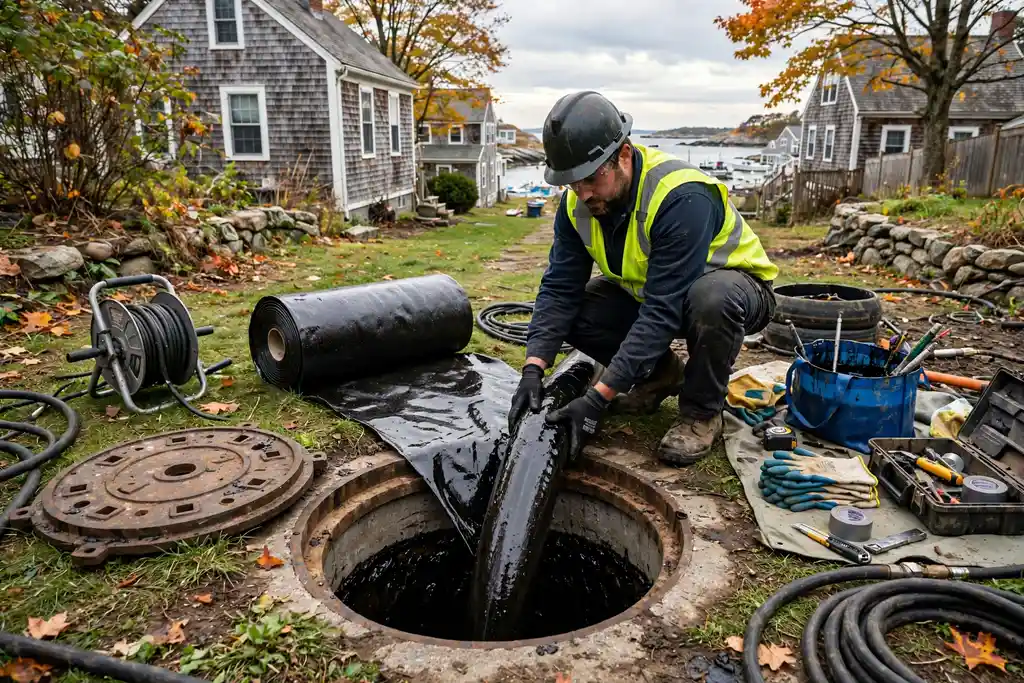
Cured-in-place lining rebuilds the lateral inside its existing route: a resin-saturated felt or fiberglass tube is inverted or winched into the old pipe and cured with steam, hot water, or UV light into a hard and seamless pipe-within-a-pipe. The cured tube bridges cracked clay hubs, offset joints, and root masses across the whole run. On Nahant — a 1.0-square-mile peninsula where the town's own hazard plan describes the rocky coasts and ledge sits near the surface — staying inside the existing pipe avoids the rock encounters that make open trenching slow and disruptive.
The town's sewer context is unusual and worth understanding. Nahant's municipal gravity collection system feeds one critical node — the Lowlands Pump Station, which receives all town wastewater and pumps it through the Lynnway force main to the Lynn Regional Wastewater Treatment Plant. The town has funded a major upgrade plus gravity-sewer rehabilitation targeting high-priority inflow and infiltration: spot repairs, full liner, joint sealing and grouting, root treatment, and watertight manhole covers in low-lying areas. A homeowner lining a private lateral is doing the same I&I fight on their own side of the property line — sealing the joints and cracks that admit groundwater and storm-driven tides.
Candidacy follows the structural rule with a coastal overlay. Cracked, offset, root-invaded clay and scaled cast iron with walls still round and continuous line well. Collapsed runs, fully separated joints with missing pipe, and sections damaged by ledge movement do not — those get pipe bursting or a short open repair. Because heavy precipitation plus storm-driven tides raise groundwater in the Lowlands, infiltration is assessed with the camera survey as a matter of course, and active joints are sealed before the liner goes in.
Rock, Salt Air, and Storm Tides: Nahant's Lining Equation
Nahant is the smallest municipality in Massachusetts — 1.0 square mile of land, about 1,724 housing units — settled in 1630 and built out during an 1870–1910 boom that produced hundreds of summer homes and resort cottages: grand late-1800s Victorians, Shingle-style and Colonial Revival cottages, including circa-1890 estates on Ocean Street. Pre-1920 homes in the historic core typically carry clay vitrified-tile laterals and cast-iron interior stacks, now a century-plus into service. The camera signature is familiar — joints opened by freeze-thaw, packed with roots, scale in the iron — but the setting around it is pure coast.
The geology argues for trenchless work on its own. The town's hazard plan describes Nahant as known for its rocky coasts, with bedrock and glacial deposits interacting around the peninsula and ledge near the surface on the rocky sections. Open-trench lateral replacement here meets rock the way Gloucester's does — while a liner placed through small access points never leaves the pipe. The single land route in and out, the Causeway (Nahant Beach Parkway), also means heavy excavation equipment is nobody's idea of a good day; the compact lining rig fits the peninsula better.
Salt and storm water complete the candidacy picture. Full coastal exposure — nor'easters, winter storm surge, wind-driven wave overtopping at Black Rock Beach and Short Beach — defines the hazard profile, and salt air accelerates corrosion of exposed infrastructure. Lowlands-area and waterfront homes sit low with basements vulnerable to groundwater intrusion, so the infiltration check is not optional here: storm-driven tides raise the water table, and a liner installed into a line taking on water needs its joints sealed first. The town's own I&I rehabilitation program — full liner, joint sealing, grouting, root treatment in low-lying areas — is the municipal version of exactly this sequencing.
The Lining Process on a Nahant Property
Camera survey with infiltration assessment
The camera maps the full lateral from house to main — joints, offsets, roots, bellies — while the technician assesses infiltration. On this peninsula, storm-driven tides and the high water table make the infiltration check a standard part of every survey, not an add-on.
Cleaning, descaling, and joint sealing
Mechanical root cutting clears the run, and iron sections are descaled and hydrojetted to a round, clean interior. Where the survey showed active inflow, joints are sealed or grouted first; the crew confirms the host is continuous enough to line before resin is committed.
Liner placement and cure
The liner is cut to the surveyed run, saturated with resin, placed through the access point, then cured under steady pressure. The cure is checked against live site readings, with the peninsula's groundwater behavior folded into the plan.
Final camera pass and video record
The final step is a camera survey of the cured liner, confirming a jointless interior, sealed joints, and clean transitions at both ends. The homeowner receives the video documenting the lined run — the private-side complement to the town's own I&I rehabilitation work.