
Trenchless Lining Across Acre-Sized Lots in North Reading
North Reading's lots change the math on every sewer job: at an acre or more, laterals here run 100-plus feet from the house to the street main, across landscaped yards, mature trees, and long driveways. Full excavation across that distance is disruptive and expensive mostly because of what has to be restored afterward. Cured-in-place lining flips that equation — the liner installs the entire run from access points at either end, so the homeowner gets a renewed, jointless pipe without a hundred-foot trench through the property. On pre-1960 capes and ranches whose clay-tile laterals are now at the age of joint failure and root intrusion, a full-length liner addresses every bad joint in a single installation.
The southern half of town adds water to the picture. The Martins Brook and Ipswich River flood corridor brings seasonally high water tables and documented floodplain dynamics, which means groundwater infiltration into older clay-tile laterals is a recurring condition, not a one-time event. Lining's continuous watertight wall seals the infiltration along the full run — and because liner curing needs controlled conditions, crews verify groundwater readings on these lots rather than assuming a dry trench that does not exist. Where laterals cross wetland buffers along Martins Brook, the failure points cluster at the pond and wetland crossings on older properties.
That wetland geography is also a permitting story. The town pays close attention to the Martins Brook watershed, and open excavation near the brook corridor brushes permit-sensitive wetlands. Trenchless lining keeps the work entirely inside the existing pipe envelope — no buffer-zone excavation, no dewatering, no restoration of a protected area. For a North Reading homeowner, lining is the repair that fixes the pipe, seals out the flood-corridor groundwater, and never touches the wetland in between.
Cured-in-Place Lining for North Reading's Long Lot Runs
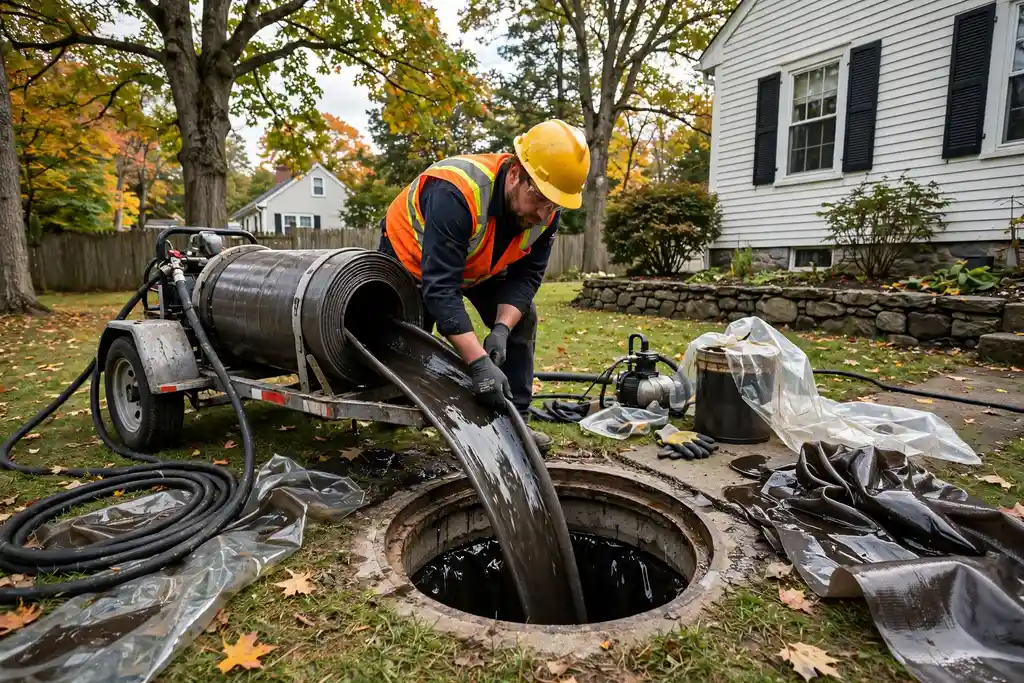
Cured-in-place lining renews the lateral from within: a resin-saturated felt or fiberglass tube is placed inside the old pipe and cured — with steam, hot water, or UV — into a hard, seamless pipe-within-a-pipe. The cured liner spans cracked clay hubs, offset joints, and root masses across the entire run. On North Reading's acre-sized lots, where laterals run long distances from the house to the street, the liner is simply cut to the measured length — distance adds installation effort, while the alternative is a hundred-plus feet of open trench through established landscaping.
The town's laterals span several generations of pipe. Pre-1960 homes — including 1700s survivors — typically carry clay tile laterals and cast-iron interiors; the 1960s–80s suburban expansion brought cast iron transitioning to PVC; 1990s-plus construction runs PVC. The lining candidates are the older two generations: cracked, offset, root-invaded clay and scaled iron with walls still round and continuous. Collapse, fully separated joints with missing pipe, and deep bellies holding standing water are not — those segments get pipe bursting or a short open repair, with the camera survey marking the boundary before any liner is ordered.
The Ipswich River watershed shapes the installation calendar. Martins Brook — which originates at the Martins Pond outlet in North Reading and carries a FEMA-documented 100-year floodplain — means laterals in the southern half of town face seasonally high water tables and documented floodplain dynamics. Groundwater infiltration into older clay-tile laterals is expected rather than surprising, so infiltration is assessed with the camera survey and active joints sealed first. Root intrusion where laterals cross the wooded corridors gets cut out during cleaning; the jointless liner then removes the entry points.
Acre Lots, Floodplain, and the Case for Lining in North Reading
North Reading's defining feature for sewer work is lot size. First settled in 1651 and transformed after World War II into a Boston-metro suburb, the town is predominantly residential with lots of at least an acre — postwar capes and ranches, colonials, and newer custom homes in tree-lined neighborhoods. Sewer laterals run through those acre-sized lots with long pipe runs, which is exactly the geometry where trenchless lining becomes the cost-effective choice: full excavation across 100-plus feet of landscaped lot is disruptive and expensive, while a liner covers the same run from small access points.
The southern half of town adds the water variable. The Ipswich River runs along the town's southern corporate limits, and Martins Brook's FEMA floodplain is a principal environmental concern — the field-stone culvert at Route 62 in Wilmington is a documented constraining feature causing water-surface jumps in 100-year floods. Laterals in that corridor face seasonally high water tables, so the infiltration check is standard practice rather than an exception. A lateral taking on groundwater between storms gets its active joints sealed before the liner goes in, and the cure is verified against real readings.
The housing mix keeps the camera survey honest. A 1700s home's lateral may be clay tile from a mid-century modernization; a postwar cape's may be original clay at end of life; a 1990s custom's is PVC that fails mainly at joints. Each generation gets read on its own terms — the survey maps joints, offsets, roots, and bellies — and the lining recommendation follows the video. Long runs, wet corridors, mixed pipe generations: the survey is what turns those variables into a plan.
The Lining Process on a North Reading Property
Camera survey of the long run
The camera maps the full lateral — often 100-plus feet on these acre lots — from house to main, recording joints, offsets, root masses, and bellies. In the southern half of town, the technician also assesses infiltration, since the Martins Brook floodplain corridor brings seasonally high water tables.
Cleaning and infiltration preparation
Roots are cut mechanically and iron sections descaled and hydrojetted until the interior is round and clean. Where the survey showed active groundwater inflow, joints are sealed or grouted first; the crew confirms the host is continuous enough to line.
Liner sizing, placement, and cure
The liner is cut to the measured run length, saturated with resin, placed through the access point, and cured under steady pressure. Cure conditions are checked against live site readings, accounting for the floodplain corridor's groundwater behavior.
Final camera pass and video record
Once cured, the camera surveys the full lined length to verify the jointless interior, sealed joints, and clean transitions at both ends. The video of the renewed lateral, house to main, goes to the homeowner.