
Lining Laterals in Revere's Saturated Marsh Fill
Revere's sewer work starts with geology found nowhere else in this set: the city is ringed by filled salt marsh, and laterals run through saturated, compressible fill with a water table that often sits near basement-floor level. Infiltration here is chronic, not seasonal — groundwater pushes into every cracked clay joint year-round, and excavation walls slump in the loose fill, so open trenches need shoring as standard practice. Cured-in-place lining is the method that fits these conditions: it works inside the existing pipe envelope, needs no trench walls to hold, and cures into a continuous watertight tube that seals the chronic infiltration along the full run rather than at a single dug-up joint.
The beachfront multi-family stock adds a second consideration. Those early-1900s buildings carry stacked fixture loads from multiple units through short clay-tile runs, stressing old joints beyond what single-family lines endure. Tidal and surge-driven groundwater pushes upward through any defect, which means post-repair sealing matters more than raw pipe strength — a liner's jointless, watertight wall plus sealed connections addresses the actual failure mechanism, while a stronger but still jointed pipe would keep leaking at every hub. Technicians here also watch the cast-iron house connections, where salt-influenced corrosion compounds the age of the pipe.
The third Revere variable is regulatory. Rumney Marsh is an Area of Critical Environmental Concern, and the city has enforced against unauthorized work near the marsh edge — open-cut excavation in those neighborhoods faces permit scrutiny that can stall a project. Trenchless lining never leaves the pipe, so the project footprint stays inside the existing infrastructure and out of the jurisdictional argument. For a Revere property owner, lining is the repair that survives the fill, seals out the tide, and sidesteps the marsh permitting entirely.
Cured-in-Place Lining in Revere's Filled-Marsh Ground
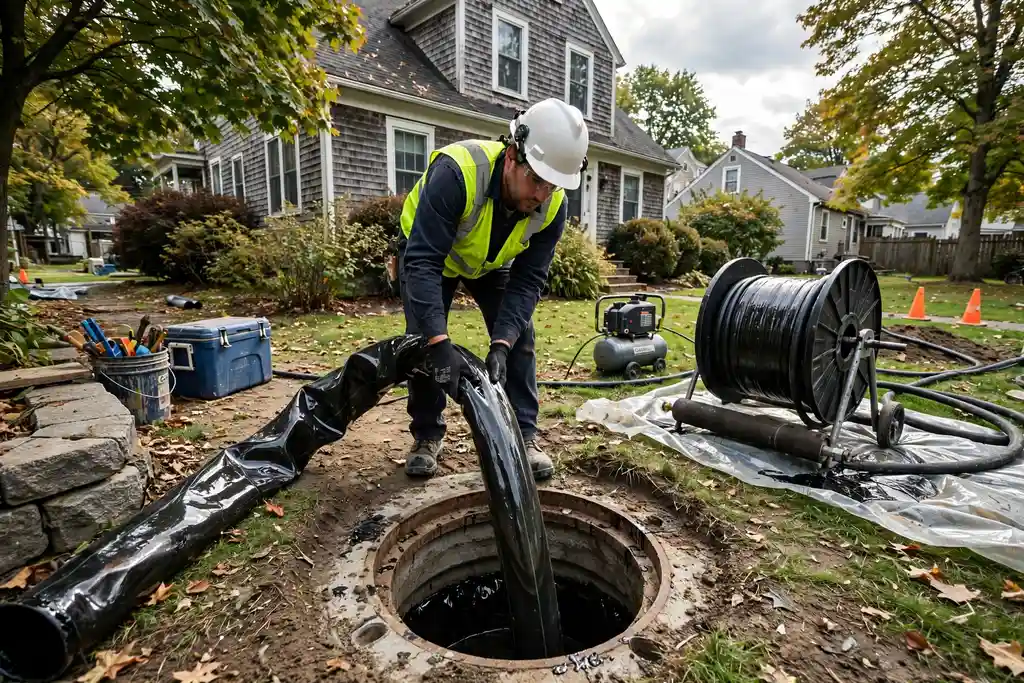
Cured-in-place lining rebuilds the lateral without opening the ground: a resin-saturated felt or fiberglass tube is inverted or winched into the old pipe and hardened with steam, hot water, or UV into a seamless pipe-within-a-pipe. The cured tube bridges every cracked hub, offset joint, and root mass along the run. In Revere, where much of the buildable land is filled marsh and excavation walls slump in loose fill, the value proposition is blunt: the liner goes in through small access points and the saturated ground above never gets opened.
The filled-marsh geology changes the preparation more than the method. Laterals run through saturated, compressible fill with a water table often near basement-floor level, so groundwater infiltration into cracked clay laterals is chronic rather than seasonal. Active joints are sealed or grouted before the liner goes in, and cure conditions are verified against real pressure readings — the crew plans for the water table as the baseline condition, not as a surprise. Cast-iron and clay laterals in the beachfront multi-family stock are typically short runs, but stacked loads from multi-unit buildings stress single aging laterals harder than a single-family flow would.
Candidacy keeps its structural boundary. Cracked, offset, root-invaded clay and scaled iron with walls still round and continuous line well — the resin tube conforms to the interior and seals every defect it covers. Collapsed runs in shifting fill, fully separated joints with missing pipe, and sections undermined by settlement do not line; those get pipe bursting or a short open repair with shoring at that spot. The camera survey — read with the fill soils in mind — draws that line before any liner is cut.
Marsh Fill, High Water, and Why Revere Lines Instead of Digs
Revere's ground is the story. The city is ringed by filled salt marsh — EPA documents show about 43 percent of Rumney Marsh was filled between 1803 and 2007 — and late-1940s excavations pulled underlying sands and clay soils for Logan Airport fill. Filled-marsh neighborhoods sit on compressible, saturated fill with a very high water table; low-lying areas face tidal influence and storm-surge pressure. An open trench in that ground does not hold its walls without shoring, dewatering runs constantly, and spoil handling becomes part of the job. A liner that never leaves the pipe sidesteps all three problems at once.
The housing stock layers onto that ground in two generations. Early-1900s beachfront multi-families and dense multi-unit blocks near the beach and along Broadway/Route 107 typically carry clay tile laterals and cast-iron plumbing; postwar capes, ranches, and colonials inland run cast iron transitioning to PVC. The beachfront multi-family laterals are short runs carrying stacked unit loads — higher fixture counts on single aging pipes — which makes their joint failures higher-consequence. Basements in the pre-war and postwar stock sit in groundwater pressure, with sump pumps and waterproofing as common retrofits in the marsh-fill neighborhoods.
Nor'easters and winter coastal storms drive surge along the beach and into the marsh estuary, and spring tides plus heavy rain can pond on the flat, filled ground. For lining, that means the infiltration assessment is chronic-condition work rather than seasonal: the survey assumes inflow, seals the active joints, and verifies the cure against the water table that is always there. Rising-sea-level pressure on coastal infrastructure is an active local concern — one more reason the jointless, sealed result matters more here than inland.
The Lining Process on a Revere Property
Camera survey with chronic-infiltration read
The camera maps the full lateral from house to main — joints, offsets, roots, bellies — while the technician assesses infiltration against the near-surface water table. In filled-marsh ground the survey assumes inflow and looks for where it is active, rather than whether it exists.
Cleaning, descaling, and joint sealing
Roots are cut out by machine and iron sections descaled and hydrojetted until the interior is round and open. Active infiltration joints are sealed or grouted before resin is committed; the crew confirms the host is continuous enough to line.
Liner placement with water-table-aware cure
The liner is cut to the surveyed run, saturated with resin, placed through the access point, then cured under steady pressure. Saturation, pressure, and cure time are checked against live readings — the cure plan assumes the high water table, not dry ground.
Final camera pass and video record
The cured liner is verified on a closing camera run: jointless interior, sealed joints, clean transitions at both ends. The video record goes to the homeowner, documenting the lined run from house to main.